allan kelly

Manual testing sinful?

One of the asides I made in “Programmers without TDD will be unemployable” which caused a bit of outrage in the testing community was my comment “Manual testing is a sin.” While I have been unfair to many testers, and somewhat simplistic, I still stand by the statement. Let me expand on why I still stand by the comment and why I am wrong.

It is all a question of context. Look at the full line the quote appeared in:

“Unit testing will be overwhelmingly automated. Manual testing is a sin. Manual unit testing doubly so.”

In the context of Unit Testing, as one who has undertaken formal and informal manual unit testing I believe unit testing can and should be fully automated. Informal unit testing is too ad hoc, prone to error, time consuming and difficult to replicate. Formal manual unit testing suffers all these problems and is hideously expensive.

In the context of unit testing I stand by “Manual testing is a sin.” I will also go further.

The vast majority of testing I see performed by professional testers – i.e. not unit testing – is manual, the vast majority of this testing could be automated. If you automate the testing the initial costs might go up – I say might because a good natural language test script is expensive to write itself – but the cost of executing the test will fall. More importantly the time it takes to run the test will fall dramatically.

The combination of low cost and fast turn execution means the tests become a very very effective feedback loop.

Failure to seize this amazing opportunity is something I consider sinful. It may be expensive but it is necessary. Even seizing 20% of this testing would be massively beneficial.

What I do not consider sinful is Exploratory Testing which almost by definition cannot be automated and therefore needs to be a manual process. Exploratory testing is about looking for the unusual, the unexpected, the thing you didn’t think of before, the thing you only think of because you now see it.

Automated exploratory testing might even be a contradiction in terms therefore manual exploratory testing is not sinful.

But, and this is a pretty big BUT: if the initial quality is low (e.g. unit testing is absent or poor) and the testing (e.g. system, integration, acceptance testing) that comes before exploratory testing is ineffective then exploratory testing will be effective at finding defects (because the earlier rounds didn’t find them) but it will be ineffective as exploratory testing.

The time and effort spent on “exploratory testing” is really being spent doing system testing. Real exploratory testing itself will not be possible when there are many defects because the exploration will continually be interrupted. 

Unfortunately the subtlety of this logic is lost on most organizations who just label everything that happens after writing actual production code “testing” and is made worse when testing is separated from the developers and, more importantly, those who understand what the system should do (the business, the BAs, the product managers, the users, etc.)

Worse still, the easy availability of cheap offshore testing capability means that rather than address the root cause of defects (low initial quality, system ineffective testing, misunderstanding of exploratory testing) means the whole thing can be hidden away cheaply.

There are probably some other examples of testing which cannot be automated and are not sinful. But I repeatedly find individuals and organizations who too ready to jump to “it cannot be automated” after very limited, or no, effort is spent on trying to automate it.

Similarly the fact that a professional tester cannot automate the testing of a piece of software system does not mean it cannot be automated. Automated testing – at least the setup – involves programming skills which many testers simply do not have, indeed it is wrong to assume they would have them.

Finally, there are a class of systems which as far as I know defy automated testing. Or rather defy automation at the moment. They defy automation because the creators of these systems have little or no interest in allowing automation. This set includes: SAP, Microsoft Sharepoint, most CRM systems such as Microsoft Dynamics, Murex (although I believe efforts are afoot here) and some other large packages.

I find it incredible that companies like SAP, Oracle and Microsoft can sell systems which cannot be effectively tested. But actually this is part of the sales-pitch. Because these systems are marketed and sold as “no programming required” to offer automated test tools would expose the lie. If you are involved with selecting one of these systems ask: how will we test it?

The inability to effectively test these systems is their Achilles heal, it is one of the reasons I don’t like these systems and it makes me wonder about whether organizations are right to use these systems.

Manual testing sinful? Read More »
Unemployable without TDD – a follow up

The reaction to my last entry – Programmers without TDD will be unemployable by 2022 – took me a little by surprised. I expected there would be a reaction, perhaps a big reaction, but I frequently expect some reaction and usually I get none. This time I got a reaction and the scale of the reaction continues to surprise me.

Particularly gratifying are all the comments on my blog, on DZone, JavaCodeGeeks, and probably some other sites that syndicate my blog but haven’t bothered to tell me. The fact that people were moved enough to write anything, supportive or not, means I caused people to think and join the discussion.

I’ve come back on many, certainly not all, of those comments directly but I won’t come back to every point. In this post I’d like to touch on a few of points which I think need expansion or clarification. Sorry if you think this is me being defensive. Stop reading if you think so, consider this a blog post for one reader only, me!

(This post, and a couple of others coming out of the TDD post does mean it will be a little while before I can get back to my software economics series.)

First, the many cynical comments (e.g. “This seems unlikely”) don’t surprise me. I frequently come across such cynicism in my work. Indeed, were such cynicism not widespread then I don’t think there would have been much interest in the prediction or any point in making it.

I am rarely sympathetic to arguments that it “won’t work for me” or “won’t work in my domain” because overwhelmingly these arguments are at best a (flawed?) logical argument, but they are usually made without trying it, they are conjecture, . When someone comes and says “We tried it… we really tried it… we invested in it… we stuck at it for a few months… and it made us worse” then I’ll accept it as so. Usually I find people who argue against TDD have never tried is or tried it superficially.

Second a point of clarification. I am happy to acknowledge that there are other ways of reducing a defect count. Code reviews spring to mind. There is a lot of research that shows that when done well they can be very very effective – and also justify the time spent.

Over dinner the other night Phil Nash also suggested highly typed functional languages – or was it functional languages and strong typing? I’m sure Phil is right in both points eitherway. Although if you ever saw the any of the Lisp/Scheme I wrote in college you would know bugs are entire possible in functional languages!

The point is: there are other techniques, probably some I don’t even know about. I single TDD out because a) I know about it and b) I think it has achieved critical mass and will be adopted more widely in future.

Because of alternative approached there will still exists jobs where TDD is not a prerequisite but they will be few and far between, in particular niches. There will be a few jobs you can get without past TDD experience but you will be expected to learn it. The same way you can occasionally get a job as a Java programmer even if you have never programmed Java. But if I was still developing, I won’t like to bet my career on finding such jobs.

Next, and most gratifying, the discussion on Twitter and in blog comments that followed the publication flushed out several companies who already operate a policy of only hiring developers who practice TDD. 7 Digital and Compare the Market stick in the memory because a) I’ve known them for a while and more importantly, b) they are hiring! Thanks guys, consider yourself plugged.

A few other people tweeted or commented to say they personally operated such a policy but didn’t give company names.

So let me float a hypothesis – based on the fact that I regard TDD as a better way of developing code than not doing it:

The divide between productivity and value-add of companies which do TDD style development and those which don’t is growing. The first group are generally among the best, most productive, highest value add, and the second group which don’t TDD are a long way behind. The first group is accelerating onto BDD, Continuous Delivery and other “new” ideas, while the second aren’t.

Sure there are companies which say they do this, and there are companies where application is not consistent – some people do and some people don’t. For such companies to join the high performing ones they need to do more and do it more consistently.

There are networks effects to doing TDD: the more people who do it in an organization, and the more consistently it is done then the greater the benefits. If one developer starts doing TDD their code will be better and everyone will benefit, but with each extra developer doing it the benefit grows greater per person – there are economies of scale here. And when everyone does it then the benefits are far more than the sum of the parts.

Yes this is conjecture, or if you prefer, call it intuition.

I don’t know what form it will take – I think it will be mixed up, some will be methodology, some will be more relaxed, and it will differ from place to place, team to team.

Next there was some discussion of how the transmission mechanism, how would TDD being good actually get it inside corporate IT departments? That is something I’ll come back to in another post, I have a view on that which might poor petrol on this particular fire.

People also threw stones at me on Twitter because my company sells TDD training. Lets get this straight: we offer such services because we believe in it, because I believe in it I wrote blog posts like I did.

It is insulting and extremely cynical to suggest that I write blog posts like I did purely to sell training. It would be nice if life was that simple, you would see more blog posts like that and I would be a lot better off.

Now I’m not saying you have to have training to learn TDD – although I do recommend it. I am also happy read Steve and Nat’s book, Growing Object Oriented Software – and yes, that is an Amazon associates link, is that a crime? I make about £10 a year from such links.

But ask yourself, if you were to buy such training who would you rather buy it from? Someone who sells it as another course or someone who passionately believes in it?

Before I finish, two other things about the reactions post surprised me. That so many people railed against my aside comment about IDEs. Of course IDEs will still exists and will still be useful. I just suggested that would be less because they were debugging environments and thus we might see changes in IDEs.

Also, very few people mentioned my comments about University courses. In many ways those comments were the driving force behind writing the post. TDD is a proven technique and Universities should be teaching it on programming courses, and they should be teaching code reviewing and probably some more techniques too.

Finally, as someone else pointed out my prediction is a safe bet. If by 2022 I am proved wrong nobody will remember my prediction. And if I’m proved right nobody will care when I say “told you so.” Besides, I expect people more famous than me will make similar predictions – both for and against – and they are far more likely to be remembered than me.

Unemployable without TDD – a follow up Read More »

Programmers without TDD will be unemployable by 2022 (a prediction)

New year is traditionally the time of predictions, and several of the blogs I read have been engaging in predictions (e.g. Ian Sommerville “Software Engineerng looking forward 20 years.”). This is not a tradition I usually engage in myself but for once I’d like to make one. (I’ll get back to software economics next time, I need to make some conclusions.)

Actually, this is not a new prediction, it is a prediction I’ve been making verbally for a couple of years but I’ve never put it on the record so here goes:


By 2022 it will be not be possible to get a professional programming job if you do not practice TDD routinely.

I started making this prediction a couple of years ago when I said: “In ten years time”, sometimes when I’ve repeated the prediction I’ve stuck to 10-years, other times I’ve compensated and said 9-years or 8-years. I might be out slightly – if anything I think it will happen sooner rather than later, 2022 might be conservative.

By TDD I mean Test Driven Development – also called Test First (or Design Driven) Development. This might be Classic/Chicago-TDD, London-School-TDD or Dan North style Behaviour Driven Development. Broadly speaking the same skills and similar tools are involved although there are significant differences, i.e. if you don’t have the ability to do TDD you can’t do BDD, but there is more to BDD than to TDD.

The characteristics I am concerned with are:


  • Developer written automated unit test, e.g. if you write Java code you write unit tests in Java… or Ruby, or some other computer language
  • The automated unit tests are executed routinely, at least every day

This probably means refactoring, although as I’ve heard Jason Gorman point out: interest in refactoring training is far less than that in TDD training.

I’d like to think that TDD as standard – especially London School – also implies more delayed design decisions but I’m not sure this will follow through. In part that is because there is a cadre of “designers” (senior developers, older developers, often with the title “architect”) who are happy to talk, and possibly do, “design” but would not denigrate themselves to write code. Until we fix our career model big up front design is here to stay. (Another blog entry I must write one day…)

I’m not making any predictions about the quality of the TDD undertaken. Like programming in general I expect the best will be truly excellent, while the bulk will be at best mediocre.

What I am claiming is:

  • It will not be acceptable to question TDD in an interview. It will be so accepted that anyone doesn’t know what TDD is, who can’t use TDD in an exercise or who claims “I don’t do TDD because its a waste of time” or “TDD is unproven” will not get the job. (I already know companies where this is the case, I expect it to be universal by 2022.)
  • Programmers will once again be expected to write unit tests for their work. (Before the home computer revolution I believe most professional programmers actually did this. My generation didn’t.)
  • Unit testing will be overwhelmingly automated. Manual testing is a sin. Manual unit testing doubly so.

And I believe, in general, software will be better (fewer bugs, more maintainable) as a result of these changes, and as a result programmer productivity will be generally higher (even if they write less code they will have fewer bugs to fix.)

Why do I feel confident in making this prediction?

Exactly because of those last points: with any form of TDD in place the number of code bugs is reduced, maintainability is enhanced and productivity is increased. These are benefits both programmers and businesses want.

The timescale I suggest is purely intuition, this might happen before 2022 or it might happen after. I’m one of the worst people to ask because of my work I overwhelmingly see companies that don’t do this but would benefit from doing it – and if they listen to the advice they are paying me for they start doing it.

However I believe we are rapidly approaching “the tipping point”. Once TDD as standard reaches a certain critical mass it will become the norm, even those companies that don’t actively choose to do it will find that their programmers start doing it as simple professionalism.

A more interesting question to ask is: What does this mean? What are the implications?

Right now I think the industry is undergoing a major skills overhaul as all the programmers out there who don’t know how to do TDD learn how to do it. As TDD is a testable skill it is very easy to tell who has done it/can do it, and who just decided to “sex up” their CV/Resume. (This is unlike Agile in general where it is very difficult to tell who actually understand it and who has just read a book or two.)

In the next few years I think there will be plenty of work for those offering TDD training and coaching – I regularly get enquiries about C++ TDD, less so about other languages but TDD and TDD training is more widespread there. The work won’t dry up but it will change from being “Introduction to TDD” to “Improving TDD” and “Advanced TDD” style courses.

A bigger hit is going to be on Universities and other Colleges which claim to teach programming. Almost all the recent graduates I meet have not been taught TDD at all. If TDD has even been mentioned then they are ahead of the game. I do meet a few who have been taught to programme this way but they are few and far between.

Simply: if Colleges don’t teach TDD as part of programming courses their graduates aren’t going to employable, that will make the colleges less attractive to good students.

Unfortunately I also predict that it won’t be until colleges see their students can’t get jobs that colleges sit up and take notice.

If you are a potential student looking to study Computer Science/Software Engineering at College I recommend you ignore any college that does not teach programming with TDD.

If you are a college looking to produce employable programmers from your IT course I recommend you embrace TDD as fast as possible – it will give you an advantage in recruiting students now, and give your students an advantage finding work.

(If you are a University or College that claims to run an “Agile” module then make sure teach TDD – yes, I’m thinking of one in particular, its kind of embarrassing, Ric.)

And if you are a University which still believes that your Computer Science students don’t really need to programme – because they are scientists, logisticians, mathematicians and shouldn’t be programming at all then make sure you write this in big red letters on your prospectus.

In business simply doing TDD, especially done well, will over time fix a lot of the day-to-day issues software companies and corporate IT have, the supply side will be improved. However unless companies address the supply side they won’t actually see much of this benefit, if anything things will get worse (read my software demand curve analysis or wait for the next posts on software economics.)

Finally, debuggers are going to be less important, good use of TDD removes most of the need for a debugger (thats where the time comes from), which means IDEs will be less important, which means the developers tool market is going to change.

(Postscript: sorry about the formatting problems with the first upload.)

Programmers without TDD will be unemployable by 2022 (a prediction) Read More »

Agile and the Demand Curve

In the last two posts I’ve taken two different views on what might happen to the Software Demand curve when we introduce Agile:

When we discussed how Agile effects the software supply curve things were pretty clear cut. Agile, in the long term boosts supply, and may even flatten the curve – making it more responsive to price changes, i.e. more elastic. Unfortunately things are not so clear cut with the demand curve.

Good news: There is a story Agile people – OK me! – sometimes tell – about what “should” happen with demand in an Agile environment.

Bad news: The is another story about demand in an Agile environment, one that Classicist (i.e. believer in “Waterfall” style up front requirements and planning) fear. And I’ve seen that too. It ain’t pretty.

But, the key point is: Few of the Agile tools work directly on the demand curve. After all, Agile is about software and the demand for software is derived from something else so why would they?

Let me say that again in other words because it is important: Nobody wants software for the sake of software, the demand for software is derived from some other demand, e.g. a retailer wants to sell online, that means they need software.

The current Agile tool set (e.g. User Stories, Acceptance Criteria, Specification by Example, etc.) which touches on demand – call it need, want, requirements, specification, whatever you want – does not address the underlying demand. These tools operate with the demand as presented.

Sure there can be feedback from the tools and Agile deliveries but feedback is often absent. Even when feedback is present those responsible for the underlying demand may not want to hear – or act – on the feedback. And in an environment where success is measured by criteria like “On Budget, On Schedule, On Features” acting on feedback may be impossible.

Which brings us back to the 3 Styles of Agile: Iterative, Incremental and Evolutionary (part 1) and 3 Styles of Agile part 2. (At some point in the future I will reprise those three styles in the light of this analysis.)

One of the key factors in determining whether the feedback can affect underlying demand is whether those responsible (e.g. senior managers) who largely originate the underlying demand are open to feedback. Which brings us to another story I need to tell, another time…

Where does this leave us then?

If the current Agile toolset cannot address the underlying demand we need new tools. We might choose to add those tools to the thing we call Agile or we might choose to put them in another category.

Personally I believe many of those tools do exist but they exist outside the Agile space. They are fellow travellers if you will. For example: Beyond Budgeting is clearly one of those tools. However, many of those tools have their own names, they are not Agile, they are what they are (e.g. Beyond Budgetting). They fit very nicely with Agile but they are not.

However that is my personal view. I also think that Agile is a marketing bang-wagon and those tools will be conscripted to the Agile course and in many cases put under the Agile umbrella.

Either way the problem we need to recognise is: addressing the software demand curve Agile is necessary but not sufficient by itself.

Agile and the Demand Curve Read More »

DemandRises-2013-12-23-12-03.png

The bad Agile demand curve

In explaining the Agile Demand curve I told a good news story in the previous entry. This time I want to tell a bad news story. This is every classical Project Managers’ fear about Agile, its story we don’t tell often but it can happen. Once I’ve told this story we can proceed to the proper analysis of the Agile Demand curve.

So a classical project manager looks at Agile and he sees his greatest fear: No Scope limit.

There are no signatures against exactly what is to be build, not even in pencil, let alone blood. There are some loose “Story things.” But he is told it is Agile and Agile works this way so against his better judgement he gets stuck in – after all, he needs to get Agile on his CV sometime.

And to some degree the classical Project Manager is right to have this fear.

After years of being pushed around by IT and IT’s sub-contractors the business hears of Agile and thing “Yes! – we are finally going to get what we want. No more messing about with long documents, no longer waiting for ever and no more bugs.”

These days when I go to talk to a company about “going Agile” the Agile publicity machine has beaten me to it. Unfortunately for some on the business side they believe that “going Agile” means they can have whatever they want whenever they want it. If the development team are Agile, so the logic goes, then they will deliver fast and will deliver exactly what is wanted even if the business keeps changing their mind.

You can hardly blame the business side from believing this, after all, it is how Agile presents itself. Unfortunately Agile as “all things to all people” and “I don’t need to change what I’m doing” is more prevalent than is healthy.

The next effect of this attitude is to boost the Demand curve significantly, and if it does affect elasticity it probably reduces it further.

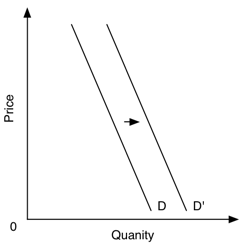
DemandRises-2013-12-23-12-03.png

The demand curve moves from D to D’. At every price point the business wants more. Of course the business doesn’t think of it that way. They are just asking for what they always wanted but now, because it is “Agile” they are not restricted.

Previously, the need to put every request in writing – voluminous writing – and argue it with various managers meant making the request required effort (a price) which they were not willing to pay. No with Agile all that is gone and demand is unbounded.

There is one “project” I know which is quite large, we are talking dozens of people all counted. Demand is rampant, the business keeps on thinking of new ideas, analysts keep finding more work in what has been asked for, developers find more work and the testers more (because initial quality is not what it could be.)

In short: I’ve seen rampant demand happen and I think Agile makes it more likely because it removes many of the restrictions previously used to control demand.

If the team don’t deliver on (often unreasonable) expectations “Agile” becomes another tool with which to beat the team.

It is worth noting here: that as demand is derived much of that demand always existed but was hidden. What is a more interesting question to ask is: which elements of this demand are worth doing? That question will need to wait.

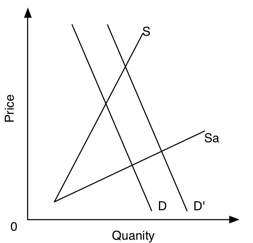
We need to add supply to our diagram above. There are two scenarios we need to consider here and shows in this diagram:

DemandRisesSupply-2013-12-23-12-03.png

Scenario 1: Demand moves to D’ but the developers are still operating on the original Supply curve S. In which case the amount and the price is going to rise in both dimensions. The next diagram shows this, the yellow area is the pre-Agile cost while green area shows the additional cost.

DemandRisesSupplyColours-2013-12-23-12-03.png

Scenario 2: Demand moves to D’ again but this time the team are operating on the Sa (Supply Agile) curve. Thus we get this diagram:

DemandRisesSupplyColours2-2013-12-23-12-03.png

Things are more complex now: because supply is elastic and responds to price more software is produced than at the beginning but the unit price is lower. So the blue are represents increased cost but the purple area represents money saved.

The immediate question I bet you are asking is: have they saved more than they increased?

As it happens yes. On my graphing tool the purpose area takes up 45 grid squares and the blue 46. So they have saved, just.

But, those curves were placed by my for readability without any data for any actual team. The difference is small and demonstrates things could go either way.

A more important question which should be asked is: are the team delivering more benefit? More value?

When I started this blog entry my aim was to show that talking Agile could by itself increase demand. The problem I want to highlight is rampant demand, and this is not confined to Agile. Although I think Agile can make it worse.

What I have also shown is that if the development team really is Agile they can handle this but it isn’t clear.

The bad Agile demand curve Read More »

ThreeDemandCurves-2013-12-21-12-39.png

The good Agile demand curve

I’ve been slow with this entry on Agile and the Demand Curve, apologies. Part of the reason for the delay is software demand is not simple.

In my last entry on software economics I discussed why the Software Demand curve for custom software is both high (i.e. people want a lot of software) and inelastic (i.e. increases in costs don’t reduce demand by much.) This time I want to look at how applying Agile changes the demand curve.

In order to explain what happens to the demand for software in an Agile environment we need to consider different possibilities. So lets start with a good news story – the bad new story and analysis will come in later blog posts.

This story is about how, using Agile software development, a team reduced the demand for software and shipped a product sooner. This is the story most Agile advocates will associate with and happily promote. This is the way Agile is supposed to work….

There was once a team who adopted Agile software development. At first they were able to demo their enhanced software to others in the business on a more regular schedule. They made a big thing about this and invited others to come and look. This generated feedback on the thing they were creating: some good, some not so good, some requests for more and some cancellations of things which had been asked for.

A little while later they stated making more regular releases. And because the software was “ready to release” more often the business could decide: “Do we want it now – with any pain that might bring? Or do we want to wait a little longer for more?” (A bird in the hand is worth two in the bush as they say.)

Simultaneously the team were adopting technical practices which improved the quality of their code – they also had the side effect of reducing the amount of code. Not only did this make the team more productive because they had less code to maintain and bugs to fix but it also meant the business had fewer reasons to complain about bugs.

(In my experience, for some teams when the conversations about “Have you fixed it yet?” and “Can we release it yet?” start to disappear it turns out business don’t know what to ask for. They’ve forgotten or never knew what they really wanted.)

The team also adopted User Stories at some point. As they got better at this technique they were challenged to think about “Who actually wants this story?”. With a little time stories advanced from “As a User” to something more specific.

And one day the “Product Owner” realised: they were not building one product but two.

The Product Backlog of work to do would be better throughout of as two backlogs for two products, each with its own user/customer base. User Stories had helped him see this.

When he restructured the backlog he found he had three piles. Product A, Product B and not justified. A chunk of the backlog, maybe as much as a third, didn’t fit in either product. They were nice ideas, things people had asked for, but when you came to analyse them they didn’t belong anywhere and justification was weak.

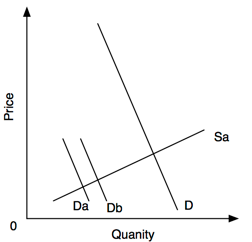
ThreeDemandCurves-2013-12-21-12-39.png

This diagram shows the Demand Curve graphically. The team start with demand D, Agile supply is Sa. After the restructuring to separate products appear with their own demand curves Da and Db. Each on of these can be reasoned about independently.

At any price point the combined demand of A plus B is less than D (the original total) because some work has gone away. Note: I have not suggested any changes to the slope of the curves, it is possible that different products will have different elastics but that is another discussion.

While the team had been battling lots of bugs and their output was a black hole to the rest of the organization, and while they thought they were building one big product this insight had been hidden from them.

That is the way Agile is supposed to work on the demand side. By being clear, by being delivery focused, by feeding back to users and customers people get what they want.

But, do you know what? All the members of this team are still employed and still work on software. In fact I think the team might have grown a bit. There is still work to do, there is still demand.

Agile reduced the demand in one part but there is still plenty that company wants to do, and much of that means software. Getting demand reduced in one place just leaves the team more time to do other work, other demand.

(OK, if I’m being honest while I have one team in mind while I was retelling this story I’ve simplified it (knocked a few rough edges off) and composited it a bit to include other examples. I don’t think that invalidates the story as this is how it is supposed to be.)

The good Agile demand curve Read More »

Honoured – I’m on a 100-top lists

Bit thank yo to the guys at ProgramCreek.com for including this blog on their list of “100 High-Quality Java Developers’ Blogs”.

Strictly speaking this is not a Java blog but most of the issues I talk about do effect Java developers.

It also seems that in listing this blog at number 55 (yeah, still room for improvement!) the ProgramCreek.com team have set up a little competition between me and my #NoProjects conspiracist Steve Smith who is just two places behind me 🙂

(Whoops, should have posted this when it was announced! – better late than never)

Honoured – I’m on a 100-top lists Read More »

SoftwareMarket-2013-12-3-19-08.png

Software demand curve

Returning to my series of posts applying the tools of economics to software development – Supply & Demand in software development, Software supply over time and Software supply & demand – this time its Agile – it is time to turn our attention to the demand curve. First a reminder of how things start…

SoftwareMarket-2013-12-3-19-08.png

First I need to explain why I believe there is so much demand for software and why I believe the curve is inelastic, i.e. why a higher price doesn’t reduce demand very much. The reasoning here breaks into five groups: technology progress, separation of demand from cost, separation of benefit from delivery, lack of evaluation and the effect of “fixed” work – although the last in that list doesn’t always play a part.

It is important to remember in all this discussion that software is a derived demand. Nobody wants software for its own right, they want it to achieve some other aim.

Technology Progress

Moore’s Law implies that processor power doubles every two years (give or take a bit). Consequently the ability of computers to tackle ever more complex problems and fill more needs constantly increases. Supply creates demand, we want it because we can.

For example, I’m hoping Farther Christmas will bring me an activity tracker for Christmas, I didn’t know such devices existed until recently but I can see it solving one “problem” in my life. These devices didn’t exist until recently, I didn’t need one because they didn’t exist. The underlying problem existed but had been put in the “thats life” bin.

At a company level this means the benefits computers can bring to our companies are constantly increasing and there are new opportunities to save costs or generate revenue. And if the incumbent company doesn’t take these opportunities then Amazon, Google or some start-up will.

Moore’s Law is not alone, Metcalfe’s Law compounds the effect. The more devices we enable and the more devices we connect to the internet the greater the value and opportunities from connecting these and more devices.

Separation of Demand from Cost

Traditional development process – and even Agile processes – tend to separate the demand for software technology from the supply, consequently those requesting technology are isolated from the cost of that technology.

Many practices in software development make this problem worse. We send Business Analysts to talk to “users” about “What they Want” i.e. what is their demand. These BAs are sometime little more than order takers, waiters. People are encouraged to ask for more and more. Indeed, some of our practices incentivise people to ask for more and punish them for not asking for it.

Even if “users” don’t ask for it Analysts may be encouraged to include any need they can comprehend. I once had a BA tell me “If we miss a something in the requirements document it is seen as a black mark against the BA.”

Separation of Benefits from Delivery

To make things worse its not just demand which is separated from costs but so too are the benefits. Nobody wants IT for IT’s sake, they want it for some benefits. But achieving the benefits may well take time, it might be months or years after an IT system is delivered before the benefits are seen.

That is, if the benefits are ever seen, IT alone is not enough to bring about benefit. Users may need training, changes to processes may be needed, customer agreements may need to be changed and so on.

Although it is a few years old now Wired for Innovation contains a good, short, discussion of why IT benefits don’t appear in the way we would like them too (i.e. quickly and easily) and what can be done to help.

Lack of evaluation

Ideally companies would evaluate the benefits delivered by IT work but all too often this fails to happen. Instead companies may rely on the original claimed benefits. But this might the result of optimistic thinking itself: “38% of businesses openly admit benefits are overstates in business cases in order to obtain project funding” – from a Cranfield Business School study I reported in October 2010.

And when one manager exaggerates benefit to get his project funded it creates an incentive for the next manager to exaggerate the benefit of the next project and so on. Benefit inflation cascades through the organisation.

This isn’t helped by vendors who claim benefits for their product which might not apply to a particular business or in a particular context. If company A used product B to save $C millions then surely company X can use product B to save about $C millions, right?

In our personal lives we have become accustomed to technology getting cheaper and more powerful and we expect the same in business. But consumer technology is paid for by millions of people buying millions of products while business technology may have one customer. Consequently we don’t appreciate the costs involved in creating new software.

Goal Displacement: Floorded contracts, projects and governance

In an effort to control IT, to maximise the return organizations frequently fixate on controlling the costs. They demand things like price, time and scope are decided in advance and fixed. Sometimes this is done internally – projects are approved and must be finished according to some set budget or date. And sometimes it is done by finding a supplier who will agree to fixed price/time work. (I’ve written about this before in Dear Customer on this blog and on Agile Connection/TechWell.)

The problem is, when you put these arrangements in place the objective becomes: meeting the fixed criteria, not delivering value. It is what psychologists and management students call Goal Displacement.

Options to reduce scope, time and cost are lost in the process. The things which were meant to be maximums, ceilings, become minimums, floors. Opportunities to reduce costs are lost to more features and more software.

Net effect

Taken individually, together and in combination with other forces we end up with a demand curve which is very high and inelastic. Changing the price of the technology doesn’t reduce the demand by much, Moore and Metcalfs Law mean there are always new opportunities, failure to capture original benefits mean they are still there for the taking, and lack of evaluation means nobody is counting, boys will always make arguments for more toys.

In the next instalment of this series I intend to look at what Agile can do about this and whether Agile makes things better or worse.

Software demand curve Read More »

Agile is like sex

I’ll get back to software development economics, there are more posts in the works, but right now I need to say something….

I have blogged before on the subject of “What is Agile” – I’ve even expanded on that blog in an unfinished piece of writing called “What is Agile? Perspectives on Agile” – but sometimes I think its just sex….

(OK, this blog just got filtered out of lots of feeds and stopped by lots of firewalls but lets continue.)

In the software development world there are, broadly speaking, two groups of people: those who create the software (coders, testers, etc.) and those who manage the process (project managers, development managers, etc.). When discussing “Agile” I find that both sides think the problem is with the other.

To put it another way, if I’m talking to developers they think its managers who are the block to adopting more Agile techniques and improvement. But when I’m talking to managers they say its the developers who resist Agile and other improvements.

Which always reminds me of the old Philip Crosby quote:

“Quality has much in common with sex. Everyone is for it. (Under certain conditions, of course.) Everyone feels they understand it. (Even though they wouldn’t want to explain it.) Everyone thinks execution is only a matter of following natural inclinations. (After all, we do get along somehow.) And, of course, most people feel that all problems in these areas are caused by other people.” Philip Crosby

Lets bring it up to date and make it Agile specific, substitute the work ‘Agile’ for ‘Quality’:

“Agile has much in common with sex. Everyone is for it. (Under certain conditions, of course.) Everyone feels they understand it. (Even though they wouldn’t want to explain it.) Everyone thinks execution is only a matter of following natural inclinations. (After all, we do get along somehow.) And, of course, most people feel that all problems in these areas are caused by other people.” Allan Kelly after Philip Crosby

You see? It fits.

Agile isn’t someone else’s thing, it doesn’t belong to another person: Its yours. You are as likely to be the block as the person you think is the block.

Agile is like sex Read More »

SoftwareMarket-2013-11-19-11-25.png

Software supply & demand – this time its Agile

Carrying on from my previous posts applying the economists tools to thinking about software development (Supply & Demand in software development and Software supply over time). In this post I want to see what happens when we apply Agile…

We start with our supply and demand curves as before:

SoftwareMarket-2013-11-19-11-25.png

First we need to define Agile, not a trivial matter. Lets simplify this by saying “Agile practices”, specifically:

  • Short iterations and regular releases (or at least demos), e.g. every two weeks
  • Planning meetings, planning poker estimation (or similar, or #NoEstimates), velocity (or commitment if you prefer)
  • User Stories, Epics, task breakdown (if you do this sort of thing)
  • Stand-up meetings
  • Team retrospectives and team planning boards or electronic equivalent
  • Test driven development and continuous integration
  • Pair programming, code review and shared code-ownership
  • Acceptance Test Driven Development (ATDD), Behaviour Driven Development (BDD), Specification by Example (SbE), and other automated testing mechanisms

The first thing to note about all these techniques – and indeed the majority of what we tend to call “Agile” – is that these techniques work on the supply side. They operate on the supply curve, the net effect is to increase supply.

Possibly, if used in the right fashion, BDD and SbE might effect the supply side. But since most of the efforts to use BDD I encounter are little more than super-charged TDD we’ll leave it there for now – see Dan North’s blog for a better discussion BDD v. TDD.

Projects – specifically projects but other work initiatives too – are often still judged on the basis of: on schedule, on feature and on budget. Agile in this fashion is what I have called Iterative Agile, or at best Incremental. The team is still seeking to deliver a fixed quantity of software. Thus the demand curve is unchanged. (We will return to the demand curve in another post and discuss how Agile techniques might affect it.)

While Agile tools promise increased performance this is only in the long run. In the short run we can expect teams to slow down as they adopt these tools. We can also expect costs to go up as companies to spend money to buy in this expertise.

Maybe they hire the likes of myself to supply training and consulting in adoption (yes! I’m for hire, see my company website Software Strategy). Even if they don’t pay the likes of me costs will go up because engineers need to learn these skills. Companies rationale for hiring me is that I will help reduce the period of time for which they are slower and reduce the risk. The deal is: hire me and I will help you get to increased productivity faster (and with less risk).

Putting this in terms of curves:

SupplyAgAdop-2013-11-19-11-25.png

A team starting on Ss can expect to move left (1) to Sasr (agile short run) before moving to the right (2) – Salr (agile long run) – reduced supply before greater supply. In the first instance the price per unit increases while the quantity delivered falls but after the second move the price per unit falls and the team produces more software.

Leave consultants like me to one side for a moment and simplify it. Imagine a team which “just does it”. Assume for a moment that the team members stay the same and the amount they are paid each week stays the same. When the team start doing something new they slow down, they produce less software each week so the average price of per unit increases. As they get better the same team better their original performance, earn the same money, produce more software and as a result the average price per unit falls.

Hopefully that all makes sense and isn’t controversial.

But I think something else happens. This is a hypothesis, at the moment I can’t measure it so please tell me – in the comments on this blog – whether you agree or think I’m wrong.

Staying with the supply curve, consider again the tools we were looking at:

  • Short iterations and regular releases make it cheaper to make small changes. Therefore the supply of the small quantities of can should take place at a lower cost. And since the delivery – or at least a demo – is earlier the whole “project” could be cancelled if things don’t work out. Thus the bottom of the curve moves left over time.
  • Automated testing (TDD, ATDD, etc.) reduce the quantity of faulty software produced and increase the amount of useful software increased at any point thereby raising all points on the curve. With less “technical debt” teams can deliver more functionality more cheaply.
  • The same techniques – TDD, ATDD, etc. – and shared code ownership also make it easier for new engineers to become productive because a) there are more code examples of how the system works and b) places a safety net under any work they do, allowing them to experiment and learn faster, and get their changes to production sooner.

The net consequence of these changes is to flatten the curve, not entirely but certainly reduce of an angle. In economics terms we increase the elasticity. Changes in price – adding or removing a developer – causes a bigger effect on the quantity supplied than before.

SupplyAvlr-2013-11-19-11-25.png

Supply moves from the initial Ss curve to the Savlr (Supply Agile Very Long Run). As the chosen name implies, this takes some time to occur.

Now there is a catch. Consider the total amount of software bought and the total price paid (price x quantity.) To do this look at the next two diagram.

SupplyAvlrGreen-2013-11-19-11-25.png

The green area represents the total paid for the software. You can’t see it here but on my graphics tool I can see price is 10 high and quantity 7 wide, so 70 (whatever) units.

SupplyAvlrBlue-2013-11-19-11-25.png

In this diagram, on the new supply curve, the blue area represents the total spend. Again you can’t see it but on OmniGraffle it is 5 high and slightly more than 9 wide, almost 45 units of total spend.

Now if you are producing software for your own company – either to resell (e.g. Microsoft) or to consume yourself (e.g. a bank) – this model is good news. You get more software for a lower overall spend.

But, if you are an outsourced provider of software selling custom software to a client this is bad news. You now deliver more software for less money, about 36% less in total. If profit is tied to revenue (time and materials) then this is bad.

No wonder outsourced providers can be reluctant to embrace Agile or to do it badly. If you are a consumer of outsourced software development services you might want to think about that.

Next time I want to turn my attention to the software demand curve.

(As a footnote, using the same analysis techniques it is possible to show that reducing supply of software – moving the supply curve left, either because the software ages or because Agile adoption is slowing things down – will result in a greater overall spend for less software. This might be good for outsourcer suppliers but isn’t so good for in-house development.)

Software supply & demand – this time its Agile Read More »