allan kelly

What does an Agile coach do?

I often describe myself as an Agile Coach. In fact coaching teams in Agile development is only part of what I do but its the only bit that fits in two words. For some people the title Agile Coach is self-descriptive but for others it leaves the questioner none the wise.

With, Clark Ching’s recent blog about bread as a prompt, here is what I do as an Agile Coach.

The Coach helps teams adopt and improve Agile methods and practice. A Coach helps people rethink and change the way they go about development.

The Coach role is part Consultant and part embedded Trainer. My task is to help individuals understand how to apply Agile ideas in practice. Part of this involves painting a picture of how the Agile world works by telling stories. It involves explaining how to tackle specific problems, in a specific environment.

I tend to work from the process and management side, so I spend most of my time with team leaders, managers, business analysts and product managers. I attend their regular meetings and hold one-on-one sessions to help them try new approaches to the problems they face. That could be project planning, talking to the business, talking to the development team, or about ongoing problems.

Some Agile Coaches get involved with the technical side. They will pair program with developers and help them write tests for TDD. I don’t normally get involved with the actual coding any more but I do spend time with developers. Sometimes these are one-on-one conversations to address specific issues raised by managers, and sometimes they are conversations initiated by developers themselves. They have a question, they come to me and together we find an answer.

I also work with the entire team – managers, developers, testers, etc. – to help improve the team performance. This typically starts with a discussion about Agile, or a process mapping exercise. When a team is first starting out with Agile I like to run what I call “future-spectives”, or “reverse retrospectives”, in which the team choose the practices they would like to adopt.

Initially I run planning meetings, stand-up Scrum meetings in the mornings, reviews and retrospectives. Over time I like to hand these meetings over to team members to run themselves.

As the team improves I introduce new practices and new exercises. Gradually the team starts to look like a true Agile team. I think you need about six weeks to lay the foundations – hence my Scrum Foundation Programme.

I also help remove block and impediments when I can. It can also be as simple as buying books, or (as on a recent engagement) persuading the company to spend money on more technical training for the teams.

There are hundreds, even thousands, of small decisions made everyday during software development. These decisions are based on people’s mental models of how development works – or how it doesn’t work. Part of the Coach’s role is to help people unlearn many of these models and relearn models based on Agile values.

I’m often heard to say that it is in these thousands of small decisions that success or failure hides – “God is in the detail” or “The Devil is in the detail” if you prefer. By definition big decisions aren’t made that often and you usually know they are being made but small ones are made without thinking. Its no use switching to Agile if you keep making the small decisions based on some other model.

Its these small decisions that you can’t see in advance that can derail work. That’s part of the reason I prefer working as a Coach with a team rather than as a Trainer. Yes I deliver training but when I’m gone do people use it? When I’m there as a Coach I walk people through the changes, and I can provide any training as we go.

Each team is different so the approach has to be different every time. It also means that while I describe myself as an Agile Coach I sometimes work in a more interventionist manor. On occasions I will take over the management of the team – as a Development Manager or Project Manager – and help the team change that way.

Working this way is actually harder. Working as an external Coach you are looking into the team and you can see what is happening more clearly. When you are inside the team its often more difficult to see what needs doing. That said, once you have decided on action it is usually easier to make it happen.

On other occasions I’m more of a hit-and-run Consultant. I arrive, I talk to people, I make recommendations – perhaps write a report – and move on.

Finally, working as a Coach isn’t, and shouldn’t be, a full time job. I’m always conscious that the team shouldn’t become overly dependent on me. I prefer to spend only couple of days a week with a team – although when a company has several teams I may end up switching between them during a full week.

So that – briefly – is what this Agile Coach does for teams. And if you think some of this would help you please give me a call – 0845 310 8366 (UK), allan@allankelly.net. (Yes, that last paragraph is self serving but this is my blog!)

What does an Agile coach do? Read More »
The F progamming Language

My suggestion that C++ should split in two prompted an e-mail from Robin Williams. It seems there have been similar thoughts in the Fortran community about extensions to that language. The result is the F programming language.

Its not clear whether F is an active language or whether it is a moribund experiment. As Robin pointed out, one could consider Fortran 77 as the simpler version of Fortran.

I suppose a similar thing could happen with C++, people don’t have to use the new standard, they could just stick with C++ 1998. Hopefully some compiler vendors will offer a switch to switch off the C++ 200x features.

Or of course, we could just stick with C.

I was contact by a company a few weeks ago looking for some Agile and Test Driven Development training. At first my heart sank when they said they still had a lot of code in Pascal, or rather Object Pascal (Borland 7). But in the last couple of weeks I’ve been wondering if that’s a good thing.

I used to program in Borland (Object) Pascal 7 and it was a nice language. Sure we didn’t have meta-templates or reflection but it could do most of what I wanted without half the complications of modern C++, Java or C#.

The F progamming Language Read More »

ACCU confernece: The Future of C++

As you might expect from the ACCU conference there was plenty of C++. But the language was far from the only one in town – there were at least 8 others. This year most of the C++ sessions looked at the forthcoming C++ 200x standard. It now looks unlikely that this will be completed this year so we might want to rename is C++ 201x. As to exactly when, well, your guess is better than mind.

Some years ago I said that this standard would be “the longest suicide note in history.” I stand by this comment – indeed I found other people repeating it, either to agree or disagree.

I say this because I believe the language is now so big to be un-teachable, and possibly unusable. I don’t see how making the language so much more complicated will encourage more people to use it, indeed I see the reverse. And I believe this standard will only add to the confusion around C++.

I’ve also been saying for the last few years that we have seen the last generation of C++ programmers. A recent meeting made me rethink this position – a recent graduate who has to learn C++ for his first job. But then, at the conference and without promoting from me, Andrew Holmes said he didn’t think anyone would learn C++ after 2006 so maybe I’m not completely wrong.

Anyway, learning the new C++ will only be an academic exercise for the next decade. It will be a while before any compiler implements it and much longer before a substantial code base exists to work in.

I believe things need to be removed from language to simplify it. So I have also been suggesting for a while – to anyone who will listen – that C++ should split in two. There should be one backward compatible version with minor fixes and enhancements. A second version should break backward compatibility, remove features, fix elements of syntax and make it easier to learn.

After speaking to several people at the conference I believe this has now happening. Not officially but by defacto.

Walter Bright’s D Programming Language is gaining traction. This is the simpler C++ which I – and others – have been looking for. Unfortunately I didn’t get to talk to Walter at the conference, I hope he will return next year with more D and I will get the chance to speak to him. (Walter, if your reading this, can you please present D in 180 minutes?)

Its not a forgone conclusion yet but I hope D will succeed. Actually, I think Oracle’s purchase of Sun could help here. Oracle are quite clear why they are buying Sun: to get Java. This means things will change in the Java world – if only because Oracle want to make money out of Java.

Its too early to tell yet how this will plat out but I expect to see many people rethinking their languages choices as Oracle’s plan plays out.

ACCU confernece: The Future of C++ Read More »

ACCU conference: attendence

Attendance was high. People came from as far away as California and Tokyo. Since the move from the Randolph to the Barcelo hotel the conference has been able to cope with 350 attendees. The last couple of years it has been sold out, this year it fell short by about 5. I believe 15 or more bookings happened in the last week.

Given that other conferences are reporting falls of 30% or 40%, and some are cancelling altogether that is remarkable. The success I believe is down to two reasons.

First the obvious: the conference had an extremely strong programme.

Second: community.

The ACCU conference is not just the best software development conference in the UK – possibly in Europe and indeed the world – but it is also the high point of the ACCU year. The ACCU has close to 1,000 members thoughout the world, it publishes 12 journals a year, runs several active mailing lists and holds numerous local events in the UK and USA.

For many members the conference is a chance to meet people face-to-face who they only meet electronically otherwise.

ACCU conference: attendence Read More »

ACCU conference 3 of many (Friday)

Friday opened with something completely different for an ACCU conference: Neuroscience and women. Baroness Greenfield spoke on the subject of women in science and technology. Much of her talk was given over to exampling the neurological differences between men and women and why they don’t matter. Great stuff – enough to persuade me to buy her book(s).

After that I started to slack off a bit, miss sessions and arrive late. The effects of two late nights and lots of beer. Plus a need to talk more to people outside the sessions.

Several activities this year were designed to support Bletchley Park]. A donation scheme, a raffle, challenge puzzle and a sponsored bike ride (thereby hangs a long story.) In keeping with this theme Simon Greenish from the Bletchley Park Trust and Dr Sue Black from Westminster University gave a talk at lunch time.

The history of Bletchley Park is increasingly well known. Simon and Sue focused on the future, how they trust wanted to improve the park and the difficulties that stood in the way. The key point was that the trust is now in a race against time, the buildings are decaying and need repair if they are to be preserved at all. There are still enough Blethchley Park war veterans alive to make historical projects based on the park worthwhile. Before long much of our history will be lost if we do not act now.

Certainly it was enough to persuade me to make a donation to the Park, and hopefully I’ll go and see it this summer. And….

IF YOU ARE READING THIS BLOG PLEASE SIGN THE PETITION TO SAVE BLETCHLEY PARK NOW http://petitions.number10.gov.uk/BletchleyPark/

Friday’s sessions ended with the Pattern Buffet. Anouther innovation, this time from Kevlin Henney and myself. With help from Linda Rising, Michael Feathers, Peter Sommerland, Jim Siddle and Klaus Marquardt we presented 7 patterns in 90 minutes. Each speaker had 10 minutes to tell the audience about a pattern of their choice.

Friday closed with the traditional speaker banquet dinner. As usual this saw conference attendees swapping tables between each cause. After dinner there was the now traditional ACCU Boat Race.

ACCU conference 3 of many (Friday) Read More »

ACCU conference 2 of many (Thursday)

Thursday kicked off with a keynote from Linda Rising in which she described her personal journey of discover of, and with Patterns. I’m lucky enough to count Linda as a friend, and I already knew much of the patterns story she told. Still, I had fresh insights and understanding.

For many of those in the room Linda’s ideas and thoughts were completely new. She finished by presenting us with something of a challenge – albeit on originally thrown down by Christopher Alexander – What are you doing to make a better world?

Next I went along to Phil Nash’s talk on Objective-C. He tried to teach Objective-C in 90 minutes. He almost managed it too! I don’t really code anymore but I enjoyed this insight into another language and how Mac’s and iPhones are programmed.

Mark Delgarno of Software Acumen and Helen Sharp of the Open University workshop on “What motivates software developers?” provided plenty of food for thought.

Helen reported on her research which can be summarised as: “Nobody knows” – basically there are many studies, but none of them actually bothered to define what is a “software developer” so they covered project managers, coders, testers, and possibly many other people who are involved one way or another with creating software but have very different approaches, skills and motivation.

For me Thursday’s sessons finished as they had begun with Linda. The good news from this session is that we, as human beings, are hard wired to be optimistic. The bad news is that consequently that means we cannot estimate work and even when presented with evidence we make the same mistakes. I’ve mentioned our confirmation bias before in this blog, this presentation was a though examination of the issue.

A new innovation at ACCU conference this year was the introduction of lightening talks. After the main sessions on Thursday and Friday an hour was given over to short (5 minute), talks and presentation from various people. The speakers and subjects were only agree on the day and several of the talks were only written in the hours before.

I got several nuggets of information from these talks. Two in particular stick on my mind: the Google Web Toolkit as an alternative to Selenium (Paul Grenyer); and the advantages of giving specifications by example rather than by rule (Keith Braithwaite),

ACCU conference 2 of many (Thursday) Read More »

ACCU conference 1 of many (Wednesday)

Another year, another great ACCU conference. I counted 9 languages on the conference program, everything from Scala to C++ – yes there was more C++ that anything else but it was far from the only thing going on. Languages plus sessions on design, pattern, management, Agile and neuroscience.

Normally some of the most insightful comments come not in the scheduled sessions but in the discussions over coffee and in the bar afterwards. Sometimes you don’t know these are insightful until after the event when you’ve left and had time to think it all through.

This will always be a special ACCU conference for me because I was the keynote speaker on Saturday. My keynote was well received and the slides ….

So here is a brain dump.

The opening keynote on Wednesday was from Bob Martin – “Uncle Bob” – about software craftsmanship. (I’m watching the software craftsmanship movement with interest and will write a blog about it in future.) Bob suggested that the most successful Agile method – Scrum – was the accidental “winner” of the Snowbird summit in 2001. This was because the Agile manifesto and Agile values said nothing about technical practices.

Scrum, as is well know, does not contain any technical practices. Teams often borrow these from XP. Because of this Bob believes Scrum is a subset of XP – a subset which just deals with project management. Without the technical practices productivity falls off and teams make a “big mess faster.”

Bob’s answer is a renewed emphasis on technical practices – hence software craftsmanship.

Bob is a great showman and his talk was very entraining, if you get the chance to see him do so. Along the way made several Scrum jokes and was quite critical of Scrum Master Certification.

Someone like Bob can do this, Bob has the reputation and standing to be able to take pot shots from a safe(ish) position. This is good because someone needs act as a foil.

Jutta Eckstein’s session on transparency in Agile was interesting. It reminded me of the session I ran here a few years ago called “Exposing problems / Creating awareness.” The these was similar: “Agile as a problem detector.” The session was largely a discussion between Jutta and the various people in the room.

Keith Braithwaite presented the latest instalment of his “Measuring the effects of TDD” research project. I’ve seen Keith talk about this subject before and over time his presentation is getting more and more compelling. His sample size in increasing and its looking like a more convincing case.

If you don’t know the work have a look at Keith’s blog. To summarise it: you can measure code complexity using a measure called cyclomatic complexity. Keith’s research shows there is a correlation between complexity and automated until tests. Namely: code with a high level of automated unit tests exhibits lower complexity metrics and people comment they are “happier” with the code.

Having discovered the metric Keith is still trying to understand the cause-and-effect relationship and, perhaps, more importantly, uncover how this relationship can be used to improve matters.

Nicolai Josuttis finished the day with a second keynote. You could call it the antidote to software craftsmanship: Crappy code.

Although Nico made it jovially it had a serious point: there is a lot of bad code out there and it is likely to be around for a while to come. The economics of software development and business tend to perpetuate this situation. Therefore, we need to get used to crappy code and find ways of dealing with it.

While I agree with Nico I can’t help feeling it was a little defeatist. If we accept this poor state of affairs do we still have hope of a better tomorrow?

Between them Bob and Nico certainly set a debate raging – Good code, or Crappy code?

Wednesday finished with 40 of us in Chutney’s curry house.

ACCU conference 1 of many (Wednesday) Read More »

Impediments – hidden or otherwise

A comment to my post on “Three ways to run a stand-up meeting” asked: “Can you give an example of the ‘hidden’ impediments?” so here goes.

First: know the difference between a block and an impediment. A block stops all work, they are seldom hidden because people can’t get on with what they are doing. A impediment is something which gets in the way, slows you down, saps your morale.

Fortunately, or maybe unfortunately, software people are very good at routing around blocks. They find ways to “get stuff done” even if it is not the best way, the fastest way, or the “right way”. So blocks often become impediments. Unless we strive to impediments our teams will not perform to their maximum.

One nasty form of impediment is the “I’m blocked so I’ll make work to look busy.” The work which is created is seldom as valuable as that you are blocked from doing and even worthless.

Anyway, examples of impediments, especially hidden one:

• Vendor is not responsive: someone is waiting on a vendor to deliver something and it isn’t happening; or you are waiting on a vendors technical support, or perhaps you need information from the vendor before deciding whether to use their product or someone elses.
• Build problems: the build is broken, or you need someone else to fix their bit, or you are waiting for access rights, or the compiler seems to have a bug, or … the list goes on
• Waiting on another team: particularly test, source control, user interface, tech support, etc. Idealy we want each team to be vertical, that its, to be self sufficience, to contain the skills and authority to get a job done without needing action from others. But this doesn’t happen as much as it should so you need another team to do something. At this point problems occur because the other team doesn’t have the same prioirities as your team
• Upgrading compiler, OS, app server, etc: some piece of software (or perhaps hardware) needs to be upgraded. So instead of getting on with the task in hand someone is diverted to upgrade the system. And when this takes long than expected, or hits problems, then it becomes an impedimant and even a block.
• Bug – typically in a library: you can’t get on with your own work because of someone elses bug. Ideally you can just jump into their code and fix it but…. if the bug is in a third party library then it not quite so easy. And if the problem is with the compiler, or a vendor you get to one of the problems above.
• Database changes: databases teams seem to work in a completely different temporal dimension . Too often I meet teams who can’t progress because a DB schema change is needed, or the meta-data is a problem, or …. The real solution is two fold: simplify designed and reduce the need for complex databases, and ensure the team has database skills itself.
• Waiting on a management decision: all too common, management can’t make their minds up whether to do it like X or like Y. A particularly nasty version is when you’ve asked for something “Can we buy Z?” and rather than say “No” you are kept hanging on. If they just said “No because…” you could address the reason or find another way of doing it.

When team members can’t report real achievements in a Scrum meetings they usually report ”what they have done“ which includes ”why there isn’t an achievement“. Thats the point at which these kind of impediments are mentioned. A good Scrum Master / Meeting Leader / Agile Coach will spot these issues and move them to impediments.

If you have any more examples of impediments please add them as comments below.

Impediments – hidden or otherwise Read More »

Three ways to run a stand up meeting

Stand up meetings – those short meeting that a team holds every day to update each other. Also called daily meetings, Scrum meetings and probably some other things. The basic format is well known: three questions –
• What have you achieved since we last met?
• What are you working on next?
• Do you have any blocks or impediments?

Yet despite this simple sounding format there is still a lot of subtle detail and variation possible.

Take the questions for example:
• “since we last met” as opposed to “yesterday”: if the meeting happens every day there may be little difference. But there are weekends, people have holidays and occasionally meetings are skipped
• “what have you achieved” as opposed to “what are you working on”: this makes the questions results oriented and many people find it hard to answer because while they have worked on stuff, there is nothing they can yet say they have “achieved”. (I don’t usually enforce this distinction until the team and the developers are experienced in answering the question and actually delivering stuff. To enforce it early can make people negative as everyone reports “nothing”.)
• “blocks or impediments”: blocks might limit discussion to just those things that had stopped work, including impediments means we ask about things which are slowing work down

Still asking the same three questions every day can be boring and sometimes you want to vary the questions as long as you stick to the same key elements I don’t mind.

What is less well know is that there are – at least – three different ways of running the meeting to ask the questions.

For years I asked the three questions in three rounds. With everyone circled around the whiteboard (or if you prefer Kanban board or information radiator or just task board) I would ask the first person “What have you achieved?”, then the second person, then the third person and so on.

Once I completed that round I would start over a second time with “What are you working on today?”. Again, first person, second person, etc..

And then another round of “Any blocks to report?”

One modification was to ask the third question as an open question to the whole group at once. That can speed things up a little although it might lead to one person’s block or impediment monopolising discussion.

The second way to ask the questions – and the one I think most teams use – is a single round asking all three questions at once. So the first developer reports achievements, current work and impediments in one monologue, then the next developer and so on.

I’ve recently started to favour this format simply because it is a little faster so easier to keep a meeting short. But, this week I realised it might be a false economy.

I did some Scrum training for a team in Switzerland and stayed on to do a little coaching. One of the problems the Scrum Master had identified was failure to identify impediments. I stood in their Scrum meeting and heard each monologue, within the monologue people talked about impediments but did not explicityly identify them as such. They were “hidden”.

Splitting the three questions up into three rounds encouraged team members to categorise what they are saying into Achievements, Work and Impediments. It is very clear what is Achieved, what is In Progress and what is slowing them down.

The third way of running a to do it from the team board. Rather than ask each team member in turn you point to a task card on the board and say: “Who’s working on this task? – what’s happening here?” If the task is in the done column it is (obviously) an achievement (only point to done cards that become done since the last meeting.) If the task is in the “In Progress” column then its work that is ongoing and deserves discussion.

After the card have been discussed there are two questions to ask:
• “Anyone not reported?” – which may be the case if two people are working on the same card, in which case they just say “Same as <who ever>”. If anyone has much to say at this point then maybe there should be another card on the board. Why is a team member working on something not agreed?
• “Blockers or impediments?” – which needs saying collectively.

This format works well when the whole team is split into several sub-teams who work together or when some people are remote, in which case someone locally can report for them.

I’d never thought of this approach as anything special until few weeks ago. I read something by David Anderson and he said that his Kanban teams had taken this approach. David went on to say that this format allows for bigger teams because one person can report on a group effort. This formay also deals with remote people more easily.

Finally, there is a common problem I see with team reports: lack of focus.

The cause is usually the lack of a board showing the task (the team board, the Kanban board, the information radiator – I’m repeating myself). Without a board with the task cards on it the team lacks a focus point. When someone can point to a card (i.e. piece of work) and say “I’m doing this” it is physical. Without it the team members end up saying something like “I’m working on that feature which does blah blah blah and …” which takes more time and looses focus.

Lets be clear: a board showing current tasks brings focus to team reporting.

My Swiss team really want to use an electronic tool. I’ve suggested they look at getting a big plasm screen on the wall to show the status, I’ll be interested to know how it works out.

Three ways to run a stand up meeting Read More »

cumulativeflow.png

Burn-down charts: The Good, Bad, advice and alternatives

I’ve never completely accepted burn-down charts. I know they are a staple of Agile development and I’ve even used them myself but I’ve never been completely happy with them.

The reason I’ve never been happy with them is that they require and initial figure to burn-down. You need an initial number – in hours, days, points or what ever – to seed the chart and then you burn off some amount and you see the line falling.

The problem is that initial figure, it has to come from somewhere. In generating that figure you need some description of the work to be done, i.e. requirements, and you need some estimation of how long it will take. Both known requirements and estimates have their problems.

Burn-down charts were popularised by Scrum where there are, strictly speaking, two types of burn-down chart: the product burn-down chart and the sprint burn-down chart. Since in Scrum the work to be done is fixed for the iteration (barring a major issue) the requirements are pretty well fixed so that isn’t s a big issue, and the estimates are the best known at the time which isn’t too much of an issue.

In a 4 week iteration, with a Sprint Goal I can see were the Sprint burn down has a place. But if the iteration is 2 weeks or 1 week I’m not sure it is worth the trouble. And if there is no Sprint Goal then what does it show? Progress against a collection of tasks?

My bigger issue lies with the Product Backlog burn-down chart. Because the items haven’t been committed to a Sprint then there is every possibility they will change. Indeed, the more Agile you are the more likely they are to change.

However, once the estimate gets out there, once it becomes known the team estimates the project at 100 points of work people start ask questions when the number changes.

There is also an inbuilt assumption that there will an end to the development work. When the thing under development is a Product or a Programme development work may continue for a long time, perhaps ever. So its wrong to talk about end dates – and also wrong to talk about projects because projects, by definition, have an end date.

Then there is the estimate: it is made when there is little information known about the requirements, the system or how much work is needed on the code. So the estimate is going to be pretty inaccurate. The best that can be said is that its a finger in the air.

But, the estimating process normally takes a lot longer than sticking a finger in the air. If you involve the whole team it takes even longer. If you don’t involve the team then its the estimate of some “leadership” which runs counter to the principle of self-organizing teams.

More detailed estimates also leads you into design decisions – because how can you estimate if you don’t know what you are going to do? However, its best to delay design (and other) decisions until the last possible moment because the information on which they are based can change.

The first Agile teams I coached skipped burn-down charts altogether. Then one day a colleague on another project (yes, you Ed), told me his Project Manager felt a lot happier now there was a burn-down chart in place for his work.

And thats where much of the value of burn-down charts. They give Project Manager types something to stare at. Burn-down charts look enough like a Gantt chart to reassure people.

All that said I use burn-down charts. Yes they are useful. They are genuinely useful when you have a piece of work with a defined end condition, i.e. a genuine project.

Of course you have to overcome the estimation problem. The trick is to accept estimates are just that, estimates, do them fast, don’t worry about them. Then do plenty of statistical tracking. How much new work is found each iteration? How much is removed? Then project forward best and worst case.

I did this with a team last year. At first we had a burn-down chart with but I refused to give a end date. After a few weeks we had data on how fast the team was working, what new work was being found and how much work was being removed. From this I could forecast a best case and an worst case end date.

That’s important: there is no definitive end date, just a range of possibilities. The more data you have the more accurate the estimate should be but its no guarantee. Giving a range of dates might not make you popular but it ensure people remember there is no certainty.

Burn-down charts are not the only tool for tracking team progress. Some people prefer burn-up charts. At first I thought this was for psychological reasons – up is more positive than down – but its also easier to add more work to the top.

So, if a team is doing 10 points a week on a 100 point project its easy add another 20 points to the chart and show the team now have to get to 120.

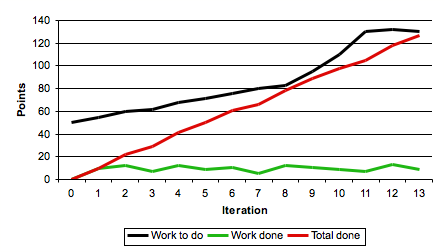
Taken to the extreme you get cumulative flow charts – often used by Kanban teams – shown in this diagram:

These show both the total work done and the total work to-do as constantly rising lines. If total done ever matches total to-do then its game over. This technique is open ended, the work is ongoing. And it is only necessary to estimate a little bit ahead.

So, if you do use burn-down charts:
• Consider using burn-up charts or cumulative flow diagrams
• Don’t make estimates too detailed; don’t worry about over estimating, it will all come out in the wash anyway
• Certainly don’t spend too long making detailed estimates
• Track work done, work discovered as you go along and work removed; you don’t need to put these on the charts but keep the numbers so that you can…
• Use statistics to project a range of end dates
• Don’t let anyone thing a burn-down chart is a substitute for a Gantt or Pert chart

And when people demand a done date remind them that the old method didn’t give them a done date either. Yes it gave them a date but it was never the actual date.

Burn-down charts: The Good, Bad, advice and alternatives Read More »