Agile

Definition of Ready considered harmful

Small-iStock-502805668-2017-09-6-12-58.jpg

Earlier this week I was with a team and discussion turned to “the definition of ready.” This little idea has been growing more and more common in the last couple of years and while I like the concept I don’t recommend it. Indeed I think it could well reduce Agility.

To cut to the chase: “Definition of ready” reduces agility because it breaks up process flow, assumes greater role specific responsibilities, introduces more wait states (delay) and potentially undermines business-value based prioritisation.

The original idea builds on “definition of done”. Both definitions are a semi-formal checklists agreed by the team which are applied to pieces of work (stories, tasks, whatever). Before any piece of work is considered “done” it should satisfy the definition of done. So the team member who has done a piece of work should be able to mentally tick each item on the checklist. Typically a definition of done might contain:


  • Story implemented
  • Story satisfies acceptance criteria
  • Story has been seen and approved by the product owner
  • Code is passing all unit and acceptance tests

Note I say “mentally” and I call these lists “semi formal” because if you start having a physical checklist for each item, physically ticking the boxes, perhaps actually signing them, and presumably filing the lists or having someone audit them then the process is going to get very expensive quickly.

So far so good? – Now why don’t I like definition of ready?

On the one hand definition of ready is a good idea: before work begins on any story some pre-work has been done on the story to ensure it is “ready for development” – yes, typically this is about getting stories ready for coding. Such a check-list might say:


  • Story is written in User Story format with a named role
  • Acceptance criteria have been agreed with product owner
  • Developer, Tester and Product owner have agreed story meaning

Now on the other hand… even doing these means some work has been done. Once upon a time the story was not ready, someone, or some people have worked on the story to make it ready. When did this happen? Getting this story ready has already detracted from doing other work – work which was a higher priority because it was scheduled earlier.

Again, when did this happen?

If the story became “ready” yesterday then no big deal. The chances are that little has changed.

But if it became ready last week are you sure?

And what if it became ready last month? Or six months ago?

The longer it has been ready the greater the chance that something has changed. If we don’t check and re-validate the “ready” state then there is a risk something will have changed and be done wrong. If we do validate then we may well be repeating work which has already been done.

In general, the later the story becomes “ready” the better. Not only does it reduce the chance that something will change between becoming “ready” and work starting but it also minimises the chance that the story won’t be scheduled at all and all the pre-work was wasted.

More problematic still: what happens when the business priority is for a story that is not ready?

Customer: Well Dev team story X is the highest priority for the next sprint
Scrum Master: Sorry customer, Story X does not meet the definition of ready. Please choose another story.
Customer: But all the other stories are worth less than X so I’d really like X done!

The team could continue to refuse X – and sound like an old style trade unionist in the process – or they could accept X , make it ready and do it.

Herein lies my rule of thumb:


If a story is prioritised and scheduled for work but is not considered “ready” then the first task is to make it ready.

Indeed this can be generalised:


Once a story is prioritised and work starts then whatever needs doing gets done.

This simplifies the work of those making the priority calls. They now just look at the priority (i.e. business value) or work items. They don’t need to consider whether something is ready or not.

It also eliminates the problem of: when.

Teams which practise “definition of ready” usually expect their product owner to make stories ready before the iteration planning meeting, and that creates the problems above. Moving “make ready” inside the iteration, perhaps as a “3 Amigos” sessions after the planning meeting, eliminates this problem.

And before anyone complains saying “How can I estimate something thing that is not prepared?” let me point out you can. You are just estimating something different:


  • When you estimate “ready” stories you are estimating the time it takes to move a well formed story from analysis-complete to coding-complete
  • When up estimate an “unready” story you are estimating the time it takes to move a poorly formed story from its current state to coding-complete

I would expect the estimates to be bigger – because there is more work – and I would expect the estimates to be subject to more variability – because the initial state of the story is more variable. But is still quite doable, it is an estimate, not a promise.

I can see why teams adopt definition of ready and I might even recommend it myself but I’d hope it was an temporary measure on the way to something better.

In teams with broken, role based process flows then a definition of done for each stage can make sense. The definition of done at the end of one activity is the definition of ready for the next. For teams adopting Kanban style processes I would recommend this approach as part of process/board set-up. But I also hope that over time the board columns can be collapsed down and definitions dropped.

Read more? Join my mailing list – free updates on blog post, insights, events and offers.

Definition of Ready considered harmful Read More »

Documentation is another deliverable and 7 other rules

8295173-2017-08-30-13-43.jpg

“Working software over comprehensive documentation.” The Agile Manifesto

Some have taken that line to mean “no documentation.” I have sympathy for that. Years ago I worked on railway privatisation in the UK. We (Sema Group) were building a system for Railtrack – remember them?

We (the programmers) had documentation coming out our ears. Architecture documents, design documents, user guides, functional specifications, program specifications, and much much more. Most of the documentation was worse than useless because it gave the illusion that everything was recorded and anyone could learn (almost) anything any time.

Some of the documentation was just out of date. The worst was written by architects who lived in a parallel universe to the coders. The system described in the official architecture and design documents bore very little relevance to the actual code but since the (five) architects never looked at the code the (12) programmers could do what they liked.

Documentation wasn’t going to save us.

But, I also know some documentation is not only useful but highly valuable. Sometimes a User Manual can be really useful. Sometimes a developers “Rough Guide” can give important insights.

So how do you tell the difference?

How do you know what to write and what to forego?

Rule #1: Documentation is just another deliverable

Time spent writing a document is time not spent coding, testing, analysing or drinking coffee. There is no documentation fairy and documentation is far from free. It costs to write and costs far more to read (if it is ever read).

Therefore treat documentation like any other deliverable.

If someone wants a document let them request it and prioritise it against all the other possible work to be done. If someone is prepared to displace other work for documentation then it is worth doing.

Rule #2: Documentation should add value

Would you add a feature to a system if it did not increase the value of the system?

The same is true of documentation. If it adds value then there is every reason to do it, if it doesn’t then why bother?

Rule #3: Who will complain if the document is not done?

If in doubt identify a person who will complain if the document is not done. That person places a value on the document. Maybe have them argue for their document over new features.

Rule #4: Don’t write documents for the sake of documents

Don’t write documents just because some process standard somewhere says a document needs to be written. Someone should be able to speak to that standard an explain why it adds more value than doing something else.

Rule #5: Essential documents are part of the work to do

There are some documents that are valuable – someone will complain if they are absent! User Manuals are one reoccurring case. I’ve also worked with teams that need to present documentation as part of a regulatory package to Federal Drug Administration (FDA) and such.

If a piece of work requires the documentation to be updated then updating the documentation is part of the work. For example, suppose you are adding a feature to a system that is subject to FDA regulation. And suppose the FDA regulation requires all features to be listed in a User Manual. In that case, part of the work of adding the feature is to update the user manual. There will be coding, testing and documentation. The work is not done if the User Guide has not been updated.

You don’t need a separate User Story to do the documentation. In such cases documentation may form part of the definition of done.

Rule #6: Do slightly less than you think is needed

If you deliver less than is needed then someone will complain and you will need to rework it. If nobody complains then why are you doing it? And what value is it? – Do less next time!

This is an old XP rule which applies elsewhere too.

Rule #7: Don’t expect anyone to read what you have written

Documentation is expensive to read. Most people who started reading this blog post stopped long ago, you are the exception – thank you!

The same is true for documentation.

The longer a document is the less likely it is to be read.
And the longer a document is the less of it will be remembered.

You and I do not have the writing skills of J.K.Rowling, few of us can hold readers attention that long.

Rule #8: The author learns too

For a lot of documentation – and here I include writing, my own books, patterns, blogs, etc. – the real audience is the author. The process of writing helps the author, it helps us structure our thoughts, it helps us vent our anger and frustration, it forces us to rationalise, it prepares us for an argument, and more.

So often the person who really wants the document, the person who attaches value to it, the person who will complain if it is not done, and the person who will learn most from the document is the author.

Join my mailing list to get free updates on blog post, insights, events and offers.

Documentation is another deliverable and 7 other rules Read More »

Principles of software development revisited

BeachSpainLite-2017-08-15-10-04.jpg

Summer… my traditional time for doing all that stuff that requires a chunk of time… erh… OK, “projects” – only they aren’t well planned and they only resemble projects in the rear-view mirror.

Why now? Why summer? – Because my clients are on holiday too so I’m quiet and not delivering much in the way of (agile) training or consulting. Because my family is away visiting more family. Thus I have a chunk of time.

This year’s projects include some programming – fixing up my own Twitter/LinkedIn/Facebook scheduler “CloudPoster” and some work on my Mimas conference review system in preparation for Agile on the Beach 2018 speaker submissions.

But the big project is a website rebuild.

You may have noticed this blog has moved from Blogger to a new WordPress site, and attentive readers will have noticed that my other sites, allankelly.net and SoftwareStrategy.co.uk have also folded in here. This has involved a lot of content moving, which also means I’ve been seeing articles I’d forgotten about.

In particular there is a group of “The Nature of Agile” articles from 2013 which were once intended to go into a book. Looking at them now I think they still stand, mostly. In particular I’m impressed by my 2013 Principles of Software Development.

I’ll let you can read the whole article but here are the headlines:

Software Development Principles

  1. Software Development exhibits Diseconomies of Scale
  2. Quality is essential – quality makes all things possible
  3. Software Development is not a production line

Agile Software Principles

  1. Highly adaptable over highly adapted
  2. Piecemeal Growth – Start small, get something that works, grow
  3. Need to think
  4. Need to unlearn
  5. Feedback: getting and using
  6. People closest to the work make decisions
  7. Know your schedule, fit work to the schedule not schedule to work
  8. Some Agile practices will fix you, others will help you see and help you fix yourself

The article then goes on to discuss The Iron Triangle and Conway’s Law.

I think that essay might be the first time I wrote about diseconomies of scale. Something else I learned when I moved all my content to this new site is that the Diseconomies of Scale blog entry is by far my most read blog entry ever.

I’m not sure if I’m surprised or shocked that now, four years later, these still look good to me. I really wouldn’t change them much. In fact these ideas are all part of my latest book Continuous Digital.

I’m even starting to wonder if I should role those Nature of Agile essays together in another book – but thats bad of me! Too many books….

Join Allan Kelly’s mailing list to get free updates on blog post, insights and events.

Principles of software development revisited Read More »

Programmer’s Rorschach test

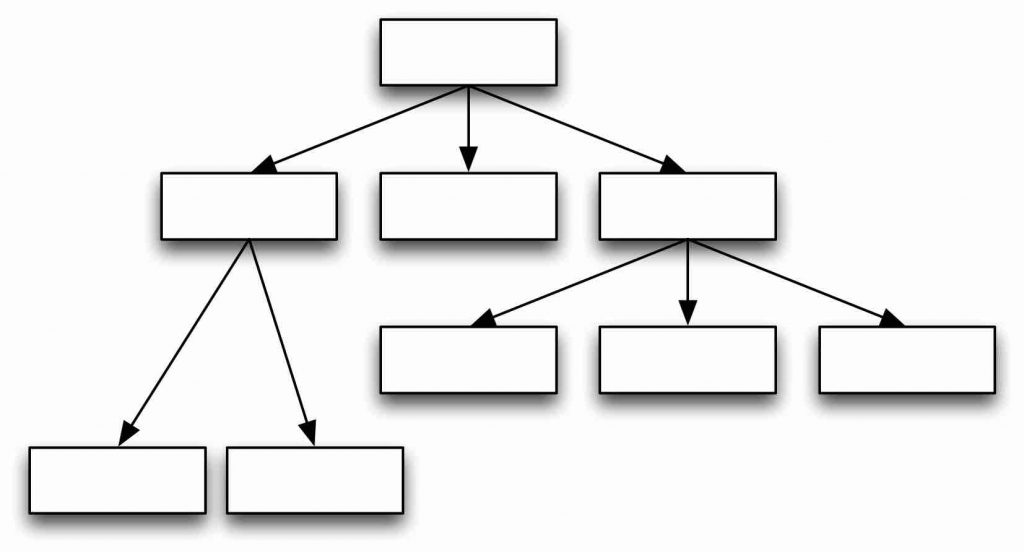
The picture above, I recently added this picture to Continuous Digital for a discussion of teams. When you look at it what do you see:

An old style structure chart, or an organization chart?

It could be either and anyone who knows of Conway’s Law shouldn’t be surprised.

When I was taught Modula-2 at college these sort of structure charts were considered superior to the older flow charts. This is functional decomposition, take a problem, break it down to smaller parts and implement them.

And that is the same idea behind traditional hierarchical organizational structure. An executive heads a division, he has a number of managers under him who manage work, each one of these manage several people who actually do the work (or perhaps manage more manager who manage the people who do the work!)

Most organizations are still set up this way. It is probably unsurprising that 50 years ago computer programmers copied this model when designing their systems – Conway’s Law, the system is a copy of the organization.

Fast forward to today, we use object oriented languages and design but most of our organizations are still constrained by hierarchical structure, that creates a conflict. The company is structurally decomposed but our code is object oriented.

The result is conflict and in many cases the organization wins – who hasn’t seen an object oriented system that is designed in layers?

While the conflict exists both system and organization under perform because time and energy are spent living the conflict, managing the conflict, overcoming the conflict.

What would the object-oriented company look like?

If we accept that object oriented design and programming are superior to procedural programming (and in general I do although I miss Modula-2) then it becomes necessary to change the organization to match the software design – reverse Conway’s Law or Yawnoc. That means we need teams which look and behave like objects:

  • Teams are highly cohesive (staffed with various skills) and lightly coupled (dependencies are minimised and the team take responsibility)
  • Teams are responsible for a discrete part of the system end-to-end
  • Teams add value in their own right
  • Teams are free to vary organizational implementation behind well defined interface
  • Teams are tested, debugged and maintained: they have been through the storming phase, are now performing and are kept together

There are probably some more attributes I could add here, please make your own suggestions in the comments below.

To regular readers this should all sound familiar, I’ve been exposing these ideas for a while, they draw on software design and Amoeba management, I discuss them at greater length Xanpan, The Xanpan Appendix and now Continuous Digital – actually, Continuous Digital directly updates some chapters from the Appendix.

And like so many programmers have found over the years, classes which are named “Manager” are more than likely poorly named and poorly designed. Manager is a catch all name, the class might well be doing something very useful but it can be named better. If it isn’t doing anything useful, then maybe it should be refactored into something that is. Most likely the ManagerClass is doing a lot of useful stuff but it is far from clear that it all belongs together. (See the management mini-series.)

Sometimes managers or manager classes make sense, however both deserve closer examination. Are they vestige from the hierarchal world? Do they perform specialist functions which could be packaged and named better? Perhaps they are necessary, perhaps they are necessary for smoothing the conflict between the hierarchal organization and object oriented world.

Transaction costs can explain both managers and manager classes. There are various tasks which require knowledge of other tasks, or access to the same data. It is cheaper, and perhaps simpler, to put these diverse things together rather than pay the cost of spreading access out.

Of course if you accept the symbiosis of organization and code design then one should ask: what should the organization look like when the code is functional? What does the Lisp, Clojure or F# organization look like?

And, for that matter, what does the organization look like when you program in Prolog? What does a declarative organization look like?

Finally, I was about to ask about SQL, what does the relational organization look like, but I think you’ve already guessed the answer to this one: a matrix, probably a dysfunctional matrix.

Programmer’s Rorschach test Read More »

iStock_000012937008XSmall-2017-07-5-13-13.jpg

Medium range capacity planning

iStock_000012937008XSmall-2017-07-5-13-13.jpg

My last blog, “Creating Beautiful Roadmaps – NOT!”, highlighted how the term “roadmap” is used and abused. While I’m probably in the minority in seeing a roadmap as long range scenario planning exercises to enhance learning there isn’t really a consensus on what a roadmap is…

To some a roadmap is a plan of how a product will evolve in the next few years. To others a roadmap is a set of promises with dates made to customers, higher management and others. Most of the roadmaps I see are little more than bucket lists with dates, fantasy dates at that.

Increasingly “roadmap” is used to describe a “release plan”, that is, a list of release dates and for each date a list of features that will be included in that release. Since these are usually based on estimates they are doomed to failure because very few teams can produce meaningful estimates.

Release plans made sense when releases were occasional, say every quarter but once they became fortnightly they loose logic. What is the point of planning releases if you release when the feature is ready? Many times a day?

So imaging how my heart sank a few weeks ago when a client said: “And I’d like you to run a road mapping session for the team next week.”

Worse still, there was no escape, I was visiting a client in Australia, I suddenly wondered if I’d done the right thing flying around the world!

So although I smiled and nodded inside I thought “Bugger!”

A day or two later I enquired about expectations, what did they hope to get from this exercise? Fortunately the answer was “An understanding of what the team will be doing in the next six months.”

OK, this wasn’t a full blown scenario planning exercise it was a mid-range scheduling plan. Normally I see little point in scheduling more than three months in advance – at most! Since this team was changing their work processes, personnel had been in a state of flux and there was no historical data this was going to be difficult.

My next stop was the Product Owner. He had a long list of things the customers – internal and external – wanted. Most of these were little more than headlines and they were all a long way from stories or epics so there was little to go on. The sheer quantity of ideas was so long that saying “No” and deciding what ideas not to work on was clearly going to be essential.

Given the vagueness and unreliability of inputs one could be forgiven for despairing but instead I saw opportunity. The problem was not so much one of road mapping or scheduling but deciding how the team were to divide their time up for the next six months. This was more big ticket prioritisation.

The vagueness of the requirements and specifications meant that once the time was divided up the team would mostly have a free hand in deciding what needed to be done and what they could do in the time allowed.

Without performance data there was no way estimation could be a reliable guide so there was no point in even thinking about it. But if one was to try estimation one would need something to estimate, which means the requirements would need fleshing out and with so many possible options that would be a lot of work. Not only did we not have the time to do such work but since we knew some items would not make the cut fleshing them out, let alone estimating them, was work which would be wasted.

Just as this was looking like mission impossible I remembered Chris Matts Capacity Planning approach. The roadmap request was actually a capacity planning exercise. Chris’ approach would need a few tweaks but it might just work…

In Chris’ version the product owners estimated the work. At first this sounds awful, product people estimating how long technical work will take! Help!

While Chris says this I’ve never seen these “estimates” as real effort estimates. I’ve always viewed them as “bids.” Each product owner wants to get as much time as they can for their chosen work. But they also know that the higher their bid the less likely they are to get what they ask for. So in “estimating” they are both bidding and self-limiting. Once they have a work allocation they will have to adjust what they ask for to get it into the time.

Rather than ask the product folk to estimate or bid I decided to ask them how many nominal days they would like to allot to each item. How would they divide the capacity between competing requests?

Secondly I decided to ask them to order request items. Thus, a line item could have a very high allocation of time but be late in the scheduling order; conversely a small effort item could be high up the priority list.

So…

The first task was to knock the wish list into shape as a series of line items.

For each line item we gave a short description and statement of anticipated benefits in a spreadsheet. Each item had a box for “days” and “order.”

Next we took a stab at calculating how many days team P had: six months for 10 people equated to approximately 1280 working days.

My plan was to have each manager allocate 1280 between the line items and assign each item a priority position. Then we would average the numbers and use the combined result as the basis of a discussion before finalising the allocations. Finally we would turn the allocated days into percentages and hand them to the team together with the priority order.

So far, so good. The meeting commenced: three managers, three techies, one team product owner and me. (Only the managers got to vote.)

To my surprise the managers readily accepted the approach: I had feared they would want detail on the line items and effort estimates.

While I had intended to hand out the printed spreadsheet, collect the numbers and average them someone decided we should put them on screen. So the whole spreadsheet was projected on screen and it became a collective exercise.

Very quickly about half the items were dismissed and allocated zero time. They were all good ideas but given capacity constrains they clearly weren’t going to win any time.

Some of the remaining items were split up and others combined. Before hand I had worried whether we had the right granularity and even the right items but the group quickly addressed such concerns without me needing to mention them.

(Anyway, I didn’t want fine granularity because that would hinder the teams ability to decide what it wanted to do.)

Next each line item was discussed and assigned an order. I had intended to order them into strict 1, 2, 3, …. but these quickly became buckets, there were several #1 items, several #2 and finally some #3.

With the “order buckets” decided we moved onto allocating nominal days. We quickly decided to simply work with 1,000 nominal days. I quickly calculated how many points equated to one developer for one sprint, how many points equalled the whole team for one sprint and a couple of other reference points to help guide the process.

The days were allocated – including an allowance for technical investment – and we were at 1300 nominal days committed, 300 over budget. Now things got hard so we stopped for lunch.

After lunch I expected a fight. But I knew that if the worst happened when we converted to percentages everything would be cut by 30%. Moving to percentages would force any cuts the meeting couldn’t make.

Maybe it was the effect of lunch but these hard decisions were taken quickly, to my immense surprise. The managers concerned could easily see the situation. Once the capacity constrain and work requests were clear the competition became clear too.

Most of all I had succeeded in preventing managers from arguing over who was doing what. There was no attempt to say “Peter will do X and Fred will do Y.” The team had a free hand to decide how to organise themselves to meet the managers’ priorities.

I was delighted with the way the whole exercise went, having tried capacity planning once I expect I’ll be doing it again – I may even build it into some of my training courses!

What do you think? Anyone else done this? – please leave me a note in the comments

Medium range capacity planning Read More »

Houston-2017-06-26-16-55.gif

Create Beautiful Roadmaps in Minutes – NOT!

Houston-2017-06-26-16-55.gif

Subject: Create Beautiful Roadmaps in Minutes

Body:

Hi << Test Name >>,

I hope you enjoyed reading our guide to product roadmaps.

If you haven’t already built a roadmap in _____, I’d encourage you sign up for a free trial.

Why did this email annoy me so? – apart from the failed name substitution that is.

This e-mail, perhaps spam or perhaps something I did sign up to, landed in my e-mail box the other day and set my blood boiling.

Roadmaps should most definitely NOT be created in minutes. Roadmap should take time, roadmaps should take lots of people’s time.

  • Roadmaps should NOT be a list of features with dates
  • Roadmaps are NOT promises
  • Roadmaps based on work effort estimates will undoubtedly fail
  • Roadmaps describe what MIGHT happen in the future to your product(s) and company
  • Roadmaps should be informed by known events (upcoming shows, purchase needs of potential customers, legislation changes, etc.)
  • Roadmaps should consider how technology changes might play out
  • Roadmaps should consider how your technology can help your (potential) customers with the problems they will have tomorrow
  • Roadmaps should be informed by company strategy and roadmaps will feedback to company strategy
  • Roadmaps should be flexible because the future will be different to any predictions you make

The value of roadmaps is not in what they say. There is a lot of value in what they don’t say – the things that the organization will not do. But the real value of the roadmap is in the creation of the roadmaps.

The act of creating the roadmap brings key people together and exposes them information about the future.

Peter Drucker once said: “We have no facts about the future” but there are probabilities: population changes is one that can be accurately predicted years ahead (e.g. we know how many 20 year olds there will be in 10 years time.) Most legal changes can be seen coming at least a few months out. There are things we can take a view on, there are things we know we don’t know, and things were we need to keep options open.

When key people are brought together they can exchange information and views. They can share their views of the future, they can talk about how they see the future, they can build a shared model and out of these can come a possible future, a possible scenario, a roadmap, which shows how your product will add value to some customers.

Because that’s what a roadmap is: a scenario plan, one or more possible descriptions of the future for your product.

Like so much planning it is the exercise of creating the plan that is the valuable bit rather than the resulting plan itself. This is especially true for roadmaps which are attempting to look far into the future. Roadmaps need to be a mix of prediction and opinion.

Roadmaps should bring people together for a discussion, to hear each others voice and opinion, creating the roadmap should be discussion.

Reducing roadmaps to a few minutes work with a tool destroys the value of the exercise. Any organization that does this has a pretty screwed up idea of collaboration.

Next time you need to create a roadmap:

  • Gather relevant information about the future
  • Look at company cycles, look at competitor and customer cycles, what can you see?
  • Look at technology trends
  • Bring together a mix group of people: senior executives, technologists, sales people and product managers
  • Spend time building your view of the world
  • Consider how your product can help that world and help your customers solve the problems they will have

And repeat the process regularly, say every six months.

You might even build several scenarios about the future and consider the implications for your product in each. Such scenario roadmaps are there to shape peoples view of the future. Your scenarios will probably be wrong and the roadmap will play out differently in the end but allowing people to consider alternative futures challenges them to think differently. When real events happen the fact that people have considered alternatives will mean they are better prepared – even though the future will be different to all your scenarios!

(Museums of the future, future memories, retrospectives and change is a blog post about future memories from 10 years back.)


Create Beautiful Roadmaps in Minutes – NOT! Read More »

SL_C20_Gamla_Stan,_Stockholm-2017-06-12-19-50.jpg

Stockholm developers & Back seat managers

SL_C20_Gamla_Stan,_Stockholm-2017-06-12-19-50.jpg

When does empathy become Stockholm syndrome?

“Stockholm syndrome is a condition that causes hostages to develop a psychological alliance with their captors as a survival strategy during captivity. These feelings, resulting from a bond formed between captor and captives during intimate time spent together, are generally considered irrational in light of the danger or risk endured by the victims. Generally speaking, Stockholm syndrome consists of ‘strong emotional ties that develop between two persons where one person intermittently harasses, beats, threatens, abuses, or intimidates the other.’” Wikipedia

It is one thing to have empathy with someone else’s outlook but sometimes empath gives way to something stronger, too much empathy not only becomes self-limiting but damaging to oneself.

Sometime when I argue the case for improving software quality – reducing defects, increasing maintainability – programmers start by telling me that their managers don’t care about quality. I talk about the cost and time implications of poor quality, and again I’m told that manager value speed above all else.

Asked who is to blame they point the finger at faceless “managers” who will not allow quality, will not allow the right design, tests, refactoring or anything else which is “good.” Ask what should be done to improve it and they will say “We don’t have time.”

Very, very, often I find myself debating with professional engineers who simultaneously despair at the lack of quality built into their code but claim that the company cannot afford quality. (See my old post The quick and dirty myth.)

Frankly, I think some programmers and testers suffer from a version of Stockholm syndrome: they simultaneously blame others but take on those views themselves.

Maybe it is not Stockholm syndrome, maybe its just a failure to take responsibility.

I actually find it easier to convince managers of the advantages of automated testing and test-first development. I find managers understand that higher quality is faster and cheaper when it is explained to them. I find managers are open to the argument that it is better to do less and do it better quality.

It seems to me that some unreformed managers do hold these opinions and they may well voice the need for speed to programmers. A few might even suggest that testing can be skipped.

But, since when was the manager the expert in the way to develop program code? Managers are managers not design experts, surely that is the programmers job? Many managers know they are not code experts, they know the programmers are.

Of course managers – and other “business” people want results faster – don’t we all? And of course they are focused on what customers want. Is there something wrong with that?

Managers are often in a worse position that programmers and testers because they are answerable to their own managers but lack the ability to do programming work. They are reduced to the position of children in the back of the car asking “Are we there yet?”

Overtime programmers come to share the same desire for speed, the same need to showing something. But since programmers control the means of production they take action, they make compromises with themselves. They cut quality. They skimp testing – after all their own code won’t contain defects. They abuse interfaces, they drop tests, increase coupling and reduce cohesion, avoid refactoring, they live with broken tests and they tell themselves “we can fix it later” even if everyone knows. (Not going back and fixing the things they meant to fix is another example of reducing quality.)

Time and time again I meet developers who do these things and claim “my manager won’t let me”. And I ask inside my head: “Does the manager sit beside them and tell them not to do these things?”

I’ve known managers who have said: “Ship bugs” but I’ve known more managers who haven’t said that.

The view that quality needs to be dropped seems to have two sources: ignorant managers and unprofessional managers who demand shoddy work, and, secondly, programmers who assume a desire for speed is a request to drop quality.

Sometimes I challenge programmers to tell me which managers have voiced the “reduce quality” argument. More often than not they cannot name such a manager. It is the programmers who interpret the managers – understandable desire – for speed as a request to cut quality.

I suspect that having cut corners and reduced quality programmers feel guilt. And that guilt leads them to make assumptions – perhaps even invent false memories – which allow them to pass these failings onto their manager.

I’m not saying managers are perfect or blameless. I am saying I think many programmers are more responsible for problems than they care to accept. (And of course, some just don’t know any better.)

In my mind programmers are engineers; engineers create solutions within constraints and professionalism should guild them to do the best job they can within those constraints.

Managers are like kids in the back seat of a car, if you keep giving them chocolate and telling them you are almost there they will expect more chocolate and to arrive soon. When you stop giving them chocolate and carry on driving is it any surprise they get upset?

Image: Gamla Stan stop in Stockholm by Kabelleger CCL on WikiCommons.

Stockholm developers & Back seat managers Read More »

remote-control--SGS-800px-2017-06-6-18-33.png

Responsabilisation, Command & Control and Jira

remote-control--SGS-800px-2017-06-6-18-33.png

A big part of Agile is about giving the workers, or rather the team, authority to do their job – putting people into control of their own work. Many people talk about self-organizing and self-managing teams, I prefer to talk about distributing and devolving authority but its all about the same thing.

I recently stumbled across an article discussing an initiative at Michelin called responsabilisation giving factories and workers more authority with responsibility. This French word, responsabilisation, deserves adopting by the Agile community.

What ever we call it, it is:

  • Giving those doing the work, as individuals and as teams, the authority to organise their own work
  • Giving the workers authority to do the right thing
  • Redefining the role of “managers” to allow, and even help, workers make their own decisions
  • And giving the same workers the responsibility for the work they do and how they do it

Again and again I find that electronic work management and tracking tools get in the way of doing this. Electronic tracking tools, of which Jira is the best known, disempower workers and give power, and control, to the tool and those who control the tool.

For example, typically in a planning meeting one person will “drive” Jira. That one person has a keyboard and mouse and controls the screen. They decide what is displayed and they get to create new items, drag existing ones around and ultimately decide what is done.

The others, the rest of the team, sit facing the screen and sometimes at the Jira driver. The driver has power, the driver becomes the manager of the meeting. Rather than interact with each other they interact with the driver and the machine.

Conversely, in a similar meeting using paper and cards someone may well have authority over the cards but they can be moved by anyone. New cards can be written by anyone. People focus on the work and on each other. The conversation isn’t moderated by the Jira driver – it moves.

The Jira driver has power, they have control.

And it is not just in the meeting.

In Jira – and similar tools – someone has to set the tool up, someone has to decide board layout, someone granters access permissions, everyone has a “role” in the software, they are defined by their role.

The Jira admin has power and control.

In the worst cases teams have little power to change Jira because the organization mandates they must set it up like other teams. Again, the organization holds power back.

And since Jira controls the workflow, Jira controls the to-do list, Jira controls the reporting… he who control Jira controls the work.

Jira is not alone in this respect. All electronic tools exhibit this problem. Jira is possibly worse than some because the interface is very complex and acts as an additional barrier to worker involvement.

Tools built on and around Jira make this worse. Supplementing Jira with additional tools makes Jira more powerful and that makes the Jira admins and drivers more powerful.

While Jira produces a mass of reports most people don’t understand or use them. Worse still are those who use the reporting mechanism to forecast delivery dates into the future, because these come from a tool they perpetuate the illusion of certainty.

Electronic tools reimpose the power structures, illusions and control that the Agile movement set out to remove.

Responsabilisation, Command & Control and Jira Read More »

Sadface-2017-05-13-08-40.jpg

Why do devs hate Agile?

Someone asked me this the other day: “Why do devs hate agile?” and as I worked through my answer I thought it worth writing down. There are three reasons I can think of but before we get to them…

First off, I don’t think all “devs do hate Agile”. Or rather, I don’t think the vast majority of them hate it – and hate is a very strong word. Sure some do, no doubt but all? A blanket “all devs hate” ? No.

I do think its is fashionable to slag agile off, and few do this better than the agile community themselves. And unfortunately like a lot of fashions once it gets started it catches on. Once dev A says “I hate Agile” then dev B thinks its cool to say it too, and dev C sees A and B doing it so joins in.

The ironic thing about all this is that Agile is the product of developers. In the beginning it was developers – like me – who saw that the classical way of doing things (write down what the customer wants, design it, plan it, code, it, etc.) didn’t work very well but noticed that the way most work actually happens (quick, code foo… O foo is not quite right change it, quick) was actually better.

I was inspired by Jim McCathy’s book Dynamics of Software Development. Jim was a developer, albeit a developer who had started managing other developers. It was that book that made me think “alternative ways are valid.”

Similar insights were occurring with developers all over the world – as they raced to fix Y2K using heavy weight processes. Some of these coders went on to become mildly famous: Kent Beck, Ward Cunningham and Martin Fowler for example.

And here in lies number #1 why “devs hate agile.”

Theft and imposition.

Agile was all about dev in the early days – especially XP. Just 10 years ago coders would say “I’d love to work Agile by my (project) manager won’t let me.” So we set about making Agile manager friendly, we expanded the business arguments for why Agile was good, and managers got it. Now you hear developers saying things like “My manager wants me to work agile but he doesn’t understand” or “My manager wants me to work agile but does’t help.”

In the beginning Agile was a bottom up movement. Now it is a top-down movement, change is imposed on people rather than people wanting to change.

That is wrong.

Making it worse is the fact that many of those imposing the change frequently fail to understand the change they are imposing or do not question their own thinking. Management thinking needs to change too – start with Software Development is Upside Down.

Reason #1: Agile is now an imposed change.

In my experience developers want to work Agile because true Agile allows them – no, demands – they do a quality job. Agile doesn’t deliver half the benefits it promises if organizations don’t pay attention to quality, that means their technical practices, thats what we used to call technical excellence. That means developers doing work that are proud of.

Namely “technical practices from XP”, specifically: simple design, relentless refactoring, test driven development (plus behaviour driven development), pair programming and things like face-to-face conversations and “story is a placeholder for a conversation.”

I’ll point the finger specifically at Scrum, and later Kanban, for not mandating these practices – something I did with Xanpan. Part of making agile acceptable to management was removing the words extreme and programming, and down playing the difference high quality can make.

Without these practices teams are driven harder to deliver something sooner and quality drops. As quality drops it gets more difficult to deliver anything in a short amount of time. Consequently more is demanded of coders, stress and tension rise and it is not fun.

Reason #2: Agile without technical quality makes developers lives worse.

I remember meeting some coders in Cambridge, almost the first thing they told me was “We hate Agile, our managers went on a Scrum course and have insisted we do it for months.” I quickly discovered that they were not doing any technical practices, as a result they were racking up more and more technical liabilities and making their own lives harder. Once I explained that they were missing the technical practices their attitude changed.

Now to the final reason, perhaps the big reason…

The Agile toolset is intended to help teams organize themselves, it is intended to make problems visible so they can be addressed and fixed. In the hands of people with the right attitude this is brilliant.

Teams don’t need a manager (although one may still be useful).

Teams can see problems.

And teams can fix problems.

But… the very same tools used by someone with the wrong attitude are a micro-managers dream.

Which micro-managers wouldn’t want everyone to give a status report at 9.00am every day?

Who wouldn’t want to see all work broken down to pieces for which NAMED individuals could be held accountable?

And why wouldn’t they want to make a shocked face and send a very clear “that is not acceptable” message every time an estimate was high?

Visibility becomes a tool of blame.

I once helped a team at an airline set up a Kanban board, instead of using it to see bottlenecks, problems and find opportunities to improve the managers concerned used it to assign blame, point fingers and demonstrate that nothing was happening because someone else wasn’t doing their job.

Reason #3: In the wrong hands the same Agile tools are very effective micromanagement tools.

Why do devs hate Agile? Read More »

Clinic: Product Owner/Manager question

An old product manager friend writes….

“Just started a new gig as senior product manager at blah blah blah

Discovering that scrum teams aren’t organized around products but rather engineering components. For instance a product manager has to work with three different scrum teams:

– front end

– back end

– data science

This makes it hard for Product Managers to manage but I assume easier for engineering. I’ve not encountered this before. Thoughts?

At any given scrum meeting there may be two or more product managers, as opposed to a single product manager per scrum team.”

OK lets see…

The organization is horizontally organised, not good – we’re back to Conway’s Law. Getting anything of business value delivered is probably going to entail getting the front end team to do something, the back-end team to do something else, and then the data science team to do something…

Now it is possible that that is the way the work falls. Its just possible that a lot of the work falls inside one component, e.g. data science, and that alone delivers business benefit. If the majority of the work is like that then horizontal organization makes sense.

But, in my experience that is rarely the case, and your comments suggest this is true here too.

Think of it in user story terms: stories rarely relate to one function, you are far more likely to need a little bit from each functional team. No one team can complete a whole story, they need the other teams to do something.

This makes work for project manager types to do – has team A done their bit so team B can start and why aren’t team C talking to team A?

The approach normally advocated by agile folks is Vertical teams.

Each team should be staffed to delivered business value itself: if it needs a representative from each function then so be it, if team members need more training, or need permission to go into a different part of the code then make it so.

Horizontal organization is’t that uncommon, it is usually adopted on the grounds that you need specialists and specialists need to focus on one thing. While you may still need specialists you want people to cross boundaries and do be business priority driven.

Then there is the question of product managers and product owners, o not again…

In this context the product managers ARE the product owners. Pick up the Scrum book, replace every instance of “product owner” with “product manager” and things are clearer.

And it is OK to have multiple product people in the scrum meeting – by the way, when you say “Scrum Meeting” do you mean “Stand up” or “Planning” meeting? Either way it doesn’t matter, you can have two Product people in each.

The important thing, especially if you mean the planning meeting, is: the product people speak with one voice.

Perhaps they have a common backlog.

Perhaps they have a pre-planning meeting of their own to decide priorities.

Perhaps they divide the work up as Strategic Product Owner/Manager and Tactical Product Owner/Manager.

Perhaps they agree one looks at segment X and the other looks at segment Y and they compare notes.

However they do it they need to speak with one voice. They need to agree.

A more interesting question is: why do you even have two?

Do each focus on different markets? Different aspects of the product? Or different time-frames?

It is entirely possible that if you had two vertical teams instead of three horizontal teams that one PM feeds one team and the other PM feeds the other team. In between times they both get out and see customers and decide between themselves what the longer term strategy, tactics and plans are.

Clinic: Product Owner/Manager question Read More »