Agile

QualityIdeas.jpg

Things to do to improve code quality

As I mentioned a couple of posts ago, I was recently out in Oslo teaching a course on Lean software development. One of the points I make is: Quality is free (or at least cheaper) provided you invest in improving quality.

This section of the course included an exercise were I ask the participants to think of things they could do to improve code quality. On this occasion the exercise went particularly well and resulted in the list in the picture below:

Lets run through these one by one – not necessarily in the order on the sheet:

Test Driven Development: if there is one practice above all others which contributes to better code quality and fewer bugs it is TDD. On the plus side it can be used on any type of project, Agile, Waterfall or other. Its roots go back a long way but it was a forgotten practice until XP resurrected it. When run as part of a continuous integration cycle with frequent automated builds and tests the practice is Unit Testing on steroids.

However it doesn’t just happen by mandating it so. Most developers don’t know how to do it, they need training and help (coaching) to do it. Even then it is going to be a learning experience, don’t expect it to become prevalent overnight.

(And before you say “But we have a legacy system with 1 million lines of code so it won’t work for us” please read my implications of the power law.)

Acceptance Test Driven Development (ATDD) is the next level up from unit test based TDD. Here those making the requests for development not only specify their acceptance criteria but do so before any development happens, and do so in a way that they can be automatically executed. In many cases professional Testers need to work with the “Customers” to create such tests.

Continuos Integration (CI): This is a valuable practices on its own – making sure code builds and new code doesn’t break anything that already exists. When coupled with TDD and ATDD to created automated, repeatable, test suites, it is an order of magnitude more valuable.

Pair Programming: The controversy over pair programming seems to have died down, but then so too have examples of people actually doing it. A shame really. It is instant code review, it is two-heads better than one (think of commercial pilots or surgical teams). It also allows developers to focus intensely on the work in hand – few distractions from telephone calls, e-mails, SMS, and all the other rubbish that distracts us so easily.

Code review: The next best thing to pair programming. If people won’t pair then at least code review. Put in place a light weight process which happens as soon after the code is written as possible. The big formal process so many of us learnt about in school aren’t practical – only NASA can really afford them anyway. Instead use a lightweight process, you will get 80% of the benefit for 20% of the cost.

Static analysis tools: in the past static analysis tools have gotten a bad name for themselves. The current generation are a lot better and while they are not a true substitute for a code review (because in a code review both reviewer and reviewee learn) they are very cheap to use. Sure you might have to buy a license but once you’ve done that and set them up in the build system they run every time code is checked in and can highlight potential issues very quickly.

Coding standards: Traditionally I’m not a fan of coding standards. In my experience too many teams waste to much time debating and arguing over coding standards and when they are put in place they can be used as a tool for some developers to bully others. However, if you can overcome those problems then they have a valuable contribution to make.

Start by having a group discussion – face-to-face, not over e-mail or on a mailing list – about what could be in a coding standard. Find the areas of agreement and have three or four categories: a very few items as “mandatory”, more items as “recommended” and more as “candidates.” This third group are possible candidates for inclusion in recommended or mandatory but need some consideration. The fourth group for things you agree not to standardise on.

Then review these guidelines every three or four months. Promote some from candidate to recommended, and from recommended to mandatory, and if some aren’t working then remove them or demote them. (This recommendation is broadly in line with Les Hatton’s suggestions in Safer C.)

Then, don’t use coding standards as part of your review. Developers should follow them out of honour. But just in case you miss one, automate them. Set your static analysis tools up to run your coding standards against code which is checked in. Remove the human from the loop and remove the bullying.

Automate: In case it hasn’t sunk in yet, most of the suggestions so far can be automated, and should be automated. Not automating them means they take time to do and are therefore expensive in the long run. Automation might cost in the short run but it makes things cheaper overall.

Refactoring (& refactoring tools): The whole point of refactoring is to improve the code quality and, more importantly, the overall design. If it isn’t then something is wrong. You can, and people do, refactor without automated unit tests but this is equivalent to a high-wire act without a safety net. With the safety net in place refactoring should be a frequent activity and one which doesn’t take up lots of time.

As an old C++ hand I’m always impressed by the refactoring tools available to Java and C# developers. These should lead to more frequent, quicker and safer refactorings.

Hopefully it is immediately obvious how the above can lead to better code. Some of the other items on the list aren’t so obvious but I think they are worth including.

Show and Tell (early): maybe not immediately obvious why this one should lead to better code but it will. By regularly showing potential customers of the software what they are getting developers need to keep their code near to release state. This forces more, smaller, steps in development.

The second reason why this helps is that feedback comes more regularly. This provides positive guidance on what is going right and will point out when things are going in the wrong direction.

Finally, if developers are scared to show their work in progress to users and customers then its time to run up the red flags and look for trouble.

User Tests extends this reasoning. User tests provide another line of testing which helps detect problems early.

Similarly, working on smaller pieces/projects provides for more small steps. Before each step there is an opportunity for re-adjustment and course correction both at the work planning level and at the code level.

Finally, Team cohesion is important because without it the team are running in different directions and doing different things with the code. Part of team cohesion must be a shared view on the development objectives, the design ideas in the code and what makes for good code.

This isn’t an exhaustive list, just the ones my students in Oslo came up with; if you have any more suggestions please add a comment, thanks.

Things to do to improve code quality Read More »
A3 reports: templates and observations

As I mentioned last time, I recently delivered a course on Lean software development in Oslo. One of the exercises I set people was to produce an A3 report.

A3 reports, for those unfamiliar with them are a mechanism used at Toyota to analyse issues and suggest solutions, or rather “counter measures” . The term “counter measures” is preferred over solution because no “solution” is ever the end of the story. One day there will be a better solution, er, I mean better counter measure.

Put it another way, as Peter Senge says in The FIfth Discipline, “tomorrows problems come from todays solutions.”

Anyway, the purpose of writing about this is to share my A3 report templates with anyone who is interested. There are actually two templates:

  • A3 training: An important part of A3 writing is to “go and see” the actual work happening, and talk to the actual people who do it. In a classroom you can’t actually go and see the issue, you can’t talk to the people performing the task or check the company data. Therefore I allowed students to make assumptions as long as they noted them on the report. Afterwards we could talk about how the assumptions could be validated to prove, or disprove them.
  • A3 report: this is the same report template without the extra space for assumptions and notes. This is the template to use for real outside the classroom.

Strictly speaking there isn’t a specified A3 format. This confused me when I first started digging into the A3 method: I was looking for templates. It turns out that you can just start with an blank sheet of A3 paper, but it also seems there are some standard elements and structures people use when writing an A3. My templates are what I think are the key elements.

But the actual A3 report, the thing you can see is only half the story. The A3 report is not just a thing, it is a process. The process of creating the report, the observation, investigation and mentoring, is probably more important than the end result.

If you want to know more about A3 reports John Shook’s book “Managing to Learn” is good, although you have to order it from the Lean Enterprise Institute, its not at your local online bookshop. For a shorter version check out Shook’s article in the MIT Sloan Management review, “Toyota’s Secret: The A3 report”.

One thing that struct me while reading Shook’s description of A3 is their similarity to patterns: both involve a context, a problem, the things that make the problem hard (forces or analysis), both propose a better way (solution or counter measures), both value brevity and both allow the authors to change the format to suit the problem.

More importantly, a key element of A3 reports is the mentoring of A3 writers that occurs during the creation process. This sounds just like the shepherding process that any pattern paper being present at a conference goes through. Having shepherded many pattern papers – and won a couple of awards for it, I might say – the A3 mentoring process seems exactly the same.

Back in the Oslo classroom I learned: allow plenty of time for the A3 report writing. Its not something to be rushed.

I recently experimented with A3 formats on a coaching assignment with a client. I asked several manager to complete one. Most of the time, if you are going to ask someone to do an A3 you need some position of respect, or at least authority. They look odd to manager schooled in long report and PowerPoint reports, they require a depth of thinking they are not accustomed to and they look funny.

If anyone tries using these reports please let me know what you think and what your results are. And if anyone wants to do an A3 with me, I will be running the Lean course again in Oslo in November. This course was two days, I’m planning to increase it to three days next time so allow more time for this and other exercises.

A3 reports: templates and observations Read More »

AgilePyramid2010.png

How do you make Lean Practical ?

I was Oslo recently teaching a course on Lean Software Development. When we were organizing this course on of our goals was: Make it practical. As I was preparing the course material this was at the front of my mind. But, there is a but.

Step back a minute and have another look at my Agile Pyramid:

Agile Pyramid

(By the way I’ve decided to start calling this the Agile Pyramid, I’ve sometimes called it this and sometimes called it the Agile Triangle. Well in the interests of consistency I’ve decided to stick with one, since Agile Triangle tends to be used to refer to project management type stuff Agile Pyramid wins. Besides, Google for Agile Pyramid and I’m on the first page.)

For practical things you look to the top: Scrum and XP are very practical, and prescriptive, Organisational Learning is more of an academic concept than a practical recipe. Lean sits between the two.

Also consider than many writers on Lean (take Like and Morgan for example) caution against seeing Lean as a toolkit you can dip into and select bits to use. They tend towards an “all or nothing” approach which needs change from the top down.

Most of the people I expected to have on the course were software engineers and architects looking to improve their processes and practices, not CEOs looking to reinvent their companies.

Nor do I think I’m unusual in having this problem. One of the reasons the course mandate was “Make it practical” was because some other Lean courses have a reputation for being less than practical.

So what do I do? How do you make something which is largely a philosophy practical?

One of my first decisions was to include Kanban software development. Kanban is a ready made, practical, Lean based approach to software development.

Next: you can’t have a Lean course without talking about Toyota, some of the things they do and some of the thinking behind the Lean approach. However, the objective here needs to be change the way people think about product development; or at least show that other approaches are possible.

The thing about Lean is that its not so much a toolkit of solutions (like Agile) but a systems thinking model to help you devise your own solutions and tools to tackle your own problems. So, having outlined the thinking behind Lean, and one example of how it is done in software I turned my attention to tools to help thinking. Things like: Value Streams and Value Stream Mapping, 5 Whys, Fishbone diagrams, A3 reports and reflection.

Two days was not enough, I might increase it to three next time, but then, you can never give too much time to Lean because to really understand it means doing it. Summarising it in a short course tends to remove the practicality.

One decision I made which might surprise some people was not to start from the Poppendieck’s books for the course. Yes I referenced them, yes I advised my students to read them but I used Morgan and Liker’s Toyota Product Development as a guide.

And since building a Lean organization really means building a Learning Organization my own Changing Software Development was the course book.

If your interested, it looks likely that the course will run again in Oslo in November.

How do you make Lean Practical ? Read More »

What Is Software Design?

This link has been in my blog backlog for a couple of months, waiting to work its way into a blog post. But I’m fed up waiting so here it is raw.

What Is Software Design? by Jack W. Reeves on Developer Dot Star

Originally published in 1992, before Java, before C#, before Agile, when Lean was just breaking out of Toyota and before the web (almost) this is a classic piece about software design.

Reeves argues that all coding is design. His specifics might refer to C++ but this could be any language.

Just in case you are in any doubt: I completely agree.

What Is Software Design? Read More »

Brain dump on team boards

I was helping a team set up their board (white board, Kanban board, Scrum board, call it what you will) for Agile working the other day and it dawned on me I use a whole bunch of heuristics I’ve never seen written down. So here goes:

  • I like magnetic white boards best myself but I’ve seen teams use walls, cupboards and flip charts too. The important points are: big, visible things you can stick other-things on it.
  • I prefer to use index cards but many teams use Post-It type stickies. If you use index cards you need a means of sticking them to the board which is where the magnets come in.
  • You can divide the columns: classically this is To do, In Progress and Done. Of course Kanban teams use many more columns.
  • At first I used the same dry market pens to mark the columns as to make notes on the board. The trouble is these lines tend to disappear. This is a particular problem with Kanban teams who have more columns and so more movements to make. So now I use coloured electrical insulation tape to mark the columns. This is much easier to see and lasts a lot longer.
  • Leave space on the board to include Team or Project name and the end date of the iteration. You might also find space to keep a burn-down/up or cumulative flow diagram.
  • You don’t need a very big board: I normally use 120cm x 90cm, again Kanban teams tend to need bigger boards because they have more columns.
  • You can buy a suitable board from most stationary suppliers for less than £100. If your company can’t afford this (or won’t pay) you have problems which Agile isn’t going to fix.
  • Remember to buy magnets, dry wipe pens and something to remove the permanent market someone is going to put on there eventually.
  • Coloured magnets are fun but so far I’ve not found using the colour of a magnet to convey information hasn’t been worth the extra effort
  • Boards are usually mounted on the wall or a stand but, I prefer them to be free standing because you can carry them around. If you have a meeting in another room you just pick the board up and carry it there. And its a team exercise to move it.
  • We had an accident with a board once: it was hit from behind at the start of the planning meeting and everything came off. But that turned out to be good, we looked at everything in more detail. Sometimes I now remove everything at the start or during the course of the planning meeting and only replace it if I need to.
  • Don’t put designed on your board: there isn’t enough space. By all means have another board for designs.

Brain dump on team boards Read More »

Business Analysis Maturity Model

One of the important, but often overlooked, roles in any software development is the “needs” guy. I put it that way to be as general as possible. Its the role which decided what the customer/end-user actually needs (sometimes wants but doesn’t need).

I’ve blogged before (many times, The Product Owner role (August 2009), Requirements: The next challenge for Agile (February 2009), Books for Product Managers (December 2008) among others) about the Product Manager role. However, Product Managers, or to give them their full title, Technical Product Managers, only really exist in genuine software product companies (including software as a service models). In corporate IT departments and software service companies (i.e. ones that write bespoke software for a specific customer) the role doesn’t exist.

In these companies the “needs” role is usually (or should) be filled by a Business Analyst. I blogged about these when I blogged about System Analysts earlier this year.

Both Product Managers and Business Analysts (BA) are concerned with the “what” of the software product, but how they decide this is different. Basically:

  • Product Managers find the need by looking outside the company, at a market of multiple potential customers
  • Business Analysts look inside the company at a single customer, with potentially many stakeholders involved

I’ll probably blog about this more in future.

However, he BA role is much misunderstood. As a title I think it ranks second only the “Project Manager” in abuse. In some places BAs are really System Analysts, in others they are Project Managers, in others they just gather the requirements. The definition I like best is “Internal Consultant.”

Thats one of the reasons I really like the Business Analysis Maturity Model.

You can view this model as model for individual career development, but I prefer to view it as a model for corporate advancement. At the “low end” BA just rather up everything “users” think they want, at the high-end the BA is responsible for discovering what the business needs to improve.

When you do this the BA role looks a lot more like a Product Manager role: its about deciding what will advance the company and product in both cases.

And its important from an Agile perspective. When the Product Owner/BA role is played as a “requirements gatherer” then there is little scope for the BA to add value and, more importantly, there is little flexibility in what is delivered. The BA becomes just the guy who communicates the need to the people who write the code.

When the BA role is played as an consultant, working with customers/users and the development team to fill a business need then the conversation changes. Rather than discussing which, and in what order, features will be developed from a given shopping list then conversation can centre on how best to satisfy a business need and maximise value.

In short, the BA Maturity Model is a critical, and until now missing, piece in understanding the BA role in Agile teams and Agile development.

Business Analysis Maturity Model Read More »

What you need is a ….

Programmer, software engineer, software developer, coder, developer, code-monkey, build engineer, tester, software tester, test automator, test engineer, quality assurance engineer, analyst, business analyst, system analyst, product owner, product manager, requirements manager, subject matter expert, domain expert, project manager, change manager, programme manager, development manager, iteration manager, release manager, deployment manager, scrum master, team leader, technical lead, development lead, architect (system architect, solution architect, software architect), consultant, coach, designer, user interface designer, user experience designer, product designer.

Did I miss any? – There are a lot of roles in software development teams and even more titles. Does your team have a full set? Do you need them all? How do you choose which ones you have, and which you don’t?

And everyone of them offers a solution to your problem. So….

In walks the Programmer (Software engineer, software developer, etc. etc.) and says: “Yes, I understand your problem, what you need is some software writing. Only us programmers can do that so don’t worry about that testing lark, or analysis. Just introduce me to some customers and I’ll work it out.”

The Business Analyst walks in next: “Its all very well writing something, and its all very well making sure it works. But, is it the right thing? How do you know its what you need? Us Business Analysts are trained to understand what you need and give those requirements to the programmers and testers.”

Next in is the Tester. “You see, the problem is that Programmers don’t really know what you want, and when they do they make mistakes. So I’ll test everything and ensure it works, and that it is what you want.”

Very convincing. Next you talk to a Project Manager: “yes, these programmer and testers are very good but have you noticed how long they take? Unless there is someone here to organise them, and dare I say push them, then you’ll never get anything.”

You see, everyone (every role) offers to solve your problem. Maybe by creating a solution, maybe by ensuring its the right solution or maybe by making sure that it all fits together.

And these roles overlap. Programmers can talk to you about what you need, so can Testers. Project Managers like to have a chat too and Business Analysts claim its their right.

As you get more people things get more complicated. They seem to make work for themselves. So you need an overall Development Manager to manage you teams. You hire Architects to ensure the Programmers really do it right.

More people begat more people: Release Managers, Programme Managers and Team Leaders appear to organise people. Designers, Build Engineers, and Consultants appear to specialise in parts of the system.

They all claim to have the answer to your problems but things look worse.

Then someone tells you about Agile. You need a Product Owner, a Scrum Master and a Team. More roles, and the people you already have don’t want to give up their titles so you add some more.

And the holders of all these roles claim they have the solution to your problem.

They can’t all be right.

Thing is: there is only one role you absolutely must have on a software development project. That is the guy who does the coding: Programmer, Software Engineer, Software Developers, call them what you will. If you are not getting code written you aren’t doing software development.

Which of the other roles you have depends on the complexity and nature of the work, the size of the team, the approach you take and your wider organisation.

This doesn’t stop the specialise from telling you they have the solution to your problem. Which makes it all confusing.

I intend to keep with this theme of roles for a few blog entries, so watch this space.

What you need is a …. Read More »

Capers Jones & "How many teams are Agile?"

A while ago I tried to answer the question “How many software teams are using Agile?”. My best efforts put the answer at somewhere between 5% and 15%.

In the search for some other data I’ve recently been look through Capers Jones “Applied Software Measurement” (2008). It is packed full of interesting statistics and I really must buy a copy and read it in more detail. Anyway, Jones gives his hypothesis of project in this table:

Type of development Number
%
End-user 2,500 2%
Agile 20,000 13%
Web 12,500 8%
Systems 8,750 6%
MIS 70,000 45%
Commercial 3,250 2%
Outsource – US 17,500 11%
Outsource – offshore 15,000 10%
Military 7,750 5%
Total
157,250
100%

(In case that table gets mangled, the first column is the type of development, the second the total Jones looked at and the third the percentage of the total.)

Jones puts the number of Agile projects at 13%, firmly inside the range I give. Of course there are two caveats here. Firstly, the ways Jones has sliced and diced the numbers leaves me wondering how he has counted military work running Agile, and outsourced work running Agile.

Second, how do we know if a piece of work is Agile or not? All the evidence I have tells me that an awful lot of teams are saying they are “Agile” and frankly aren’t. As Kevlin Henney suggested on re-twittered (from somewhere or other) recently a better question to ask is “How are you Agile?”

I’ll get Jones book and read it some more. One other thing he mentioned stood out: getting metric on software projects is hard. He says its like searching through debris, lots of rubbish then occasionally a nugget. Which sums up how I feel about software metrics now. Its quite like I imagine archaeology.

Capers Jones & "How many teams are Agile?" Read More »

Les Hatton's site and the importance of letting failures fail

I recently stumbled across Les Hatton’s site. I’ve owned one of Les’ books for probably over decade (Safer C, a classic) but this was the first time I’ve looked at his website. I highly recommend a perusal of the site and reading some of his papers. Apart from anything else he’s an even more interesting guy than I thought he was (and I already though he was interesting!).

One set of his papers looks at the power-law nature of software code. I’ll admit I couldn’t follow all of the academic speak and advanced maths terms – which might disqualify me from reading some papers but it
more a sign that I didn’t take the time to work it out in depth. (Most of his papers are written in a very accessible style.) The key point I took away was that he extends James Noble’s work to non-OO systems. Hopefully I’ll find time to go back and read more of these papers in depth and make sense of the bits I skimmed this time.

Another paper which stood out was “How to build successful complex systems: lessons from open source” with his suggestions for how to build the NHS IT system. Until I read this I was unaware that the Welsh
Health Service had taken a different route to the English one, had spent far less money and had actually produced a successful system.

Les, like many others, sings the praises of the Open Source movement. He’s right, there are some very successful Open Source products out there, but, as I’ve pointed out before, most Open Source
projects fail
. And when I say MOST I mean tens of thousands fail for every success.

Fortunately Les’ suggestions allows for this; he suggests a Darwinian process with seeds 100+ development efforts and over a series of rounds reduces them to one winner.

Although Les suggests this in an Open Source context what he is actually suggestion is also a Venture Capital model. He proposes to give over 100 teams a little bit of money (seed money in effect) to create an initial system. Year on year winners are selected to continue development, these are given a bit more money. That sounds exactly like Angel funding, VC Round A, VC Round B, etc. etc. funding. OK, Les model is “open” because the winning teams get to pick over the remains of the loosing but even that exists in commercial activity: failing companies get bought by the winners who keep the best bits.

Either way the result is the same: rather than one “too big to fail” NHS IT project we have a number of small projects which compete and can fail. If we remove the ability to fail from the process then we have to
pay for failure.

Whether it be evolution, capitalism, IT projects or even banks, if failures are not removed from the system then change is inhibited because the winners cannot really win.

This is the important thing about failure. Forget that myth about learning from failures, the important thing is that it eliminates something that doesn’t work.

Les Hatton's site and the importance of letting failures fail Read More »

ShooksModel.png

Change models: Shook, Schein, Dreyfus and Constructivism

Continuing on from my opening comments in the last entry, “Why forecasts fail: simple ones are better ”…

The other article which was good in the latest MIT Sloan Management Review was John Shook’s piece on change. His change model complements my own ideas well.

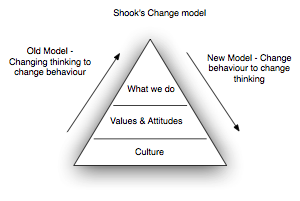
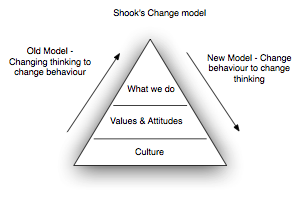
Shook’s model is shown below. He sees change starting with specific practices, e.g. just-in-time inventory, and as teams improve their practices and deepen their understanding they move to more thinking for themselves.

Shooks model
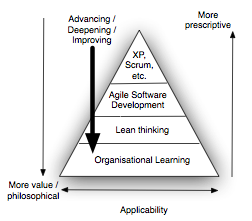
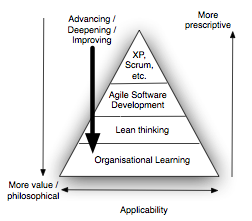
I’ve written before about my Agile triangle (or maybe pyramid is a better term). In the last few months I’ve added another insight into this model. Team which start by just “doing Scrum” or “XP” and want to advance, improve their process and practices further, deepen their understanding and application, take the next step, call it what you will, well, they need to advance by moving down the triangle.

Agile traigle
You might start doing XP but over time you want to look outside XP and see what else is out there in the Agile toolkit. Deeper still is going back to Lean and picking up the Lean tools (value stream mapping, A3s, focusing on flow, etc.) And deeper still is a learning organization, a team or unit that is continually learning and changing.

While this goes some way validating my ideas its not the end of the story. Shook goes further and suggests his model parallels Edgar Schein’s writing – Schein is an MIT Management professor who has written extensively on culture and organisations.

Schein argues that organisational culture cannot be changed directly, indeed, to start with a desire culture in mind is a mistake. Better to start with the issues in hand and set about changing the cultural artefacts. Shook gives the model below (similar but inverted to the one on Wikipedia.)
Sheins model
It hadn’t dawned on me before, although heaven knows I once read plenty of Schein, that this isn’t far from my model. XP and Scrum, and other Agile methods, really start by changing the culture artefacts of an organisation.

Out go Gantt charts, in come burn-down charts.
Out go status meetings, in come stand-up meetings.
Out go moving deadlines, in come fixed iterations.
And so on.

Only later, are teams expected to reflect and modify their models – moving down the triangle/pyramid, moving from XP to Agile, to Lean, to a Learning Organization.

This also fits well with the Dreyfus model of skill acquisition which is so well liked by many in the Agile community. In this model a Master teach the pupils, when the pupils have mastered the skills they are allowed to think for themselves.

I’ve always disliked the Dreyfus model, and I believe it has failure built in. This is because the learner spends a long time looking to the teacher for the answers, they are not encouraged to find their own, indeed they are discouraged from trying anything different to accepted norm. Consequently someone may have mastered the skill they set out to, but they are no better at learning or problem solving. Faced with a new problem, or a need to deepen their understanding, and without a Master teach and ready made answer they are lost.

Maybe I over worry about this danger, as usual the truth is probably somewhere in between the two extremes. Rather than the Dreyfus model I look to the Constructivism model of learning. Under this understanding it is peoples understanding, derived from their experience which constitute learning. The teacher is not there to teach so much as to help individuals experience something different, the individuals sense making process then takes over.

Still, as I’ve said before: my interpretation Agile comes from Lean and the underlying idea of organisational learning. (Indeed, I think I wrote a book about that!)

As a result when I’m trying to make teams more Agile, I’m really trying to make them better learners, and make the organisation as a whole a better learner. While publicly we might be working down the Agile pyramid secretly I’m trying to work up.

Change models: Shook, Schein, Dreyfus and Constructivism Read More »