allan kelly

But our users don’t want to change
A good question came into my mailbox:

“Much of the writing I’ve seen assumes that software can be shipped directly into the hands of customers to create value (hence the “smaller packages, more often” approach). My experience has been that especially with new launches or major releases, there needs to be a threshold of minimum functionality that needs to be in place.”

Check your phone. Is it set to auto-update apps? Is your desktop OS set to auto-update? Or do you manual choose when to update?

Look at the update notes on phone apps from the likes of Uber, Slack, SkyScanner, the BBC and others. They say little more than “we update our apps regularly.”

Today people are used to technology auto-changing on them. They may not like it but do they like a big change any more?

My guess is that most people don’t even notice those updates. When you batch up software releases users see lots of changes at once, when you release them as a regular stream of small updates then most go unnoticed.

Still, users will see some updates change things, and they will not like some of these. But how long do you want to hide these updates from your users?

The question that needs asking is: what is the cost of an update? The vast majority of updates are quick, easy, cheap and painless.

Of course people don’t like updates which introduce a new UI, a new payment model or which demand you uninstall an earlier app but when updates are easy and bring benefits – even benefits you don’t see – they happily accept them.

And remember, the alternative to 100 small updates is one big update where people are more likely to see changes.

If your updates are generally good why hold them back? And if your updates are going in the wrong direction shouldn’t you change something? If you run scared of giving your users changes then something is wrong.

Nor is it just apps. Most people (in Europe at least) use telco supplied handsets and when the telco calls up and says “Would you like a new handset at no additional cost?” people usually say Yes. That is how telcos keep their customers.

The question continues,

“there needs to be coordination across the company (e.g. training people from marketing, sales, channel partners, customer/ internal support, and so on). There is also the human element – the capacity to absorb these changes. As a user of tech, I’m not sure I could work (well) with a product where features were changing, new ones being added frequently (weekly or even monthly), etc.”

If every software update was introducing a big change then these would be problems. But most updates don’t. Most introduce teeny-tiny changes.

Of course sometimes things need to change. The companies which do this best invest time and energy in making these painless. For example, Google often offers a “try our new beta version” for months before an update. And for months afterwards they provide a “use the old interface option.”

The best companies invest in user experience design too. This can go along way to removing the need for training.

Just because a new feature is released doesn’t mean people have to use it. For starters new changes can be released but disabled. Feature toggles are not only a way of managing source code branches but they also allow new features to be released silently and switched on when everyone is ready. This allows for releases to be de-risked without the customer seeing.

And when they are switched on they can be switched on for a few users at a time. Feedback can be gathered and improvements made before the next release.

That can be co-ordinated with training: make the feature toggle user switchable, everyone gets the new software and as they complete the training they can choose to switch it on.

Now marketing… yes, marketeers do like the big bang release – “look at us, we have something shiny and new!”

You could leave lots of features switched off until your marketeers are ready to make a big bang. That also reduces the problem of marketers needing to know what will be ready when so they known when to launch a campaign.

Or you could release updates without any fuss and market when you have the critical mass.

Or you could change your marketing approach: market a stream of constant improvements rather than occasional big changes.

Best of all market the capabilities of your thing without mentioning features: market what the app or system allows you to do.

For years I’ve been hearing “business people” bemoan developers who “talk technical” but I see exactly the same thing with marketeers. Look at Sony Televisions, what is the “picture processor X1” ? And why should I care? I can’t remember when I last changed the contrast on my television so the “Backlight master drive” (what ever that is) means nothing to me.

Or, look at Samsung mobile phones, 5G, 5G, 5G – what do I care about 5G? What does 5G allow me to do that I can’t with my current phone?

Drill down, look at the Samsung Galaxy lineup: CPU speed, CPU type, screen size, resolution, RAM, ROM – what do I care? How does any of that help me? – Stop throwing technical details at me!

Don’t market features market solution. Tell me what “job to be done” the product the addresses, tell me how my life will be improved. Marketing a solution rather than features decouple marketing from the upgrade cycle.

So sure, people don’t like technology change – I’ll tell you a story in my next blog. But when technology change brings benefits are they still resistant?

Now, with modern technology, with agile and continuous delivery, technology can change faster than business functions like training and marketing. We can either choose to slow technology down or we can change those functions to work differently – not necessarily faster but differently in a way that is compatible with agile technology change.

These kind of tensions are common in businesses which move across to agile style working. A lot of company think agile applies to the “software engine room” and the rest of the business can carry on as before. Unfortunately they have released the Agile Virus – agile working has introduced a set of tensions into the organization which must either be embraced or killed.

Once again technology is disruptive.

Perhaps, if the marketing or training department are insisting on big-bang releases maybe it is them who should be changing. Maybe, just maybe, they need to rethink their approach, maybe they could learn a thing or two about agile and work with differently with technology teams.

Subscribe to my blog newsletter and download Project Myopia for Free

But our users don’t want to change Read More »
Regular releases reduce risk, increase value

“If you’re not embarrassed by the product when you launch, you’ve launched too late.” Reid Hoffman, founder LinkedIn

Years ago I worked for a software company supplying Vodafone, Verizon, Nokia, etc. The last thing those companies wanted was to update the software on their engineers PC every months, let alone every week!

I was remembering this episode when I was drafting what will be my next post (“But our users don’t want to change”) and thought it was worth saying something about how regular releases change the risk-reward equation.

When you only release occasionally there is a big incentive to “get it right” – to do everything that might be needed and to remove every defect whether you think those changes are needed or not. When you release occasionally second chances don’t happen for weeks or months. So you err on the side of caution and that caution costs.

Regularly releases changes that equation. Now second chances come around often, additions and fixes are easy. Now you can err on the side of less and that allows you to save time and money.

The ability to deliver regularly – every two weeks as a baseline, every day for high performing teams – is more important than the actual deliveries. Releasable is more important than released. The actual question of whether to release or not is ultimately a question for business representatives to decide.

But, being releasable on a very regular basis is an indicator of the teams technical ability and the innate quality of the thing being built. Teams which are always asking for “more time” may well have a low quality product (lots of bugs to fix) or have something to hide.

The fact that a team can, and hopefully do, release (to live) massively reduces the risk involved. When software is only released at the end – and usually only tested before that end – then risk is tail loaded. Having releasable – and especially released – software reduces risk. The risk is spread across the work.

Actually releasing early further reduces risk because every step in the process is exercised. There are no hidden deployment problems.

That offsets sunk-cost and combats commitment escalation. Because at any time the business stakeholders can say “game over” and walk away with a working product means that they are no longer held captive by the fear of sunk-costs, suppliers and career threatening failures.

It is also a nice side effect that releasing new functionality early – or just fixing bugs – increases the return on investment because benefits are delivered earlier and therefore start earning a return sooner.

Just because new functionality is completed and even released early does not mean users need to see it. Feature-toggles allows feature and changes to be hidden from users – or only enabled for specified users. Releasing changed software with no apparent change may look pointless but it actually reduces risk because the changes are out there.

That also means testing is simplified. Rather than running tests against software with many changes tests are run against software with few changes which makes changes more efficient even if the users don’t see it. And it removes the “we can’t roll back one fix” problem when one of 10 changes don’t pass.

Back with Vodafone engineers who don’t want their laptops updated: that was then, that was the days of CD installs. Today the cloud changes that, there is only one install to do, it isn’t such an inconvenience. So they could have the updates but with disruptive changes hidden. At the same time they could have non-disruptive changes, e.g. bug fixes.

In a few cases regular deliveries may not be the right answer. The key thing though is to change the default answer from “we only deliver occasionally (or at the end)” to “we deliver regularly (unless otherwise requested).”


Subscribe to my blog newsletter and download Project Myopia for Free

Regular releases reduce risk, increase value Read More »

User Story or Epic?

GoldenRules-2020-08-26-19-57.jpeg

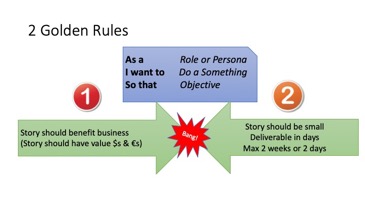
I have two golden rules for user stories:

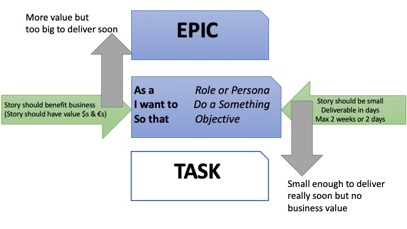
  1. The story should deliver business value: it should be meaningful to some customer, user, stakeholder. In some way the story should make their lives better.
  2. The story should be small enough to be delivered soon: some people say “within 2 days” but I’d generous, after all I used to be a C++ programmer, I’m happy as long as the story can be delivered within 2-weeks, i.e. the standard size of a sprint.

Now these two rules are in conflict, the need for value – and preferably more value! – pushes stories to be bigger while the second rule demands they are small. That is just the way things are, there is no magic solution, that is the tension we must manage.

Those two rules also help us differentiate between stories and epics – and tasks if you are using them:

  • Epics honour rule #1, epics are very valuable but they are not small, by definition they are large this epics are unlikely to be delivered soon
  • Tasks honour rule #2, they are small, very small, say a day of work. But they do not deliver value to stakeholders – or if they do it is not a big deal
EpicsStoriesTasks-2020-08-26-19-57.jpeg

Tasks are the things you do to build stories. And stories are the things you do to deliver epics. If you find you can complete a story without doing one of the planned tasks then great, and similarly not all stories need to be completed for an epic to be considered done.

In an ideal world you would not need tasks, every story would be small enough to stand alone. Nor would you need epics because stories would justify themselves. We can work towards that world but until then most teams of my experience use two of these three levels – stories and tasks or epics and stories. A few even use all three levels.

Using more than three is an administration problem. There is always a fourth level above these, the project or product that is the reason they exist in the first place. But really, three levels is more than enough to model just about anything: really small, small, and damn big.

And every story is a potential epic until proven guilty.

More about epics, stories and tasks in Little Book of Requirements and User Stories.


User Story or Epic? Read More »

Agile Guide podcast with Woody Zuill and Tom Cagley

I’m on a mission to popularise the term Agile Guide. A few weeks ago Wood Zuill (farther of Mob Programming and force behind #NoEstimates) and I recorded a podcast with Tom Cagley – another in his SpamCast series – on the Agile Guide role.

You can download the Agile Guide podcast from libsyn or you can download it from Apple, Sitcher, Google or Spotify.

Agile Guide podcast with Woody Zuill and Tom Cagley Read More »

Agile: Prix fixe or a la carte?

small-andersen-jensen-Hk2eu3OODdg-unsplash-2020-08-11-14-40.jpg

Advert: September micro-workshops – spaced limited

User Stories Masterclass, Agile Estimation & Forecasting, Maximising value delivered

Early bird discounts & free tickets for unemployed/furloughed

Book with code Blog15 for 15% discount or get more details


“They don’t do Scrum so much as ScrumBut”

“We don’t do Scrum by the book, we changed it”

“We follow SAFe, except we’ve tailored it”

“We do a mix of agile methods”

“They call it agile but it isn’t really”

You’ve heard all these comments right? But have you noticed the tone of voice? The context in which they are said?

In my experience people say these things in a guilty way, what they mean to say is:

“They don’t do Scrum so much as Scrum but we don’t do it the way we should”

“We don’t do Scrum by the book, we changed it, we dropped the Scrum Master, we flex our sprints, …”

“We follow SAFe, except we’ve tailored it by dropping the agile coaches, the technical aspects and …”

“We do a mix of agile methods, we don’t do anything properly and its half baked”

“They call it agile but I don’t think they really understand what agile is”

Practitioners aren’t helped by advisors – coaches, trainers, consultants, what-not – who go around criticising teams for not following “Brand X Method” properly. But forget about them.

I want to rid you of your guilt. Nobody should feel guilty for not doing Scrum by the book, or SAFe the right way, or perfect Kanban.

Nobody, absolutely no person or organization I have ever met or heard of, does any method by the book.

After all “agile is a journey” and you might just be at a different point on the journey right now. To me agile is learning and there is more learning to be done – should we criticise people because the haven’t learned something?

All these methods offer a price fix menu: you pay a fixed price and you get a set menu.

In reality all agile methods should be seen as an à la carte menu: pick what you like, mix and match.

In fact, don’t just pick from the Scrum menu or the SAFe menu, pick across the menus: Scrum, XP, Kanban, SAFe, LeSS, DaD, whatever!

And do not feel guilty about it.

Do it.

My agile method, Xanpan explicitly says: mix and match. Xanpan lays out a model but it also says change things, find what works for you, steal from others.

The only thing you can get wrong in agile is doing things the same as you did 3 months ago. Keep experimenting, keep truing new ways, new ideas. If you improve then great, if not, roll-back and try something else.

In other words, keep learning.

Picture: Thanks to Andersen Jensen for the above photo on Unsplash.


Subscribe to my blog newsletter and download Project Myopia for Free

Agile: Prix fixe or a la carte? Read More »

Agile & OKRs – the end is in sight

The end is insight for my new book “Little Book of Agile and OKRs”. There are only a few more (short) chapters I want to write and I have put the wheels in motion to get a professional cover.

After that there is a lot of editing – including a professional copy edit – and perhaps a change of title, plus an audio version.

Anyone buying “Little Book of Agile and OKRs” will receive updates for free as they are published on LeanPub.

And if you are prepared to trade a little of your time I’m give you Little Book of Agile & OKRs for free. I’m looking for reviewers, right now I’d like feedback on my content, in a few months I’ll be looking for reviews on Amazon.


Subscribe to my blog newsletter and download Project Myopia for Free

Agile & OKRs – the end is in sight Read More »

Is Agile is obvious?

iStock-1174931869-2020-07-27-14-29-2.jpg

[responsivevoice_button voice=”UK English Female” buttontext=”Listen to Post”]


Now booking: September micro-workshops – spaced limited

User Stories Masterclass, Agile Estimation & Forecasting, Maximising value delivered

Early bird discounts & free tickets for unemployed/furloughed

Book with code Blog15 for 15% discount or get more details


Is Agile Obvious?

From time-to-time people say to me:

“Agile is obvious”

When I’m being honest it is kind of hard to argue with them, it is certainly “obvious” to me. But at the same time agile is not obvious, or rather, the opposite of agile is also obvious. For example,

Agile says: obviously, you don’t know the future so don’t plan and research too far into the future.
Non-agile thinking says: obviously, failure to plan is planning to fail, obviously you need a plan of action, you need to plan for the future.

Agile says: obviously, people work best when they are self-motivated and given a say in what they do.
Non-agile says: obviously, people are lazy and will do as little as possible, therefore someone needs to manage them.

Agile says: high quality makes it easier to change in the future, obviously.
Non-agile says: obviously, quality is an endless quest, there is no point in polishing something which isn’t important, 20% of the effort gives 80% of the reward so don’t do any more.

Agile emphasises the here and now, the soon, obviously requirements can be handled just-in-time, so live for today.
Non-agile says: if we don’t think about the future we will obviously duplicate work and incur additional costs.

And my own entry: obviously, software development as diseconomies of scale therefore optimise for lots of small. The opposite is equally obvious: economies of scale are what makes modern business – and the cloud – successful so exploit them

There are a number of obvious examples that go with that:

Agile says: obviously we should test every change and new feature by itself to avoid the complications of interacting changes.
Non-agile says: obviously full test runs are slow and expensive so bundle work together and test it on mass.

Both agile and not-agile are obvious. What you consider obvious depends on your starting point. Once you start thinking “agile” a lot of things become obvious. But if you are not thinking agile then, if you are thinking some other model, then the opposite is also obvious.

Some would term this “An Agile Mindset”. However I don’t want to do that, I find the idea of “an agile mindset” too nebulous. I also note that most of the people I hear talking about “an agile mindset” seem to clinging on to some piece of holy lore which I consider not very agile and they believe is totally agile (the project model and upfront requirements usually.)

Instead I find myself going back to Theory-X and Theory-Y. In general people fall into one camp or the other. If you, your philosophy on work and life, align with theory-Y then all the “agile is obvious” statements above are indeed obvious. Conversely, if you generally follow a theory-X philosophy then all the non-agile statements are obvious.

Perhaps surprisingly I find people can flip, and be flipped, from X to Y. What is more difficult is getting people to unlearn behaviours and actions which they acquired with a theory-X mindset. Even if some element of theory-Y (and agile) is now obvious people need help to learn the new way and let go of the old. Some people can do this by themselves, others need help – or at least help speeding up the change.

Yes, thats part of my job as an Agile Guide. Sometimes just talking (and reflecting on recent events) helps. Sometimes exercises (or process miniatures they are sometimes called) help. Sometimes it is by experiments, exposing people to others can help as well – so conferences, user groups.

Rarely do people change because they went on training and were lectured too, but good training incorporates talking, reflection, exercises, etc. Such training is less training and more about practicing the future.

Obviously, my training is like that: I aim to make my training courses a rehearsal for future actions. Actually, while I “sell” training I prefer to think of it as a rehearsal or kaikaku event – kaikaku events also call a “kaizen blitz”, they are big change events from the people who brought you kaizen, more on them another time.

So when someone I’ve worked with turns around and says “Agile is obvious” I take it as a sign of success. They no longer seem agile as something strange, it is normal, it is onbvious.


Subscribe to my blog newsletter and download Project Myopia for Free

Is Agile is obvious? Read More »

Agile & OKRs – the next book

Last year I had a surprise: the company I was working with introduced OKRs – Objectives and Key Results. I started off very cynical about how effective these were likely to be but …

Not only did I come to like OKRs and the OKR setting process I came to see how they plugged a gap in agile and how they can be powerful for agile teams.

So a few months ago I started writing a book: A little book about Agile with OKRs.

I stalled for a few weeks but I’m working on it again so expect more updates in the coming weeks. Please let me know what you think of the book, and if you are using OKRs I would especially appreciate your thoughts and stories – I might even include them!

(Yes the name is deliberately chosen to build on the success of my “Little Book about Requirements and User Stories”.)

Agile & OKRs – the next book Read More »

I’m an Agile Guide

aron-visuals-3jBU9TbKW7o-unsplash-2020-07-1-09-44.jpg

[responsivevoice_button voice=”UK English Female” buttontext=”Listen to Post”]

Anyone who keeps a keen eye on Linkedin might have noticed I recently changed my job description to Agile Guide. I feel “guide” more accurately reflects what I do: part coach, part advisor, part teacher.

I work as a consultant – a hired gun – but “consultant” is a very vague term and covers a lot of ground. Plus a lot of people in the technology industry have a very negative view of consultants. I’ve been known to share that view myself so while consultant might be an accurate description it was also vague and open to misinterpretation.

Many people consider me an Agile Coach, and I have worked as an agile coach. However – as I’ve written before – this too is a conflicted term. Most of us who go by the title “agile coach” like to talk about helping people help themselves, unlocking the individual, respecting the individual as the expert, and so on. I agree with a lot of that and I do it. Sometimes.

I also know what professional coaches do and I don’t feel I’m one of them. I have a lot of respect for real coaches. Such coaches put their own opinions second and I don’t. I am prepared to tell people the way I think it should be – they are free to ignore my advice but I’m prepared to say it.

Thats why I also regard myself as part teacher: not just direct training sessions (which I do) but also one-on-one and in small free format group sessions.

So what title should I use?

I’ve struggled with this for years. My epiphany came a few weeks ago: Agile guide. I help others to get more agile, coaching is one tool but so is direct advice and teaching.

Hadn’t others thought of “Agile Guide”. So I checked out LinkedIn myself. One person. Someone I respect, someone I call a friend: Woody Zuill.

I checked in with Woody and his thinking parallels mine.

So I’m an Agile Guide – I help individuals, teams and enterprises become more agile in a digital world.

Part coach, part advisor, part teacher, plus thinker and route finder. I use skills of coaching, teaching and consultancy.

Who knows, maybe, it will catch on. After all, as Woody pointed out, we have both changed the world already.


Subscribe to my blog newsletter and download Project Myopia for Free

I’m an Agile Guide Read More »

The future of office working

HomeOffice-2020-06-30-16-47.jpg

The lockdown hasn’t effected my work environment that much. This is a picture of my home office, my garden office, my “man cave.” I am very lucky. When I’m not on site with clients I spend most of my time working here. Still, I miss visiting clients and conferences – although I did squeeze in Agile on the Beach New Zealand in the closing days of the old world.

A friend of mine works for Canonical – the Ubuntu Linux people. The vast majority of the people at Ubuntu work remotely. So while my friend lives in New Zealand he works with a team spread out across the world.

Once or twice a year, his whole team co-locates. They all fly together and work together for a couple of weeks, a sprint. Then they return home and work remotely with each other for another six months, then repeat. Once or twice I’ve seen Tim as he works in, or passes through, London. But as luck would have it the week I was in New Zealand he was on his travels.

In all this talk of how wonderful working-from home can be I don’t think there has been enough discussion about what makes a good experience and what makes it bad. The Ubuntu story highlights a couple of points which I think are missing from much of the current discussion over remote/home working.

Firstly the team are equal: they are all remote.

Over the years I have observed big differences in the way teams which are all distributed operate and the way teams with only one or two members operate. When the bulk of a team are co-located and only one or two are remote there is an unequal relationship. My intuition says teams are better off when they are either all remote or all co-located. When five of the team are co-located and a sixth member is remote then things are more difficult.

The way lockdown came about this year teams went from one to the other overnight, literally. Which also means it was very egalitarian. Everyone was in the same position. That can only be a good thing.

The second thing I take from Ubuntu is that face-to-face time is still valued. In fact, as we unlock I expect home working will be more common, more remote tools will be used but we will value co-locating and face-to-face contact all the more.

Where companies keep people remote I expect we will see the emergence of deliberate co-location. This might be a two week block like my friend or it might be a few hours or a whole day. I can easily imagine benefit from an agile team coming together for one day a fortnight to close out a sprint, run a retrospective and then plan the next sprint. (That will have a knock on effect in the office market as companies stop renting offices for years and rent meeting rooms by the day.)

In fact this will be essential. It is easier to build social capital – trust, comradeship – when you are face-to-face. For the last three months we have been running on the social capital and experience teams built up over years working together. The social capital account now needs toping up.

Existing teams, existing social capital and egalitarian distribution helped people work during the lockdowns. As we slowly move back to our offices that is going to change and we will need to make deliberate efforts to replenish social capital, keep people equal and build new teams.

New teams will benefit from working together face-to-face to get to know one another. Build some social capital and norms.

New employees in particular will need time together. Especially those, like fresh graduates, who are new to work altogether. Such people need to learn how to work. Doing that in a distributed environment is a challenge.

Those new to the workforce face an additional challenge: space.

Home working is OK for me, I have a garden big enough for an office (and I had the money to buy one.) How many people have been working of their kitchen table? or bedroom? Mixing your sleeping space with your work space can damage sleep patterns and add to stress.

How many new workers have that space?

I remember when I was a fresh graduate finding my way in the world I lived in house shares. I had a room in a shared house with similar people. Some of them I counted as friends but not all of them. Some of them had bad habits. Going to an office for work was important, staying in the house – especially when they were all staying in! – would have been too much.

Then there is the question of broadband: I have 200Mb fibre to the door but many people make do with a lot less and that can be variable. Not that 200Mb comes cheap…

If a company expect someone to work from home then I think they should pay for good broadband internet. They should also provide the equipment – I have heard of only a few employers who have given staff money to buy equipment for home.

In February and March many people all over the world found themselves having to work from home. Its been a better experience than many expected but I know people are flagging, I know people keen to get back to the office. In future I expect we’ll value face-to-face contact even as many people stay at home.

In the coming months people aren’t just going to walk back to the office and pick up where they left off. Work will be more varied. But now the initial pleasure and surprise of working for home is over we need to have a conversation about what companies need to do to support working from home in future and how it can be made sustainable.


Subscribe to my blog newsletter and download Project Myopia for Free

The future of office working Read More »