Agile

Software quality?

Since publishing my stream of consciousness about software quality on Friday (What is a software quality?) I’ve continued to think about the subject. In part putting the thoughts down started to structure my own thinking, in part a few comments made on Twitter caused me to think more, and, simply having written something caused me to reflect.

There are four main points I’d add to Friday’s entry.

First, what I wanted, what I needed for Xanpan, was (is) a good enough working definition of software quality, I don’t need a perfect definition. But even this turns out to be surprisingly difficult. And as Steve Smith pointed out this is not confined to software quality, defining “quality” at all tends to lead you in the direction of Zen and the Art of Motorcycle Maintenance.

Next, what I really need are two things: A definition of software quality and a definition of a software defect. I think I’m starting to approach workable definitions of both. But, definitions (by definition almost) should be free of assumptions about how you achieve – or don’t achieve – that aim. In other words, the definitions should not imply or assume an Agile, Waterfall or any other approach.

Third, one of the things I was concerned about was gold plating or over engineering. Really this is part of the “how do you achieve your aim.” A definition of software quality – and low defects – need not rule out (or embrace) any particular approach. I need to separate this out. Similarly the knowledge issue, while important, needs to be put on the side here.

Finally, I’m coming to the conclusion that we need two different terms for software defects. The clue was in that Tom Gilb quote really.

  • An Absolute Defect is, as Gilb says, free from personal opinion or taste. It is objective. For example, function called “Add Two Numbers” always returns 5 – whether you give it 2 and 2, 2 and 3, or 100 and 200.
  • A Common Defect (and I’m prepared to find a better name and I don’t imply any link to Deming) is anything which someone at some time decided to report – or classify – as a defect.

Absolute defects are a perfect subset of common defects, i.e. all absolute defects are also common defects but only some common defects are absolute defects.

I think its important to make this distinction because so much time and energy is spent by people arguing over what is and what is not a “defect”. If we define separate terms then we can at least reason about this situation and the fact that individual, teams and organizations often have incentives for classifying something as a defect whether it is or is not.

Jon Jagger pointed out in his comment on the previous blog that “Jerry Weinberg’s definition of quality is “value to someone” or “value to some persons”.” A common defect most definitely fits that description. Someone, somewhere, considers it valuable to call this thing a defect.

But I’m not sure I go along with that statement as a definition of quality as a whole. It is too open and not specific enough for me – or perhaps for the uses I want to put it to!

Some observations about defects to end:

  • All defects cost time and probably money: even logging a report of a potential defect costs time (and thus money) and action taken as a result (investigation and potential fixing) costs time. Defects themselves – even when not reported – may well costs money, e.g. overpayment or lost customers. (This also implies an element of the unexpected to defects.)
  • Absolute defects cost time and money; is the same true for common defects? Well maybe my opinion of something does result in a different financial outcome than someone else’s but does that make it a defect? Even then it can be surprisingly hard for some organizations to tell what makes, and what looses, money. I’d like this to be the dividing line but I don’t think it is.
  • Common defects need to be administered, managed and possibly fixed just the same as absolute defects. In my opinion, if someone reports a defect it should be considered against other defects – common or not – and action (fixing) taken or not. The debate between whether a particular defect is an absolute defect or a common defect isn’t very useful, it is the software equivalent of “my Dad is bigger than your Dad.”
  • If there exists some pre-code definition (specification, requirement, formula, etc.) of what the code should do it might be easier to classify something as an absolute defect but this isn’t enough reason to create that definition.
  • High quality software has few defects of either sort and is perceived as having few defects.
  • Software which has a lot of reported defects doesn’t quality as high quality.

Software quality? Read More »

What is a software quality?

If any of you have heard me speak in a training session or conference you’ll know I am found of quoting Philip Crosby: “Quality is free!”. Crosby was talking from a background in missile production but the message was picked up by the car industry and silicon chip industry (“The Anderson Bombshell” in 1980 explained how Japanese RAM manufacturers were cheaper than Americans and better quality). I am quite fond of applying the argument to software.

I like to cite Capers Jones: “projects with low defect potentials and high defect remove efficiency also have the shortest schedules, lowest costs, and best customer satisfaction levels.” (Capers Jones, Applied Software Measurement, 2008)

He’s not alone in this, Tom Gilb says: “The reduction in defects … saves ‘rework’, which otherwise is about half of all effort in software projects.” (Tom Gilb, Competitive Engineering, 2005).

Jon Jagger pulled me up on some sloppy discussion of software quality, defects and rework in Xanpan. So I’m trying to come up with a (concise) definition of what I mean by software quality and it turns out that this more difficult than you might think.

To my disappointment Jones doesn’t give a definition.

Gilb offers “Defect: a failure to observe a formal, written, required rule. It is not a personal opinion or personal taste. It is a failure to observe a group norm, or required best practice.”

That sounds good until you take the statement to pieces:

  • What if rules are informal? Well I suppose we can allow informal, tacit, rules, because they are “group norms”.
  • “written” assumes there is something written which isn’t an assumption I can accept. Jones points out that documentation is the second most expensive activity after fixing defects, so I’d hate to eliminate defects at the expense of increase writing costs.
  • “personal opinion or taste” seems fair enough but putting this into practice can be incredibly difficult. I know plenty of times when I would call a defect a personal taste but the person raising the issue wouldn’t
  • “group norm” is particularly difficult when you are developing products which will change group norms
  • And “best practice” …. who says it is best practice? who says it can’t be bettered?

I like Gilb’s definition but I don’t think is enough. Crucially even in saying “not a personal opinion” it does nothing to avoid the “one man’s bug is another man’s feature” problem.

What can we say about software quality and defects?

  • Software quality is inversely proportion to the number of defects in the system: high quality implies few defects and vice versa
  • Defects have undesirable consequences
  • Defects incur costs, in all likelihood financial costs but there are others, time in particular. Even if defects are not fixed they will incur costs, e.g. over payments from a financial system or people ringing the helpline to report a spelling mistake
  • Removing defects requires rework and rework costs time and money

This is probably the start of a longer list, what I am describing are the attributes – or qualities – I attribute to “high quality software”.

The list is also self fulfilling: everything I have said so far implies that low quality, lots of defects, will increase costs, so the quotes from Crosby, Jones and Gilb all become self fulfilling. Perhaps this isn’t a problem, perhaps the quality attributes we want from our software is that costs are kept down.

But there is another quality I would like from high quality software which is insidious. High quality software should be changeable – actually all software is changeable (its soft!) but some code is easier to change than other code.

High quality software as easy to change

Lets leave to one side a definition of easy, I agree it should be quantified but not right now.

What do I mean when I say “change” ? I think the spirit is captured by an old John Vlissidees quote I’ve long been fond of:

“A hallmark – if not the hallmark – of good object oriented design is that you can modify and extend a system by adding code rather than hacking it…. In short, change is additive, not invasive. Additive change is potentially easier, more localized, less error-prone, and ultimately more maintainable than invasive change.” John Vlissides, The C++ Report, February 1998

I’m prepared to generalise this to all software, not just OO software. I might even go as far as focusing on the “rather than hacking it” – although one then needs to define “hacking”. Good software needs to allow for change rather than having change forced into it.

Actually this quote also provides the attributes we need to define “Easy to change”

  • Change is localized
  • Change is less error-prone – perhaps better stated as “change does not inject defect” (Somewhere in Jones writing he suggests 7% of defect fixes inject new defects so high quality software would have a bad fix injection rate less than 7%)
  • Change is more maintainable, i.e. changing software does not detract from the changeability of the software

If have these attributes (qualities if you prefer) then software quality is high and as a result change is cheap(er). The relationship between quality and costs appears again.

But the way I describe the quality-cost link is the reverse of the way many people perceive it: the stereotypical Project Manager views quality as an attribute that can be reduced in order to accelerate development and reduce costs. I have to say I have difficulty in actually understanding this point of view but perhaps its because of the way I am defining quality.

Apart from that there is another danger of approaching: Over engineering.

Given all we have said so far you could make an argument for spending a lot of time designing your software to exhibit all these attributes. You could seek to build, design, software which would not require the design itself to be revisited. That after all is rework isn’t it?

Now I’ve long believed there is rework and there is rework:

  • Rework to fix bugs, defects, is bad and wasteful because you shouldn’t have put the bug in there in the first place.
  • Rework to change software for new requirements, even if that means reworking (refactoring) the design is good, or at least acceptable, because you couldn’t know about this up front therefore any effort to cater for this requirement might be misplaced and could actually end up complicating the design. In other words it is self defeating.

As I see it there is a question of knowledge here: you need to engineer within your knowledge, if you know, or could easily find out, some piece of information which would cause you to work differently then you should. But if there is information you don’t know, and would be time consuming/costly, or even impossible, to find out then it is acceptable to defer knowing and accept rework will be required later.

So the question starts to become one of knowledge acquisition. One way of acquiring more knowledge is through feedback, when feedback is rapid, timely and cheap to get we can rapidly expand the knowledge we are working with.

High quality software should be as free as possible from deficiencies given the current knowledge of what is required, but open to change when new knowledge becomes available which necessitates a change.

It’s tempting to write this as:

Quality(T) = Changeability(T) / Known defects(T)

Where T represents some point in time, as time progresses onwards changeability may well decrease which known defects may go up or down.

Notice I’ve said: “Known defects” not “Known changes”. For a piece of living, successful, software there will be a list of changes people would like made to the software. The existence of this list actually demonstrates another attribute of quality software: people use it and value changes. (Low quality software on the other hand may be so buggy that people avoid using it and thus don’t request changes.)

Excluding non-defect changes like this does leave open the problem of whether a defect report (a bug) is actually a defect report or a request for change. In some organisations such debates are heated but usually they are pointless. Sometimes they are really a Cap Ex v. Op Ex discussion, sometimes they are a “Who will do it?” or a “When will it be done?” discussion, sometimes they are a “Who will pay?” discussion. All these, and more, problems get in the way of this measurement.

While I would like to throw the door open and say: “Its all work to be done, one backlog” to do so would be to blow the equation and argument out of the water because, as I just said, high quality software may well have a longer list of change requests than low quality software.

So now we have to consider the argument about internal v. external quality…. but this blog entry is all ready too long.

Does any of this make sense?

Does any of this help?

Am I any closer to defining software quality?

Perhaps but I don’t think I’ve answered my own question yet!

Writing this entry has helped me. I think I’ve found a possible definition of quality, although I still need a definition of defect. I think we need to consider the attributes of both quality and defects. I think there is a temporal issue here related to knowledge (but I don’t know how to model or define that.) I’m even more confused then ever about the relationship between cost and quality because it appear circular.

Anyone got any better ideas? – or just comments?

What is a software quality? Read More »

Commitment considered harmful

Some Agile evangelists are very keen on the idea of “Commitment.” i.e. the development team “commit” to doing an amount of work within a time-box (normally an iteration.) The team do this work come hell or high-water. They do what it takes. Once they’ve said they’ll do it they do it.

I believe the idea of Commitment was baked into Scrum – see the Scrum Primer by Larman, Benefield and Deemer for example. And I’ve heard Jeff Sutherland proclaim the power of Commitment in person. But it seem Scrum is less keen on it these days. The October 2011 “Scrum Guide” by Schwaber and Sutherland does not contain the words Commit or Commitment so I guess “commitment” is no longer part of Scrum. Who knew?

I’ve long harboured my doubts about Commitment (e.g. from last year see “Unspoken Cultural differences in Agile & Scrum” and “My warped, crazy, wrong version of Agile”, and from 2010 “Two ways to fill an iteration”) but now I’m going to go further and say the Commitment protocol for filling an iteration is actively damaging for software development teams in anything other than the very short run. This reassessment has been triggered by a) watching the #NoEstimates discussion on Twitter and b) visiting clients were teams attempt to follow the Commitment protocol.

1) Commitment can lead to gaming by developers who have an incentive to under commit (my argument in “Two ways to fill an iteration”).

2) Commitment can lead to gaming by the need/business side who have an incentive to make the team over commit

3) Commitment combined with velocity measurement and task estimation leads to confused and opaque ways of scheduling work into a sprint, Since (#1 and #2) developers over estimate stories and tasks and the business representatives apply pressure to reduce estimates. This prevents points and velocity of floating free instead they become a battle ground. (Points are a fiat currency, if you don’t allow it to float someone, somewhere, has to provide currency support; overtime from developers, or , more likely, inaccurate measurement.)

4) At one client commitment led to busy developers for the first half of the sprint (with testers under worked) and then as the sprint came to a close very busy testers with developers taking things a little easier. Except developers where also delivering bugs to Testers, the nice pile of bugs kept developers busy but meant that a sprint wasn’t really closed because each sprint contained bugs. On paper, on the day the sprint closed the sprint was done, but it soon required rework. There was also a suspicion that as the end of sprint approached Testers lowered their acceptance threshold and both Developers and Testers asked fewer probing, potentially disruptive, questions later in the sprint.

5) Developers under pressure – even self imposed – to deliver may choose to cut corners, i.e. let bugs through. Bugs are expensive and disruptive.

6) Developers asked to Commit ask for more and more detail before the sprint starts. A “cover your ass” attitude takes hold and stores start to resemble functional requirements of old with all the old problems that brought.

7) Developers become defensive pointing to User Stories and Acceptance Criteria and saying “Your bug isn’t included in the criteria so I didn’t do it” (the other end of a “cover your ass” attitude.)

8) Developers who have not totally mastered Test Driven Development will be tempted – even incentivised – to skip this practice in order to go faster. They may even go faster in the short run – building up “technical debt” – but in the long run will go far far slower.

9) Business/Customers conversely have no motivation to support development adoption of TDD or to invest in automated acceptance test (ATDD, BDD, SbE etc) of their own because, after all, the developers are committed.

Maybe I should say that I currently believe Estimates can work, I have sympathy with the #NoEstimates argument but I have clients where Estimates do work, one manager claims “to be able to bring a project in to the day” using estimates. So I have trouble reconciling #NoEstimates with experience.

Part of the #NoEstimates argument is that “estimates” are too easily mistaken for “commitments” and when they do so teams cannot be expected to honour them but some people do. Obviously if you remove commitment then the transmission mechanism is removed and estimates might still be useful.

While I’ve been suspecting much of the above its taken me a while to come to these conclusions. In part this is because I don’t see that many teams that actually do Commitment. Most of the teams I see are in the UK and I’ve always thought Commitment was a very American idea – it always creates images of American Football teams in my mind – “win one for the Gipper”.

Actually most teams I see are teams I have taught so they don’t do it. (they do some variation on Xanpan if I’m being honest). While I talk about Commitment I teach the Velocity protocol and it is estimation and velocity that is baked into Xanpan. (I hope to be able to push out my notes on Xanpan very soon so join the list.)

Commitment considered harmful Read More »

Three backlogs?

Now I know some people dislike backlogs – queues, wait states, work we want done – and I buy the argument. But the Scrum Sprint (Iteration) and Product Backlog model actually fits for a lot of organizations.

Maybe its a temporary state before moving to continuous flow, continuous value but it might also be a sensible state for many organizations. The Product Backlog is stuff they would like to do but haven’t gotten around to yet.

While I generally accept and teach the Product/Sprint backlog model (all the stuff we might do sometime in the future / the stuff we are of focused on for the next two weeks) I keep thinking its wrong.

There should be Three Backlogs

1. Opportunity backlog: all the ideas which have been suggested ever and have been considered worthwhile for recording. Recording such ideas does not in any way commit anybody to actually undertaking them.

2. Validated backlog: items from the opportunity backlog which have been examined, researched and discussed enough to be considered valid candidates for future development.

3. Iteration/Sprint backlog: the work that will be attempted in the current iteration.

While the iteration/sprint backlog plays the same role as it ever did – setting the agenda for the next iteration – splitting the product backlog allows for a clear separate of “good ideas” and “validated ideas.” Moving from the former to the latter involves checking ideas with stakeholders, measuring them against the over-arching goal, considering the benefits in the market or to the organizations and perhaps conducting experiments to measure benefits.

This three backlog model naturally maps to the three planning horizons I described a while back, and to the commonly used Epic, Story, Task work breakdown used by teams:
  • Opportunity backlog contains big items with little breakdown, Epics. These may be happen sometime in the longer term, over future quarters and years. They may appear on a roadmap or they may be more speculative.
  • Validated backlog items should be at the story size – small enough to be deliverable soon but demonstrating real business value. These items may be developed sometime in the next quarter so they appear on the quarterly plan.
  • Iteration backlog items are here and now, they are task sized and are in the current iteration.

There is no point in doing more work on any item until it moves to the next backlog, into the next planning horizon. At each stage some items will disappear, upon closer examination they will not be judged worthwhile.

Epics need not be broken down in their entirety before any work is undertaken. Ideally the first stories broken out of any epic would be experiments which could test technology options and, more importantly, market and client reaction.

For example the first stories for an epic entitled “Launch French version” might describe a series of data gathering experiments to assess the size of the market and opportunities. Translation, payment and such can wait, they might never need doing.

As for estimation:
  • Items in the Iteration backlog may well have detailed effort estimates arrived at from work breakdown if needed
  • Items in the Validated backlog probably have ballpark estimates and, very importantly, value estimates (how much is this item worth?)
  • Items in the Opportunity backlog might have effort scores taken from historical averages (why spend time estimating something that might not happen?) and can only move to the Validated backlog when a value estimate has been made and the item has been judged as worth doing relative to everything else

Three backlogs. What do you think? Good idea or silly?

Three backlogs? Read More »

Do it right, then Do the Right thing online

I was at the Nordic Developer Conference (NDC) in Oslo last week (well, me and about 1700 other people!). I took a risk, I spoke to the title “Do things right and then do the right thing” (now on SlideShare). I was deliberately challenging accepted management practice.

In many ways this was an experiment itself, the presentation is based on a feeling I’ve had for a few years now – dating back to the Alignment Trap – but never really sat down to argue in full. In part I was looking for people in Oslo to shoot down my argument – or support it! I’m glad to say that so far most of the comments I’ve had have been broadly supportive.

Basically my argument is this:

  • It is incredibly difficult to know “the right thing”
  • Therefore it is better to try something, get feedback (data etc.) and adjust ones aim; and repeat
  • However, in order to do this one needs an effective delivery machine
  • In other words: you need to be able to iterate.
Thus organizations need to “do things right” (be able to iterate rapidly) and then they can home in on the ultimate “right thing.”

I used the analogy of using of trying to hit a target with a gun. First you shoot, then you use what you learned to adjust your aim and shoot again. Again you use the feedback to refine your aim.

You might choose to use a machine gun, rapid fire, rapid feedback. Cover the target in approximate shots.

Alternatively you might use a sniper rifle. One perfectly aimed shot and bang! Hit first time.

While I’m sure many organizations would like to think they are using a snipers rifle (one bullet is cheaper than many) I’d suggest that many are actually using something with significantly poorer performance. An older weapon, one without sharp shooter sights, on which requires manual reloading, one which is prone to breaking.

As a result they try to make every shot count but they just aren’t very good at it.

While one might like to think that organizations make a rational choice between these different approaches I think it is more a question of history – or path dependency to use the economic term. You use the weapon you have used before. You use the weapon which your tools provide for.

I’m not saying this argument is universally true but I think it increasingly looks like the logical conclusion of Agile, Scrum and Lean Start-Up. I am also saying you need to try many times.

In technology our tools have changed: when teams worked with Cobol on OS/360 making every shot from your 1880 vintage gun count was important. But for teams working with newer technologies – especially the likes of Ruby, PHP and such on the web – then a trial and error approach might well be the best way.

Possibly the right answer is nothing to do with your organisation but rather a question of your competitors. You want to choose a weapon which will allow you to out compete the competitor, perhaps through asymmetric competition.

Of course the key to doing this is to work fast, and fail fast, and fail cheap. If you take a long time to fail, or if it is expensive then this technique isn’t going to work.

After the presentation Henrik Ebbeskog sent me this blog post via twitter which is beautiful example of exactly what I’m talking about: You Are Solving The Wrong Problem.

Then I went to the PAM Summit conference in Krakow were James Archer included a wonderful quote in his presentation:

“Faced with the choice between changing one’s mind and proving that there is no need to do so, almost everyone gets busy on the proof.” economist JK Galbarith.

This adds another dimension to my hypothesis: that when we invest a lot of time, energy and/or money in detraining what the “right thing” to do it it becomes more difficult to change our mind.

For example, suppose we invest a lot in building a new feature on our website, and suppose that in the week after launch the new feature performs poorly, or at least less well than other recent new features. Those who have invested a lot in arguing for the feature, those who feel closely associated with the feature may be more prone to say “Give it another week, lets get more data” while those who are more distant might be prepared to review what is happening sooner.

In order to accept “failure” we cannot invest too much of ourselves in any feature, shot or attempt.

I’m still not completely convinced by my own argument. The management doctrine “Do the right thing, then do it right” is so strong in me – and so logical. Although I can build reasonable argument for “Do it right, then do the right thing” that I’m still uncertain that I believe it.

What do you think?

Truly, I’d love to have more comments on this.

Do it right, then Do the Right thing online Read More »

FRTbasic.png

A role for project managers and business analysts in Agile?

I was in Krakow last week at the PAM Summit of the Project Management Institute (PMI) and International Institute of Business Analysts (IIBA). I delivered a presentation entitled “Is there a role for Project Managers and Business Analysts in Agile?” – now online via SlideShare. Those of you in the London area can go even better, I’ll be repeating the presentation at Skills Matter next week. (Its free, its 6.30pm on the 24 June, sign-up on the Skills Matter website.)

For those who can’t I’ll talk through the question a little…

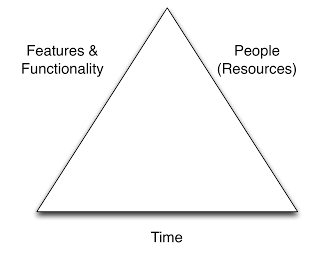
It is helpful to reference the “Iron Triangle” or “Triangle of Constraints” or “Project Constraints Triangle” – call it what you will, here it is again:

Many reader may have seen a slightly different version before. My version has neither cost or quality because I don’t believe these represent trade-offs:

  • Cost for a software development team are overwhelmingly wages, the more people you have, the longer you have them for the more money you spend. So Cost= People x Time. And people and time are both on this triangle so you can calculate cost, or vice versa.

So my preferred version looks like this:

Which leaves Features/Functionality/“the what” as the only place where we negotiate.

Which makes answering the original question very easy for BAs. Business Analysts have skills around exactly this question. There are a number of ways a BA can help: perhaps as a proxy customer, perhaps as a Tactical Product Owner, perhaps as a detail guy, or perhaps working with testers. Every team should have one (almost).

For project managers things are decidedly more complex. Much of their traditional work around “when” is redundant, since we are aiming for stable teams and sizing work to the time work around “who” is also gone. I can imagine, indeed I have seen, small teams dispense with project managers entirely. You can be successful without a project manager.

However for larger teams there is probably a role that needs filling. At a very basic level there is administration and reporting, there might be co-ordination tasks too, they might work with the BA/Product Owner around stakeholders, and when there is a client/supplier relationship both sides will probably want some managers “managing” the relationship.

But while there is management work to do I do not see a role for “projects.”

Successful software lives, it changes, if requires enhancements, adaptations. Only dead – unused – software doesn’t change. Developing a software product is like building a company: if people stop asking for things you are out of business.

Which conflicts with the PRINCE-2 definition of a project: “A temporary organization that is needed to produce a unique and predefined outcome or result at a pre-specified time using predetermined resources.”

Successful software does not have a pre-specified end date, indeed it can be incredibly hard to determine when many projects actually began!

Successful software isn’t temporary and the organizations which support/service it shouldn’t be. They may grown or shrink with time but we should aim for stability.

And since Agile embraces change the outcome isn’t pre-defined either. Indeed since all successful software changes in ways which are difficult for the originators to see there are only short term outcomes.

To me it is obvious that software development does not, and never really has, conformed to the project metaphor. Indeed I think using the project metaphor seriously damages software:
  • It leads to endless, pointless, discussions about “when will it be done”
  • It leads to governance processes that attempt to finish things which are not finished
  • It leads to short term thinking over things like quality
  • It leads companies to disband successful, performing teams – a condition I have termed Corporate Psychopahy.

BAU – business as usual – isn’t a dirty word, it is the normal. Supporting software, adding feature, fixing bugs, enhancing products is Business As Usual, we should be proud of that.

Then if we specifically look at Agile ways of working many of the traditional assumptions of project management are invalidated:
  • Teams are encouraged to self-manage: determine the details of the work to be done and decide how best to tackle it themselves
  • Agile teams are inclusive and non-hierarchical
  • Agile teams communicate peer-to-peer rather through some centralised communications hub (i.e. a manager)

In short Agile assume a “Theory Y” way of working not the “Theory X” which is implicit in too many project management texts.

And if you think I am radical then let me tell you I am a moderate, there are those who will go further. Look at my Scrum-Scrum-Scrum post last year and the discussion which followed, or watch Christin Gorman’s video “Adding a project manager to a Scrum team is like making cake with mayonnaise.”

The net upshot of all this is simple: Project Managers need to reinvent their role. And the reinvented role probably doesn’t include the word “project”.

For any software development team – especially one that wishes to be considered agile – the default choice is probably: no project manager. The onus is on the role holder to demonstrate how they add value to the team and to the wider organisation.

A role for project managers and business analysts in Agile? Read More »

Lego1.jpg

The real lessons of Lego (for software)

How many out there have hear this: “What we want is software which is like Lego, that way we can snap together the pieces we need to build whatever it is we want.”

Yes? Heard that?

Lets leave aside the fact that software is a damn sight more complex than small plastic bricks, lets leave aside too the fact that Lego makes a fine kids toy but on the whole we don’t use it to build anything we use at work (like a car, bridge or house), and lets pretend these people have a point….

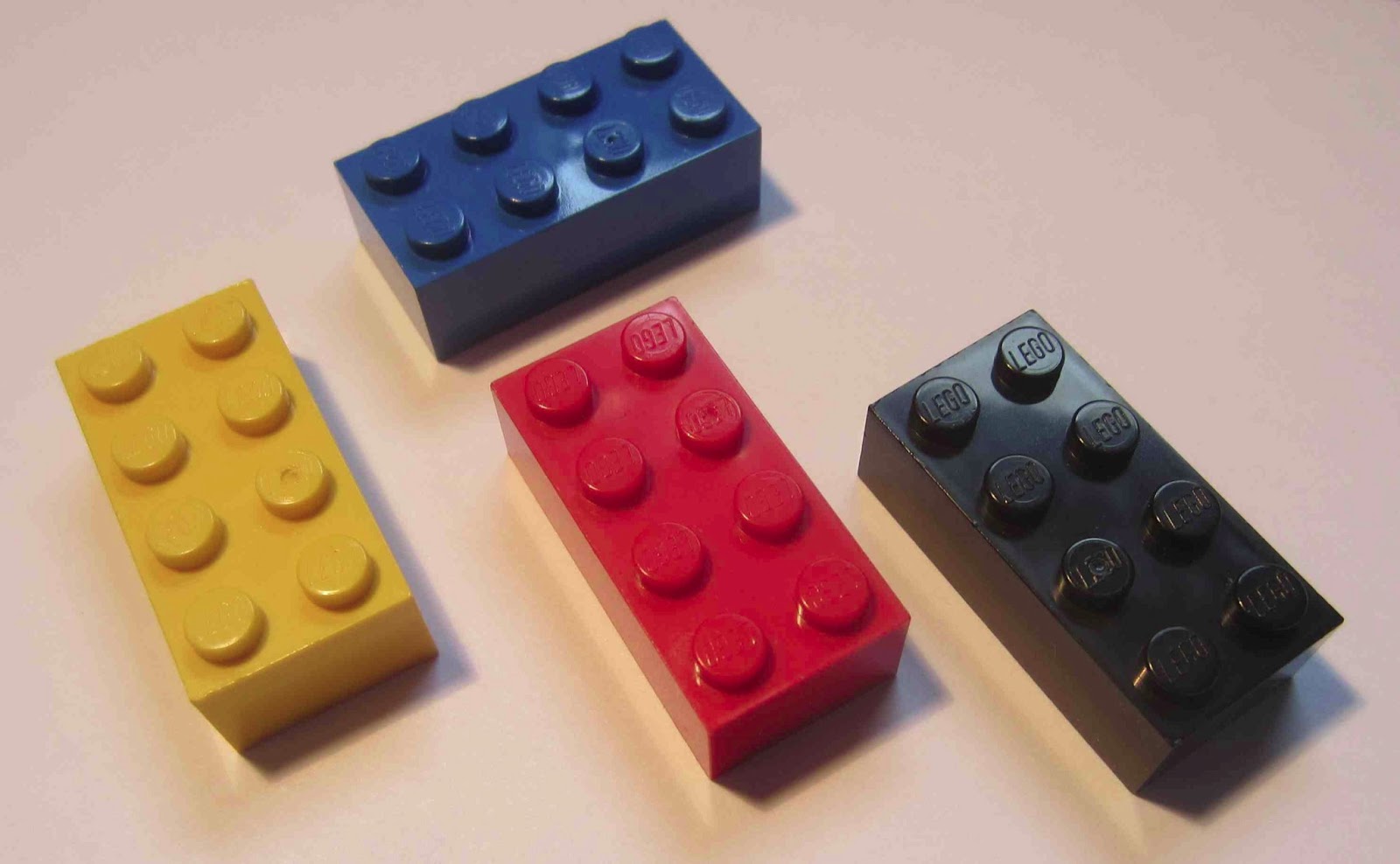
We start with the standard Lego brick:

Of course there are multiple colours:

And a few variations:

Which now allows us to snap together a useful wall:

Walls are good but to build anything more interesting we need some more pieces, maybe some flat pieces:

Or some thinner pieces, or some bigger pieces:

It might also help to have some angled pieces, you know for roofs and things, and remember the slant can go either way, up or down:

I think we’re heading for a house so we will need some doors and windows:

Personally I like wheels, I like things to move, and so do my kids. So we need some wheels – different size of course, and some means of attaching them to the other Lego blocks:

If we are building a car we need to be able to see out….

Umm… my imagination is running away, we need to steer, and how about a helicopter, and a ramp to load things onto the car/boat/plane/.…

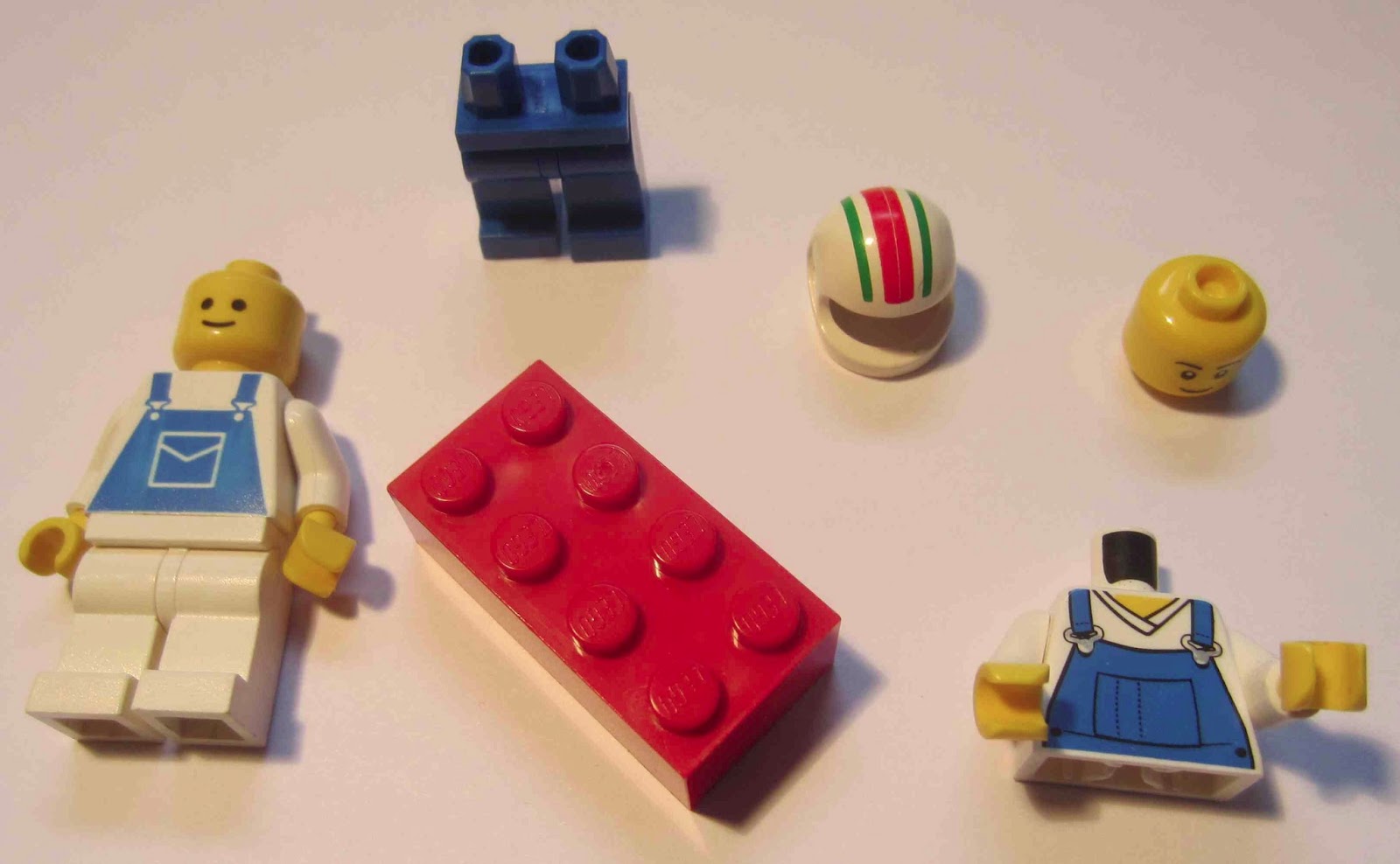
Still, something missing…. people!

Lego is not homogenous, when you say “Lego brick software” people are probably thinking of the first 2×8 block I showed. But to make anything really interesting you need lots of other bits. Some of those bits have very specific uses.

I’ve not even started on Lego Space/StarWars, Harry Potter Lego or what ever this years theme is. Things get really super interesting when you get to Technical Lego.

But there are some things that every Lego enthusiast knows:
  • You regularly feel the need for some special part which doesn’t exist
  • You never have enough of some parts
  • You always make compromises in your design to work with the parts you have

The components themselves are less important than the interface.  The interface stays consistent even as the blocks change.  And over the years the interface has changed, sure the 2×4 brick is the same but some interfaces (e.g. wheels with metal pieces) have been removed (or deprecated?) while others have been added.  There is an element of commonality but the interface has been allowed to evolve.

So the next time someone says: “We need software like Lego bricks” remind them of these points.

The real lessons of Lego (for software) Read More »

TestingTriangle.png

Testing triangles, pyramids and circles, and UAT

A few months ago Markus Gartner introduced me to the Testing Triangle, or Testing Pyramid. It looks like this:

If you Google you will find a few slightly different version and some go by the name of Testing Pyramid.

Now a question: where did this come from? Who should I credit with the original? Markus thinks it mike be Mike Cohn but he’s not sure.

This triangle is actually pretty similar to a diagram I’ve been drawing for a while when I do Agile training:

But it occurs to me the triangle should be pushed to the side, and when you do that you can add some axis which add more information:

At the base the, Unit Tests, there are lots and lots of tests and they typically execute in milliseconds. I typically hear people say there are between two and four times as much test code (for unit tests) as production code.

As you rise up there are fewer tests, tests take longer to execute and therefore tend to be run less often. Also as you rise up it becomes more difficult to automate the tests, you can automate but it requires more effort and more co-ordination. Therefore manual testing continues to exist.

True, manual testing can never be eliminated entirely for various reasons (e.g. exploratory testing) but you can get very high levels of automated acceptance or system tests.

Cost is proportional to time – and manual testing is an order of magnitude more expensive than automated tests over anything other than the very short run – and therefore as tests take longer to run costs go up.

Now a word on UAT or Beta testing.

As far as I am concerned User Acceptance Testing is the same as proper Beta Testing. Both mean: showing a potentially finished product to real life users and getting their response.

The difference is: UAT tends to happen in corporate environments where users work for the company and will need to use the software. Beta testing tends to happen in software vendor environments and it means showing the software, even giving it to, potential users outside the company.

Thus: UAT and Beta testing can only truly be performed by USERS (yes I am shouting). If you have professional testers performing it then it is in effect a form of System Testing.

This also means UAT/Beta cannot be automated because it is about getting real life users to user the software and get their feedback. If users delegate the task to a machine then it is some other form of testing.

And having users play with software means they are not doing their actual job so UAT is very expensive: expensive because it is manual and expensive because something else is not being done. Given this cost it is sensible to minimise UAT whenever possible.

In my experience most UAT phases (although not beta phases) are in effect an additional round of System Test and are frequently performed by Professional Testers. The fact that these professional testers are doing UAT is the give away. Professional Testers are not Users, they are Professional Testers.

(The other give away is that Professional Testers doing UAT are usually paid for by some group other than the IT department, i.e. IT test is not trusted, perhaps for good reason.)

More than once I have seen System Test / Acceptance Test cycles which are either completely absent or very poorly done. This necessities the need for a second round. Which is called UAT (possibly to hide the actual problem?)

I also see situations were Unit Test is poorly done or completely omitted.

If the low levels of this triangle are done well – and quality built in – then UAT should be reduced to a) real users, b) as near as possible a formality.

UAT is a very expensive way to find bugs, it also shows that something was missing in the development process. Either in coding or before that in understanding the users. It also, perhaps more worryingly, shows a failing in the earlier test steps.

Testing triangles, pyramids and circles, and UAT Read More »

Dialogue Sheets – update & new planning sheet

Last month InfoQ carried an update on the use of retrospective dialogue sheets. The use of these sheets continues to grow and I continue to receive good feedback.

If you’ve tried the sheets and haven’t sent me some feedback than please e-mail me and let me know about your experiences.

And for those of you who’ve not tried a dialogue sheet retrospective, whats stopping you? The Dialogue Sheet PDFs are free to download. For those who don’t have a large A1 Printer/Plotter there is a print on demand service for all the dialogue sheets.

I have also added a new sheet, this one is designed for Iteration Planning Meetings. I think one of the things teams new to Agile struggle with is the initial planing meetings. So I’ve created a new A1 sheet to guide teams through the planning meeting. This one has a bit more of a board game feel because there are activities to do and steps to repeat.

One thing I realised when creating this sheet is: planning meetings are not simple, and there are lots of variations in them. So I set about writing a Guide to Iteration Planning meetings. This turned out to be a little longer than I expected but this just goes to show what is involved. If you intend to use the sheet then I recommend you read the guide too.

Like the other sheets the planning sheet is free to download although I ask people to register – the guide is free without registration. Again, the printed version is available from the print on demand service too.

When I do training course I always give teams one or two retrospective dialogue sheets for them to use for their first retrospectives. I’m hoping that the planning sheet will fill a similar role at the start of the iteration.

I should say, I’m not completely sure this iteration planning sheet qualifies as a dialogue sheet in the strictest sense because it is much more guided and less about discussion. That said, I don’t think there are any hard and fast rules on what is, and what is not, a true dialogue sheet.

Dialogue Sheets – update & new planning sheet Read More »

Agile Clinic: Dear Allan, we have a little problem with Agile…

Consider this blog an Agile Clinic. On Friday an e-mail dropped into my mailbox asking if I could help. The sender has graciously agreed to let me share the mail and my advice with you, all anonymously of course…

The sender is new to the team, new to the company, they are developing a custom web app for a client, i.e. they are an ESP or consultancy.

“the Developers work in sprints, estimating tasks in JIRA as they go. Sprints last three weeks, including planning, development and testing. I have been tasked to produce burndowns to keep track of how the Dev cells are doing.”

OK, sprints and estimates are good. I’m no fan of Jira, or any other electronic tool but most team use one so nothing odd so far. But then:

“three week sprints”: these are usually a sign of a problem themselves.

I’ll rant about 3-week Sprints some other time but right now the main points are:

3 weeks are not a natural rhythm, there is no natural cycle I know of which takes 3 weeks; 1 week yes, 2 weeks yes, 4 weeks (a month) yes, but 3? No.

In my experience teams do 3 weeks because they don’t feel they are unto shorter iterations. But the point of short iterations is to make you good at working in short cycles so extending the period means you’ve ducked the first challenge.

“planning, development and testing” Good, but I immediately have two lines of enquiry to peruse. Planning should take an afternoon, if it needs to be called out as an activity I wonder if it is occupying a lot of time.

Second: testing should come before development, well, at least “test scripts”, and it should be automated so if it comes after development it is trivial.

Still, many teams are in this position so it might be nothing. Or again, it could be a sign the team are not challenging themselves.

Also, you are doing the turndowns but by the sounds of it you are not in the dev teams? And yo have Jira? I would expect that either Jira produces them automatically or each devl “cell” produces their own. Again, more investigation needed.

Continuing the story:

“The problem I’m encountering is this: we work to a fixed timetable, so it isn’t really Agile.”

No, Agile works best in fixed deadline environments. See Myth number 9 in my recent Agile Connection “12 Myths of Agile” – itself based on an earlier blog “11 Agile Myths and 2 Truths”.

“We have three weeks to deliver xyz and if it gets to the end of the sprint and it isn’t done, people work late or over the weekend to get it done.”

(Flashback: I worked on Railtrack privatisation in 1996/7, then too we worked weekends, death march.)

Right now the problem is becoming clear, or rather two problems.

Problem 1: It isn’t done until it is done and accepted by the next stage (testers, users, proxy users, etc.). If it isn’t done then carry it over. Don’t close it and raise bugs, just don’t close it.

Problem 2: The wrong solution is being applied when the problem is encountered, namely: Overtime.

As a one-off Overtime might fix the problem but it isn’t a long term fix. Only the symptoms of the problem are being fixed not the underlying problem which explains why it is reoccurring. (At least it sounds like the problem is reoccurring.)

Overtime, and specifically weekend working, are also a particularly nasty medicine to administer because it detracts from the teams ability to deliver next time. If you keep taking this medicine it you might stave off the decease but the medicine will kill you in the end.

The old “40 hour work week” or “sustainable pace” seems to be ignored here – but then to be fair, an awful lot of Scrum writing ignores these XP ideas.

Lines of enquiry here:

  • What is the definition of done?
  • Testing again: do the devs know the end conditions? Is it not done because it hasn’t finished dev or test?
  • What is the estimation process like? Sounds like too much is being taken into the sprint
  • Are the devs practicing automated test first unit testing? aka TDD
  • Who’s paying for the Overtime? What other side effects is it having?

“This means burndowns don’t make any sense, right? Because there’s no point tracking ‘time remaining’ when that is immaterial to the completion of the task.”

Absolutely Right.

In fact it is worse than that because: either you are including Overtime in your burn downs in which cases your sprints should be longer, or you are not, in which case you are ignoring evidence you have in hand.

The fact that burndowns are pointless is itself a sign of a problem.

Now we don’t know here: What type of burn-downs are these?

There are (at least) two types of burn downs:

  • Intra-sprint burn-down which track progress through a sprint and are often done in hours
  • Extra-sprint burn-down which tracks progress against goal over multiple sprints; you have a total amount of work to do and you burn a bit down each sprint.
I’ve never found much use for intra-sprint burn-downs, some people do. I simply look at the board and see how many cards are in done and how many in to-do.

And measuring progress by hours worked is simply flawed. (Some of my logic on this is in last years “Story points series” but I should blog more on it.)

Extra-sprint burn-downs on the other hand I find very useful because they show the overall state of work.

From what is said here it sounds like hours based intra-sprint burn-downs are in use. Either the data in them is bad or the message they are telling is being ignored. Perhaps both.

“I was hoping you might be able to suggest a better way to do it? I feel like we should be tracking project completion, instead, i.e. we have xyz to do, and we have only done x&y. My main question is: Is there a useful way to use estimates when working to a fixed deadline by which everything needs to be completed by?”

Well Yes and Yes.

But, the solution is more than just changing the burn-down charts and requires a lot of time – or words – to go into. I suspect your estimating process has problems so without fixing that you don’t have good data.

Fortunately I’ve just been writing about a big part of this: Planning meetings.

And I’ve just posted a Guide to Planning Meetings on the Software Strategy website. It is designed to accompany a new dialogue sheet style exercise. More details soon. I should say both the guide and sheet fall under my “Xanpan” approach but I expect they are close enough to XP and Scrum to work for most teams.

This quote also mentions deadlines again. I have another suspicion I should really delve into, another line of enquiry.

Could it be that the Product Owners are not sufficiently flexible in what they are asking for and are therefore setting the team up to fail each sprint? By fail I mean asking they to take on too much, which if the burn-downs and velocity measurements aren’t useful could well be the case?

We’re back to the Project Managers old friend “The Iron Triangle.”

Now as it happens I’ve written about this before. A while ago in my ACCU Overload piece “Triangle of Constraints” and again more recently (I’ve been busy of late) in Principles of Software Development (which is an work in progress but available for download.)

This is where the first mail ended, but I asked the sender a question or two and I got more information:

“let’s say the Scrum planners plan x hours work for the sprint. Those x hours have to be complete by the end – there’s no room for anything moving into later sprints.”

Yikes!

Scrum Planners? – I need to know more about that

Plan for hours – there is a big part of your problems.

No room to move work to later springs – erh… I need to find out more about this but my immediate interpretation is that someone has planned out future sprints rather rigidly. If this is the case you aren’t doing Agile, you aren’t doing Scrum, and we really need to talk.

I’m all for thinking about future work, I call them quarterly plans these days, but they need to be flexible. See Three Plans for Agile from a couple of years back(long version is better, short version was in RQNG.

“Inevitably (with critical bugs and change requests that [deemed] necessary to complete in this sprint (often)) the work increases during the sprint, too.”

Work will increase, new work will appear, and thats why you should keep the springs FLEXIBLE. You’ve shot yourself in the foot by the sounds of it. I could be wrong, I might be missing something here.

Right now:

  • Bugs: I’m worried about your technical practices, what is your test coverage? How are the developers at TDD? You shouldn’t be getting enough bugs to worry about
  • Change requests are cool is you are not working to a fixed amount of work and if you haven’t locked your sprints down in advance.
You can have flexibility (space for bugs and change requests) or predictability (forward scheduling) but you can’t have both. And I can prove that mathematically.

You can approach predictability with flexibility if you work statistically – something I expose in Xanpan – but you can only do this with good data. And I think we established before your data is shot through.

“This leads to people ‘crunching’ or working late/weekends at the end of the sprint to get it all done. It is my understanding that this isn’t how Agile is supposed to work.”

Yes. You have a problem.

So how should you fix this?

Well obviously the first thing to do is to hire me as your consultant, I have very reasonable rates! So go up your management chain until you find someone who sees you have a problem and would like it fixed, if they don’t have the money then carry on up the chain.

Then I will say, first at an individual level:

  • The intra-sprint sprint hours based burn-downs are meaningless. Replace them with an extra-sprint charts count your delivery units, e.g. User Stories, Use Cases, Cukes, Functional spec items, what ever the unit of work is you give to developers and get paid to deliver; count them and burn the completed units each sprint
  • Track bugs which escape the sprint; this should be zero but in most cases is higher, if its in double figures you have series problems. The more bugs you have the longer your schedule will be and the higher your costs will be.
  • See if you can switch to a cumulative flow diagram charting to show: work delivered (bottom), work done (developed) but not delivered, work to do (and how it is increasing change requests), bugs to do
  • Alternatively produce a layered burn-down chart (total work to do on the bottom), new work (change requests) and outstanding bugs (top)
  • Track the overtime, find who is paying for this, they have pain, find out what the problem is they see
None of these charts is going to fix your problems but they should give you something more meaningful to track than what you have now.

Really you need to fix the project. For this I suspect you need:

  • Overhaul the planning process, my guess is your estimation system is not fit for purpose and using dice would be more accurate right now
  • Reduce sprints to 1 week, with a 4 weekly release
  • Push Jira to one side an start working with a physical board (none was mentioned so I assume there is none.)
  • Ban overtime
We should also look at your technical practices and testing regime.

These are educated-guesses based on the information I have, I’d like to have more but I’d really need to see it.

OK, that was fun, thats why I’ve done it at the weekend!

Anyone else got a question?

Agile Clinic: Dear Allan, we have a little problem with Agile… Read More »