Agile

To estimate or not to estimate, that is the question

Disparaging those who provide software estimates seems to be a growing sport. At conferences, in blogs and the twitter-verse it seems open season for anyone who dares to suggest a software team should estimate. And heaven help anyone who says that an estimate might be accurate!

Denigrating estimation seems to be the new testosterone charged must-have badge for any Agile trainer or coach. (I’ve given up on the term Agile Coach and call myself and Agile Consultant these days!)

Some those who believe in estimation are hitting back. But perhaps more surprisingly I’ve heard people who I normally associate with the Scrum-Planning Poker-Burndown school of estimation decry estimation and join in the race to no-estimation land.

This is all very very sad and misses the real questions:

  • When is it useful to estimate? And when is it a waste of time and effort?
  • In what circumstances are estimates accurate? And how can we bring those circumstances about?
These are the questions we should be asking. This is what we should be debating. Rather than lobbing pot-shots at one another the community should be asking: “How can we produce meaningful estimates?”

In the early days of my programming career I was a paid up member of the “it will be ready when its ready” school of development. I still strongly believe that but I also now believe there are ways of controlling “it” (to make it smaller/shorter) and there are times when you can accurately estimate how long it will take.

David Anderson and Kanban may have fired the opening shots in the Estimation Wars but it was Vasco Duarte who went nuclear with his “Story Points considered harmful” post. I responded at the time to that post with five posts of my own (Story points considered harmful? – Journey’s start, Duarte’s arguments, Story points An example, Breakdown and Conclusions and Hypothesis) and there is more in my Notes on Estimation and Retrospective Estimation essay and Human’s Can’t Estimate blog post – so I’ve not been exactly silent on this subject myself.

Today I believe there are circumstances where it is possible to produce accurate estimates which will not cost ridiculous amounts of time and money to make. One of my clients in the Cornish Software Mines commented “These aren’t estimates, that is Mystic Meg stuff, I can bring a project in to the day.”

I also believe that for many, perhaps most, organisations, these conditions don’t hold and estimation is little more than a placebo used to placate some manager somewhere.

So what are these circumstances? What follows is a list of conditions I think help teams make good estimates. This is not an exhaustive list, I’ve probably missed some, and it may be possible to obtain accuracy with some conditions absent. Still, here goes….

  • The team contains more than at least two dedicated people
  • Stable team: teams which add and loose members regularly will not be able to produce repeatable results and will not be able to estimate accurately. (And there is an absence of Corporate Psychopathy.)
  • Stable technology and code base: even when the team is stable if you ask them to tackle different technologies and code bases on a regular bases their estimates will loose accuracy
  • Track record of working together and measuring progress, i.e. velocity: accuracy can only be obtained over the medium to long run by benchmarking the team against their own results
  • Track the estimates, work the numbers and learn lessons. Both high level “Ball Park” and detailed estimates need to be tracked and analysed for lessons. Then, and only then, can delivery dates be forecast
  • All work is tracked: if they team have to undertake work on another project it is estimated (possibly retrospectively) in much the same manor as the main stream of work and fed into the forecasts
  • Own currency: each team is different and needs to be scored in its own currency which is valued by what they have done before. i.e. measure teams in Abstract Points, Story Points, Nebulous Units of Time, or some other currency unit; this unit measures effort, the value of the unit is determined by past performance. In Economists’ lingo this is a Fiat Currency
  • Own estimates: the team own the estimates and can change them if need be, others outside the team cannot
  • Team estimates: the team who will do the work collectively estimate the work. Beware influencers: in making estimates the teams needs to avoid anchoring, take a “Wisdom of crowds” approach – take multiple independent estimates and treat experts and anyone in authority like anyone else.
  • (Planning Poker is a pretty good way of addressing some of these points, I still teach planning poker although there may be better ways out there)
  • Beware The Planning Fallacy – some of the points above are intended to help offset this
  • Beware Goodhart’s Law, avoid targeting: if the estimates (points) in anyway become targets you will devalue your own currently, when this happens you will see inflation and accuracy will be lost
  • Don’t sign contracts based on points, this violates Goodhart’s Law
  • Overtime is not practiced; if it is then it is stable and paid for
  • Traditional time tracking systems are ignored for forecasting and estimating purposes
  • Quality: teams pay attention to quality and stove to improve it. (Quality here equates to rework.)
  • The team aim for overall accuracy in estimates not individual estimates; for any given single piece of work “approximately right is better than precisely wrong”
  • Dependencies & vertical teams: Teams are not significantly dependent on other groups or teams; they posses the skills and authority to do the majority of the work they need to
  • The team are able to flex the “what” the thing they are building through negotiations and discussions. (Deadlines can be fixed, teams members should be fixed, “the what” should be flexible.)
  • The team work to a series of intermediate deadlines
  • It helps if the team are co-located and use a common visual tracking system, e.g. a white board with cards
  • Caveat: even if all the above I wouldn’t guarantee any forecasts beyond the next 3 months; too much of the above relies on stability and beyond 3 months, certainly beyond 6, that can’t be guaranteed
My guess – and it is only a guess – is that when these conditions don’t hold you will get the random results that Duarte described. Sure you might be able to get predictable results with a subset of these factors but I’m not sure which subset.

The more of these factors are absent the more likely your velocity figures will be random and estimates and forecast waste. When that happens you almost certainly are better off dumping estimation – at best it is a placebo.

Looking at this list now I can see how some would say: “There are too many conditions here to be realistic, we can’t do it.” For some teams I’d have to agree with you. Still I think many of these forces can be addressed, I know at least one team that can do this. For others the prognosis is poor, for these companies estimation is worse than waste because the forecasts it produces mislead. You need to look for other solutions – either to other estimation techniques or to managing without.

I’d like to think we can draw the estimation war to an end and focus on the real question: How do we produce meaningful estimates and when is it worth doing so?

To estimate or not to estimate, that is the question Read More »
Requirements and Specifications

As I was saying in my last blog, I’m preparing for a talk at Skills Matter entitled: “Business Analyst, Product Manager, Product Owner, Spy!” which I should just have entitled it “Requirements: Whose job are they anyway?” and so I’ve been giving a lot of thought to requirements.

I finished the last blog entry noting that I was concerned the way I saw Behaviour Driven Development (BDD) going and I worried that was becoming a land-grab by developers on the “need side” of development. (Bear with me, I’ll come back to this point at the end.)

Something I didn’t mention in the last blog was that I thought: if I’m doing a talk about “need” I’d better clearly define Requirements from Specifications. So I turned to my bookshelves….

The first book I picked up was Mike Cohn’s User Stories Applied, the nearest thing the Agile-set has to a definitive text on requirements. I turned to the index and…. nothing. There is no mention of Specifications or of Requirements. The nearest he comes is a reference to “Requirements Engineering” efforts. Arh.

Next up Alistair Cockburn’s Writing Effective Use Case, the shortest and best reference I know to Use Cases. No mention of Specifications here either, although there are some mentions of Requirements there isn’t a definition of what Requirements are.

So now I turned to a standard textbook on requirements: Discovering Requirements: How to Specify Products and Services by Alexander and Beus-Dukis. A good start, the words Requirements and Specify are in the title. Specifications gets a mention on page 393, thats it. And even there there isn’t much to say. True Requirements runs throughout the book but doesn’t help me compare and contrast.

Now I have a lot of respect for Gojko Adzic so I picked up his Specification by Example with great hope. This has Specifications running through it like the words in seaside-rock, and there are half a dozen mentions of requirements in the index. But….

When Gojko does talk about Requirements he doesn’t clear differentiate between Requirements and Specifications. This seems sloppy to me, unusual to Gojko, but actually I think there is an important point here.

In everyday, colloquial, usage the words Requirements and Specifications are pretty interchangeable. In general teams, and Developers in particular, don’t differentiate. There are usually one or the other, or neither, and they are both about “what the software should do.” On the occasions were there are both they are overkill and form voluminous documentation (and neither gets read.)

The fact that so many prominent books duck the question of requirements and specification makes me think this is a fairly common issue. (It also makes me feel less guilty about any fuzziness in my own mind.)

To solve the issue I turned to Tom Gilb’s Competitive Engineering and true to form Tom helpfully provided definitions of both:

  • “A requirement is a stakeholder-desired, or needed, target or constraint” (page 418)
  • “A ‘specification’ communicated one or more system ideas and/or descriptions to an intended audience. A specification is usually a formal, written means for communicating information.” (page 400)
This is getting somewhere – thanks Tom. Requirements come from stakeholders, Specifications go to some audience. And the Specification is more formal.

Still its not quiet what I’m after and in the back of my mind I knew Michael Jackson had a take on this so I went in search of his writing.

Deriving Specifications from Requirements: An Example (Jackson & Zave, ACM press 1995) opens with exactly what I was looking for:

  • “A requirement is a desired relationship among phenomena of the environment of a system, to be brought about by the hardware/software machine that will be constructed and installed in the environment.
  • A specification describes machine behaviour sufficient to achieve the requirement. A specification is a restricted kind of requirement: all the environment phenomena mentioned in a specification are shared with the machine; the phenomena constrained by the specification are controlled by the machine; and the specified constraints can be determined without reference to the future. Specifications are derived from requirements by reasoning about the environment, using properties that hold independently of the behaviour of the machine.”
There we have it, and it fits with Tom’s description. Lets me summarise:

  • A requirement is a thing the business wants the system to bring about
  • A specification a restricted, more exact, statement derived from the requirement. I think its safe to assume there can be multiple specifications flowing from one requirement.
From this I think we can make a number of statements in the Agile context:

  • Agile work efforts should see requirements as goals
  • A User Story, or plain Story, may be a Requirement itself, or it might be Requirement or Specification which follows from an previous Requirement.
  • At the start of a development iteration the requirement should be clear but the specification may be worked out during the iteration by developers, testers, analysts or others.
  • Over analysis and refinement to specifications will restrict the teams ability to make trade-offs and will also prove expense as requirements change during the development effort.
  • Therefore while requirements should be know at least before the start of the iteration specifications should only be finalised during the iteration.
In discussing this on Twitter David Edwards suggested the example of a business requirement to provide a login screen. Presumably the business requirement would be something like “All users should be validated (by means of a login system).” From this would flow the need to be able to create a user, delete a user, administer a user, etc. etc. These could be thought of as requirements themselves or as specifications. Certainly what would be a specification would be something like “Ensure all passwords contain at least 8 characters and 1 numeric.”

Which bring us back to BDD.

Having worked through this I conclude that BDD is an excellent specification tool. After all BDD is an implementation of Specification by Example.

And while fleshing out specifications may lead to the discovery of new requirements, or the reconsideration of existing requirements, BDD is not primarily a requirements mechanism and probably shouldn’t be used as one.

Requirements need to be established by some other mechanism, deriving specifications from those requirements may well be done using BDD or another SbE technique.

Now, while BDD and SbE may well give Developers first class specification tools these tools should not be mistaken for requirements tools and shouldn’t be used as such.

Pheww, does that all make sense?

I need to ponder on this, I suspect there is a rich seem of insight in being clear about specifications and requirements.

Requirements and Specifications Read More »

Requirements whose job are they anyway?

Later this week I’m giving a talk at Skills Matter entitled: “Business Analyst, Product Manager, Product Owner, Spy!” The talk title is a reference to the John Le Carre book “Tinker Tailor Solider Spy!”, its probably too clever by half and I should just have entitled it “Requirements: Whose job are they anyway?”

The talk idea was born out of what I see as confusion and land-grabbing in the requirements space, or as I prefer to think of it “the need side” i.e. the side of development which tries to understand what is needed.

I think there are a number of problems on this side of the business…

First all too often this side is neglected, companies believe that Developers will somehow comprehend what is needed from a simple statement. In the worst cases this is a condition I refer to as: “Requirements by Project Title”. Just because Developers understand the technology does’t mean they understand what is needed.

Unfortunately Agile tends to make this problem worse because a) developers think they get to decide what is needed, b) business see Agile as a cure all.

The second problem is the exact opposite of the first: Developer exclusion from requirements. In this case a Requirements Engineering type is the one who is tasked with understanding need, probably producing excessive documentation, and probably giving it to developers who are then expected to create something. In the extreme this means developers never get to meet, talk to or understand the people and businesses that will be using the product.

However, it was another problem that was on my mind more when I thought up the talk: the confusion of roles between Business Analysts and Product Managers, made worse by the appearance of the Scrum Product Owner title.

In the UK it seems to me that too many companies think requirements are done by Business Analysts. This is often the case when development groups are developing software for the company’s own use or by a specific client. But when the product is being Developers for multiple external customers, when it will be sold as a product then requirements are the job of a Product Manager. I’ve written about this role before, several times so I won’t repeat myself right now – see Inbound & Outbound marketing or Product Management in the UK.

Part of the problem is that in the UK – I can’t really talk for other countries but I think most of Europe is the same – software companies appoint Business Analysts to do what us essentially a Product Manager role. I base this statement partly on the fact that when I deliver my Agile for Business Analysts course (at Skills Matter later this week and another version then later this month at Developer Focus) I find people on the course who I would regard as Product Managers but they – and their employees often have never heard of the Product Manager role.

Finally, I’ve also become concerned in recent months the Behaviour Driven Development is being used by Developers in an attempt to occupy the requirements space – a land grab!

On the one hand this needn’t be a problem, if BDD allows Developers to better understand the problem they are trying to solve then I would expect development to go smoother.

On the other hand there are three reasons why I’m concerned about this trend:

The “need side” is a fussy, messy, ambiguous area and I sometimes wonder if the rational engineering mindset is right tool here.

  • I wonder if Developers really have the skills to understand the need side. Undoubtedly some do but I’m far from convinced they all do. Indeed those who do might be better off moving entirely from development into the BA or Product Manager role.
  • Time: perhaps is the main concern
I have long believed that to really understand the need side, and to get to the bottom of what is needed requires time. If Developers are trying to tackle the need side while still coding then I question whether they have the time to do both. If they do not then I believe that opinion and assumptions will substitute from fact finding and requirements validation.

(I should say that on a small work effort, with a suitable Developer(s), having one person do the needs assessment and coding can be ideal.)

I’ve only really stated the problem here not the solution. I’m still working all this out in my own head, Wednesday’s talk should move the discussion forward and I’ve already started to sketch another blog entry on this subject – coming up soon “Requirements & Specifications.”

Requirements whose job are they anyway? Read More »

People or the system?

“the two view-points are always tenable. The one, how can you improve human nature until you have changed the system? The other, what is the use of changing the system before you have improved human nature?”

George Orwell, “Charles Dickens” essay in Shooting and Elephant and Other Essays, Penguin Books

I am sure I am not alone in exhibiting another of Orwellian trait: Double think.

For several years I have been guilty of agreeing with two contradictory points of view:

  • The Deming idea that the system governs how people will perform and act
  • That no matter what system (e.g. Scrum, XP, Prince2, DSDM, etc.) you use to develop software the motivation and quality of the people is the overriding factor
It wasn’t until John Harvey tweeted about the latter recently that I realised In was double thinking, my positions were not compatible with one another.

I should have noticed the cognitive dissonance sooner. I’ve been known to say, and still believe: “The true test of any software development method (e.g. Kanban, Scrum, etc. etc.) is whether it can help mediocre people perform, i.e. deliver, be more productive”

In that one statement I epitomise the contradiction. I’m hoping that writing this blog will allow me to resolve this!

This isn’t an academic problem: depending on which side of the argument you come down on will determine how you go about improving things. It also explains why some people in the Agile moment emphasis: trust, communication and other inter-personal issues while others emphasis a method, technical practices, etc.

I’m thinking of my experiences:

  • I have worked in environments where the system defeated the people: Railtrack privitisation, Sema had an ISO-9000 waterfall process and 120 people. Of course in 120 people some were good and some not so good.
  • I have worked in places where (good) people have overcome the system: two years after leaving Railtrack I returned, a much smaller team were in maintenance mode. The same process was in place but we circumvented it, we faked the documentation and so on.
  • And I have worked places where everyone was treading water and complying enough with the system
I have seen different things happen within the same organisation, even within what the company regarded as “one team.” I saw Reuters destroy its own processes in an effort to impose a CMMI level 2 (going to 3) process. (Managers were a bit like the American General in Vietnam who supposedly said “we have to destroy this village to save it”. Like the American’s Reuters ultimately lost.)

I have worked places were the concept of “system” would have been laughed it, things might be more accurately characterised as “Chaos.” But even in this chaos there was a system of sorts.

At Dodge Group it was hard to define any system or process, but there was somewhere a process. The company was trying to sell, sell, sell so they could IPO and the software team just had to keep up as best they could.

The good people at Dodge won out for a while. I instigated a simple process we could now recognise as a form of Agile but ultimately the company, the system, killed the success. Partly by hiring bad people, partly by not recognising the good people and partly by letting the system run its course.

In my “Agile will never work in investment banks” posting a while back I made a similar point: Good people in banks can install a good process which can deliver. But in time the bank – the systems, culture and contradictions – will kill the system and dispose of the good people.

Then there is the question of whether “good people” are themselves the result of the system. Can you pick up a “good person” from company A, put them into company B and let them do their good stuff?

An article in the MIT Sloan Management Review a few years back suggested that when “star players” move to a new team they don’t necessarily, or even normally, keep their “star player” performance. (When ‘Stars’ Migrate, Do They Still Perform Like Stars?, Fall 2008 issue.)

So where does all this lead us?

I think there is truth in both the System-first and People-first point of views. Things are not so black-and-white. Sometimes the System-first view is right and sometimes the People-first is right. There are forces at work in different contexts.

Some of these forces are:

1) The strength of the system: the stronger the system the more likely it is to win out.

The strength of the system derives form multiple sources including: the effectiveness of the system, the degree to which it is enforced and the degree to which people see their interests being served by the system.

Reuters CMMI initiative also put a lot of effort into policing. At Dodge the system was weak day-to-day, developers got on with it and they made good stuff.

At Sema Railtrack (first time) a lot of effort was put into policing the system, the system delivered ISO-9000 which helped the company win contracts. As a programmer woking in the system it didn’t seem particularly effective but I guess it was effective at generating money.

2) The System affects the Good People

At Reuters the system encouraged people to leave, I was one. At Dodge the system eventually recruited the wrong people, forced others out and wore down the good people who submitted.

3) Good people can make an poor system work

Primarily through ignoring it, compensating or changing it. Which leads to…

4) Good people can change the system

I’ve seen it happen. In fact you need at least one good person to cause they system to change or it will not.

Again a strong system is harder to change.

5) How “good” are the people?

Yes “good people” can do things change thing but how “good” do you need to be? Is it real a question of having super-stars? Most people aren’t super-stars. Surely we should be more concerned with the mediocre.

And before anyone rushes to say “Good developers are 10 times (or 28 times) better than average” please read Laurent Bossavit book “Leprechauns of Software Development” where he shows the evidence for this claim doesn’t hold up.

I guess these conclusions are going in the Deming direction.

Yet good people can make a bad system work; but if they do not succeed in actually changing the system it will eventually impose itself.

Can I suggest it comes down to a question of time scales: In the short-run good people can overcome a poor system, but in the long-run, unless they change the system for something better the system will overwhelm them.

And the mediocre people? – How about we say this:

Over the short-run, the better your people are the more likely they will overcome a poorer system, but in the long-run the hard it will be for people to sustain the effort if they do not change the system.

A good system will help everyone work the best. It will allow star-performers to shine and mediocre people to contribute and feel good, I’d even like to think a good system will improve the mediocre people.

People or the system? Read More »

Conway's Law v. Software Architecture

I’ve written about Conway’s Law before (Return to Conway’s Law (2006) and a Focus Group I ran at EuroPLoP “What do we think of Conway’s Law Now?”)

but I make no apologies for revisiting it again because I still think it hold true.

There are times when I wonder if there is any point to the discipline called “Software Architecture.” Sure design can make a difference in the small but when it comes to the big then, for my money, Conway’s Law is a far more powerful force than the plans, designs and mandates of an enterprise architect.

Conway’s Law predates Agile and Waterfall but it applies to both:

“Any organization that designs a system (defined more broadly here than just information systems) will inevitably produce a design whose structure is a copy of the organization’s communication structure.” Conway, 1968

The original paper “How do committees invent?” is available from Conway’s own website. The original publication was in Datamation, April 1968.

While Conway’s Law can be seen at the macro level, the company level, it is also observed in in the small, at the micro level. The law if often restated in the small as:

“If you have four developers writing a compiler you will get a four pass compiler”

Or

“If you have three developers writing a UI you will get three ways of doing everything (mouse click, menu item, short-cut key)”

For example, if a development team is set up with a SQL database specialist, a JavaScript/CSS developer and a C# developer you they will produce a system with three tiers: a database with stored procedures, a business middle tier and a UI tier. This design will be applied whether it is the best or not. Indeed, the system might not even need a relational database or a graphical interface – a flat file might be quite adequate for data storage and a command line interface perfectly acceptable.

It is a little like a children’s cartoon where the superheroes need to rescue somebody: Superman says “I can use my super strength to lift the ice boulders out of the way”, while Fireman says “I can use my fire breath to melt the ice” and Drillerman says “I use my drill hands to make a rescue tunnel”. Once added to the picture each specialist finds a way to utilise his or her special powers. For a software team this can lead to poor architecture, over complicated designs and competing modules.

In setting up a team architectural decisions are being made even if no architecture diagrams are being drawn. Just deciding to staff the team with four developers rather than three will influence the architecture because work now needs to be found for the fourth team member.

These decisions are made at the time when the least information is known – right at the beginning. They may made by planners – project managers – who have little knowledge of the technologies or by people who will not actually be involved in the development effort, e.g. enterprise architects.

To avoid this my advice is to start a team as small as possible. Try to avoid making architectural decisions in staffing the team by understaffing it. Keeping the team hungry will reduce the possibility of building more than is needed or over architecting it.

There are those who would quickly point out the risk of under architecting a system, not looking to the future and not building a system that can change and grow. But the risks of over architecting are if anything worse. Too much architecture can equally prevent a system changing and growing, and too much architecture leads to more time consuming and expensive code to cut. Then there is the risk of not shipping at all, too long spent producing the “right” design may result in a system too late to be viable.

Second staff the team with people who are more generalist than specialist, people who have more than one skill. Yes have a Java developer on the team but have one who knows a bit of SQL and isn’t scared of a little UI work. In time you might need to add database and UI specialists but delay this until it is clear they are needed.

These suggestions echo Conway’s own conclusion at the end of his paper:

“Ways must be found to reward design managers for keeping their organizations lean and flexible. There is need for a philosophy of system design management which is not based on the assumption that adding manpower simply adds to productivity.”

It is worth remembering that Conway was writing over 20 years before Womack and Jones coined the term Lean to describe Toyota.

Reverse Conway’s Law & Homomorphic force

Since Conway wrote this a lot more systems have been developed. Many of these systems are now referred to as “Legacy Systems.” In some cases these systems force certain structure on the team who maintain the systems and even on the wider company.

For example, take the 3-tier database, business, GUI system from above. Years go by, the original developers leave the company and new staff are brought in. Perhaps some of these have been and gone in the years. The net effect is a system so complex in all three tiers that each requires a specialist. The database is so rich in stored procedures, triggers and constraints that only a SQL expert can understand it. The GUI is crammed full of JavaScript, CSS and not HTML 5 that only someone dedicated to interfaces can keep it all working. And the middle tier isn’t any different either.

Given this situation the company has no option but to staff the team with three experts. Conway’s Law is now working in reverse: the system is imposing structure on the organization.

Again this happens not just at the micro-level but at the macro-level. Entire companies are constrained by the systems they have. Economists might call this path-dependency: you are where you are because of how you got here not because of any current, rational, forces.

Underlying both Conway’s Law and Reverse Conway’s Law is the Homomorphism, or as I prefer to think of it: The Homorphic Force.

This force acts to preserve the structure of system even as the system itself moves from one technology to another, from one platform to another.

Both forms of Conway’s Law and the Homomorphic Force pose a dilemma for any organization. Should they work with the force or try to break it?

I can’t answer this question generically, there is too much context to consider. However I tend towards saying: Work with Conway’s Law, not against it – like woodworking, work with the grain not across it. Be aware of Conway’s Law and Learn to play it to your advantage.

Conway’s Law does contain a get out clause: the system that will be created will be a copy of an existing system, if you can create a new system, a system not pre-loaded with assumptions and well-trodden communication paths then maybe you can create something new and of a better design.

Thus I sometimes view myself as an architect. Now I don’t think I’d accept membership of the Architects-Club even if it was offered, and probably my software design skills are not up to the job but it doesn’t stop me dreaming.

But I architect by (trying) to bring about a good organizational architecture which will in turn bring about a better system architecture via Conway’s Law.

Conway's Law v. Software Architecture Read More »

11 Agile Myths and 2 Truths

I deliver a lot of Agile training courses and I give a lot of talks about Agile (BCS Bristol tonight). There are some questions that come up again and again which are the result of myths people have come to believe about Agile. Consequently I spend my time debunking these myths again and again.

I’ve been keeping a little list and there are 11 reoccurring myths. There are also two truths which are a bit more difficult for teams and companies to accept.

Agile Myths

  1. Agile is new: No, the Agile manifesto was published in 2001, the Scrum Pattern language was works hoped at PLoP 1998, the Episodes pattern language (the forerunner of XP) was workshopped at PLoP 1995, Tom Gilb’s Evo method dates back to 1976 and there are some who trace things back further.
  2. Agile means No Documentation: You can have as much documentation as you like in Agile. Documentation is just another deliverable, if it brings you value then schedule it and product it like anything else. Please be aware: documentation is often unread, often fails to communicate, is used as a defensive tool and is typically the second most expensive think on a large software project (after rework).
  3. Agile means No Design: No, Agile probably means MORE DESIGN. Design is inherent all the way through development, at every planning meeting and more. Agile does mean the end to big-up-front design which is invalidated five minutes after someone starts coding.
  4. Agile means No Planning: No, again, Agile probably has more planning. Again planning is spread out through the whole development exercise rather than at the front and it is the work of everybody rather than one or two anointed individuals.
  5. Developers get to do what they like: No, if this is true for you then you are doing it wrong, please call me. Agile needs more discipline from the team and what gets done should be lead from a specific role usually designated the Customer or Product Owner and usually played by a Product Manager or Business Analyst. If developers are doing what they like then there is a failure of in this role.
  6. There is a right size for a User Story: There is no right size for a user story. Every team is different, get over it.
  7. Work must fit in a Sprint: If you are doing Hard Core Scrum then Yes. If you are playing Agile the way I do (which I now call Xanpan) then No. In fact I advise letting stories span sprints in order to improve flow. You can have stories spanning sprints but we won’t let them continue for ever and we will try and break them down into smaller pieces of work.
  8. Scrum and Kanban are sworn enemies: No but the marketing efforts behind each they can get a lot of eyeballs by playing it that way. Xanpan is a Kanban/XP hybrid, and XP isn’t that different to Scrum so there you go.
  9. Agile doesn’t work for fixed deadline projects: No, Agile works best in fixed deadline project environments.
  10. Agile doesn’t work on Brownfield projects: No, Agile works best in brownfield environments. Granted retrofitting automated unit tests is harder but it is far from insurmountable.
  11. Agile doesn’t work on Greenfield projects: No but your first objective is to get yourself to a steady state where you can think like a brownfield project.
To my mind the ideal project to start an Agile initiative with is a brownfield system with a fixed deadline in about 3 to 6 months where development has started but requirements are still unclear.

  1. Now two truths about Agile:
  1. Agile will not work for us because… (complete this sentence for yourself)
  2. Agile is a good idea but … we should wait until we have finished X, got Y to buy in, bought Z and the (new) Pope has given it his blessing
You can always talk yourself out of it or find a good reason for not doing it today.

11 Agile Myths and 2 Truths Read More »

Agile Advice for Aviva (and many other big companies)

I’m starting this blog entry on the train returning to London after speaking at Sync Conference in Norwich – and I’m finishing sitting in my local coffee shop on Tuesday. (My conference presentation Agile in 90 minutes is online (PDF) or via Slideshare.)

An awful lot of people at SyncConf worked for Aviva and during the day I spoke to many of them. Aviva are trying to be “Agile” but like every other big company are struggling.

Personally I’m pessimistic about their chances. Someone asked me if I could name a big company which had made the Agile change and I struggled. Yes, many big companies are trying Agile, and yes there are many successful teams in these companies. But has an entire company made the entire change? I don’t know of any.

All the banks are trying it, and all are failing in similar ways (see Reverse-Tolstoy and Why Agile will Never work in Investment Banking). Many other big corporations are trying and most of what I here is not positive.

During the day I did build up a picture of much that is happening inside Aviva and I did give some advice in conversations. Now I’ve thought about it there is some more, bullet points below.

(I can say this because Aviva are not my client – OK, I did do a little work with them years about but it was insignificant. If Aviva were my client I wouldn’t be writing this blog, I don’t speak openly like this about clients. I try to avoid talking about active clients at all in this blog. Nor am I in the habit of giving unsolicited free advice to clients.)

Advice for Top

  • There are no Silver Bullets: Conway’s Law, Reverse-Conway’s Law, Brooks Law, Goodhart’s Law and dis-economies of scale constrain what can be done.
  • Take Software Craftsmanship seriously: Start and apprenticeship programme – speak to Jason Gorman about how the BBC do it
  • Let a thousand flowers bloom: dump any attempts at standardised working and let people experiment, let them have fun as they learn and change. In a few years time when you’ve made lots of progress start to mine out your own “Good practices” and sharing them amount teams.
  • (That also means be prepared to work with multiple difference consultants, coaches and advisors. Accept they will give you different advice. Yes engage with some big players but also work with the small players.)
  • Embrace dis-economies of scale – you don’t have time to be involved with the details so delegate
  • Get with Quality: the Quanlity v. Time trade-off is the reverse of what you think; higher quality (i.e. reduced bug count) makes for shorter scheduled, shorter schedules makes for lower costs, together this make for happier customers and more responsive business
  • Get clear about what you want: if it is cutting costs say so, you can use some of the Agile toolkit for this but don’t expect to use it all or achieve Agility. There is nothing wrong with not being Agile if you have a better alternative.
  • Pay the SyncConf Norwich team to re-run the conference again (with a few tweaks) inside the company. (You’ll have to pay the speakers but this will be a drop in your ocean of your IT budget.)
  • Go further and let give employees attending seed money, let them spend it to sign up for courses and bring in some of the consultants they liked into the company. Yes this is radical, no apologies.
  • If you want to be Agile then accept that it won’t be the lowest costs, it should result in the greatest value overall so focus on value not costs
  • Your business and IT operations need to be more joined up. Maybe you want to dismantle your IT group, at least embed it in the business.
  • Your annual planning cycle needs to relax, you need to learn to start small pieces of work without having every T crossed an i dotted.
  • In the long run you want to look to Beyond Budgetting.
  • Don’t worry about your CMMI or ISO or whatever accreditation, my clients have FDA and ISO-13485 approval, if they can do it so can you.
  • In the meantime give up on strategic planning: that idea died in the paddy fields of Vietnam thanks to Robert MacNamara. Go read Henry Mintzberg “Rise and Fall of Strategic Planning”.
Advice for the Middle

  • Visualise, visualise, visualise: boards, graphs, everything!
  • You have to lead the top, they don’t know how to spell TDD so educate them
  • Involve “the business”, their representatives in everything
  • Get with the Quality Agenda: ditto the above, embrace and push quality to eliminate bugs. Give your team support, send them on training, hire consultants to come and coach, buy them books.
  • Architects must also code
  • Celebrate every little success; make sure the whole company knows about a realise
  • Spend on travel: Indian outsourcing doesn’t work because you paid TCS, you actually have to go there and see, they have to come here and see, you need to talk, talk, talk. Skype, VOIP, everything
  • Don’t spend money on expensive test tools
  • Manage teams as a whole: not a Test Team and a Test Manager there, and a Dev Team and a Dev Manager there, and a BA…. the whole team wins or looses together.
  • There is no long term future for Test Managers, you options are: a) focus on Test and work to improve the Testing Process, specifically Automation; b) focus on management and manage the whole development team; c) disentangle Test from Quality and become get Quality throughout the process
  • Form self-support book study groups: spend an hour, meet for lunch every other week, agree a book, agree a chapter in advance, someone volunteer to summarise it. Open each meeting by going once around the table and having someone say something positive (“Tell me something that made you smile today?” “Tell me something you learned this week?”).
  • Good luck: you have the hardest task, and its lonely. Some of you will need to lay down your jobs to make this happen
Advice for the Workers

  • You control the means of product, Agile is in your hands, Make it So. Your greatest weapon is Quality, you have the power to improve it today.
  • Embrace Test Driven Development, Refactoring (i.e. emergent design.) Dump big-up-front design, get coding on day-1 and work out the design later.
  • You have to lead the middle and they will lead the top. Neither of these two groups knows as much about your work as you do. Lead by showing them what works. Which means…
  • You have to do it, make those improvements. Developers start learning TDD, spend your own money if you need to. Testers: download the open source test automation tools and enrol developers to help you get them working.
  • Testers: Automation, Automation, Automation – get with the Open Source tools – Selenium, FIT/Fitnesse, Cucumber, etc. etc.
  • Form your own study groups
  • Make sure retrospectives happen and action items are actioned
Most of this advice is applicable to any large company. I really don’t know that much about the inside of your company, I’m assuming. Nor is this list really that different from the one I published on InfoQ last year – 10 things for making your Agile adoption successful.

Finally, Aviva, you don’t have to take any of my advice but a) I guess your paid advisors are saying similar things and b) if you don’t change new competitors will kill you; you are big so it will take time but it is never nice to watch a big animal in pain.

Agile Advice for Aviva (and many other big companies) Read More »

3Perspectives.jpg

What is Agile?

Two weeks into 2013 and I’ve not blogged, in fact my last blog entry was a month ago. What’s happening? Well partly Christmas, New Year and then flu took a lot of my time. Plus, pre-Christmas my writing energies have been going into writing up Xanpan.

At first I thought my notes on Xanpan would be similar to my “Agile Reader” mini-book, then I thought Xanpan would be a replacement for the Agile Reader series, now I’m seeing it as a book format collection of writing that goes beyond Agile Reader and includes new material on Xanpan specifically. At the moment my working title is “Xanpan – and other notes on Agile & Lean Software Development”.

If you are interested in seeing this project complete please goto the LeanPub Xanpan page and register your interest. Otherwise its likely to be pushed to the bottom of my to do list.

One of the things I’d like to do in Xanpan is define what Agile is, and maybe what Agile is not. In other words, I’d like to answer the question: “What is Agile?”

After much thinking I have concluded there there is no single, short, concise, answer to this question. Rather how you define Agile depends a lot on who you are and why you are asking. With that in mind there are several perspectives you might take in answering the question. The perspectives I see are….

The Historic perspective: Agile is defined by the a manifesto and 12 principles written in 2001. As I’ve said before, the manifesto is now a historic document, it was written at a time when heavy-weight development processes (e.g. SSADM and V-Model, and most things which were ISO-9001 or CMM approved) ruled software thinking. The term “Agile” was coined to group the “light weight” methodologies.

The manifesto is like the US Constitution, and like the constitution we can read all sorts of meaning into it, depending on who you are you read different things. But there is no Supreme Court to arbitrate on whats-what. So Agile is what I say it is – or maybe, like art (“art is what artists do”), Agile is what Agile advocates say it is.

The Not the Waterfall perspective: traditional software development was largely rooted in a mindset which said “Define what you want, design it, build it, testing it and deliver it, in sequence with little or no feedback from later stages.” While (in my experience) we didn’t usually manage to follow that model we tried and when we didn’t we considered it a failure.

I think a lot of the time “Agile” is defined colloquially as “anything other than the waterfall model” but Agile is more than “not not the waterfall”. Indeed, as Laurent Bossavit described in The Leprechauns of Software Engineering, Royce’s Waterfall model wasn’t even discussed in literature much until Barry Boehm started using it as a counter example to his Spiral Model.

The Agile as Better Perspective: Similar to the The Not the Waterfall Perspective, people who hold this view want a improvement over their current (usually poor) development processes and techniques. The motivation is simply to have fewer late projects, fewer unhappy users, fewer bugs and so on.

On the one hand this view is cynical, it holds limited promise; on the other hand this is perhaps the most work-a-day view. People holding this view are looking to make their lives better and their company’s use of IT better.

In some cases Agile as Better links the Historical perspective and the Not the Waterfall perspective. I’ve seen companies that have tried hard to apply traditional waterfall based heavy-weight development approaches. In doing so companies tie themselves in knots trying to enforce a development model which doesn’t match the problems they are trying to address. For these companies the year is still 2001; just adopting a mindset which is not Waterfall based is itself a massive improvement.

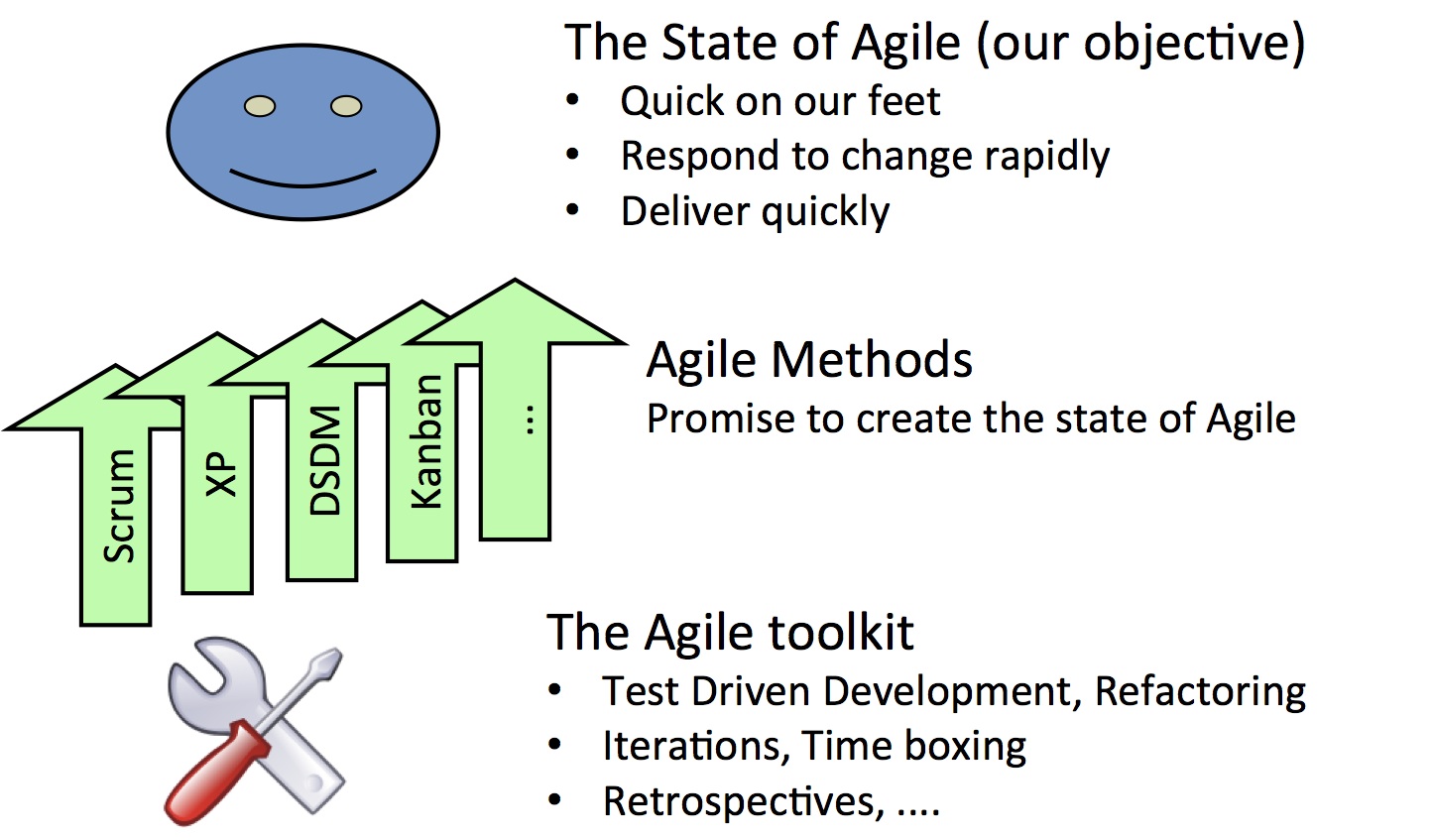
The next three perspectives are best explained together, in this diagram: The State of Agile Perspective, The Methods Perspective and The Toolkit Perspective

I often find that when I talk to developers and testers in an company they implicitly view Agile as a toolkit of techniques which might be applied – The Toolkit Perspective. Ask them “Are you Agile?” and they will answer by referencing the practices which they use or don’t use.

Conversely, talk to managers – especially senior managers – and they are concerned with company Agility. Their perspective is the end result, – The State of Agile Perspective – they don’t care whether a team do stand-up meetings, iterations or not, they care about the Agility of the company. Indeed, some Agile practices – e.g. Test Driven Development – may appear downright unAgile to them.

How you define the “state of Agile” depends on what the company is trying to do. In general it is something about being responsive to customers – which implies you actually know what customers want in the first place so that must be included too. It is something about delivering fast and generally being quick on your feet.

Talk to another group of people – middle managers mainly – and The Method Perspective appears. Those who take the Methods view are concerned with which Agile Method (Scrum, XP, DSDM, etc.) the company is following. These methods are largely composition from the toolkit, ready made combinations of tools. According to this view following one of the methods will deliver the state of Agile.

(I touched on the these three themes in my Objective Agility presentation (PDF) (Objective Agility on SlideShare) a few years ago and a piece of the same name in Modern Analyst – Objective Agility: What does it take to be an Agile company?)

Almost last but definitely not least there is The Learning Perspective of Agile: I continue to believe that Agile is fundamentally an implementation of Organizational Learning concepts. The idea that all teams, departments, companies learn and those who are able to harness positive learning and change in technology/solution, problem/business and process domains will succeed. He who learns fastest wins.

Organizational Learning is present in one form or another in all Agile and Lean approaches but it is seldom front of stage. Indeed to bring it too far forward would be self-defeating. In working with clients I find that taking the learning perspective of Agile allows me understand and approach the most difficult issues.

For me organisational learning provides the theory and underpinnings of Agile. I should stop there, I could carry on but I’d need a book to do this perspective justice – fortunately I wrote just such a book a few years ago: Changing Software Development: Learning to be Agile.

Given these different perspectives the question we need to ask is: “what is not Agile?”

In many ways this is a more difficult question to answer because while any self-appointed authority can define what is Agile nobody has the authority to declare things unAgile, there is no Supreme Court of Agile. Personally I find it hard to see how business process re-engineering, CRM and ERP systems, virtualisation technology and domain specific languages can be regard as Agile but I have seen all of these cited as Agile tools or enablers.

Which perhaps leads us to the final and most cynical perspective on Agile: The Marketing Perspective.

Agile has grown and changed since it first appeared nearly 12 years ago. It has grown and changed in that time, and with no-one to police the brand it has become all encompassing. Come up with a good idea now and marketing demands you brand it Agile and put it under the umbrella.

There is no one right answer to the question “What is Agile?”. Each of these seven perspectives are good answers and they are not, on the whole, incompatible.

My advice is: when someone says they want to “be Agile” or “adopt Agile” or anything else “Agile” it pays to look beyond the label and ask: “what is Agile to you?” and “what are you looking to achieve?” Unless you know the context “Agile” is meaningless.

What is Agile? Read More »

What is the right size for a User Story?

A question that comes up again and again from teams is “What is the right size for a User Story?” – a day? a week? three weeks? – 1 point? 5 points? 10 points? 37? 100? 5 words? 20 words?

Short answer: there isn’t a universal right size for a User Story, it depends on your team, their skills and their level of domain knowledge.

Long answer: for some teams a User Story is Big, several days or weeks of work. On other teams they are small – maybe a day’s work. Both are possible, both are the right answer. Although, as a general rule smaller is better.

For me there are criteria that a User Story should meet:

  • It should be small enough for the technical team to understand it and create in in a short time period
  • It is small enough to move on the board sometime soon
  • It should be big enough to represent business value in its own right – it might build on something that has been done before (e.g. a lower fidelity version of the same story, the new one increasing fidelity)
  • It is big enough to be deliverable in its own right – you might not want to do so but if you needed to you could
In an ideal environment: the story would be developed in a few days, would be released on its own right and the business value measured directly. (For those who know about Minimally Marketable Features (MMFs), also sometimes called Business Value Increments (BVI) or Quantum of Value (QoV), I casually consider a User Story to be a MMF.)

When a team are dedicated to a particular product, and have worked on it for several years, and have learned about the domain – as I would expect in for in-house development operations – I expect to see larger stories. Conversely, when a team don’t know the domain – as is common with outsourced development – I expect to see small stories, and more knowledge pull from the client.

Taking a step back, a few basics:

  • A User Story is not in and of itself a requirement; I like to call them “Tokens for Work to be Done”, others like to say they are “A placeholder for a conversation” both are true
  • Don’t feel that you must use User Stories: if the format doesn’t fit your need then don’t use it! You can still have a “token for work to be done” and a “placeholder for a conversation” using any words you like, they don’t have to be “As a… I can … So that…”
  • The User Story format does capture three very important elements: Who, What, Why so they make a good starting point and are easy to understand but if they don’t work for a particular need then don’t force it into the format
Small stories are better – they can be developed more quickly, delivered more quickly and return value more quickly. But there comes a point were stories become too small to return any business value at which point they, well, loose value. Plus, when you have a lot of small stories they become a headache to manage.

One common problem I see is teams who create really small stories in order to get them to fit within one sprint. These means large stories don’t get scheduled or teams split large stories into many small ones which have no business value themselves.

People say this is a Scrum thing, I’m not sure. Scrum doesn’t mandate User Stories, the story format came along after Scrum. True the format is widely used they has become part of Common Scrum.

What Hard Core Scrum does say is that all the work the team commit to should be done by the end of the Sprint. Which would imply a story has to be small enough to fit I the Sprint. The problem then comes: what else do you put in the Sprint? If one story is going to take more than half the Sprint you need one or more stories to use the rest of it up. Plus you hit the commitment problem – developers have an incentive to under commit and the business/custom has an incentive to over demand.

My solution – one which I’m baking into my description of Xanpan – is:

  • Stories are split into Tasks during the planning meeting
  • Tasks do not follow any particular format, nor do tasks have any business value
  • Tasks are for the team – the developers, testers, analysts and anyone else
  • Tasks should be small, a day or two at most.
  • A story is not done until all the tasks are done. Stories can therefore flow across iterations, the chances of tasks flowing across iterations is low (because they are small) but they can and do.
However – and this is the key point – in counting the points (velocity) of a team only the completed Tasks are counted. Partially done tasks are not. The only states that matter are Done and Not Done.

As I’ve written before, the breakdown of stories to tasks fills (at least) three purposes:

  • It is superficially an estimation exercise
  • It is also a requirements elicitation process (I like the Requirements Engineer, BA, Product Owner/Manager to be present)
  • It is a design activity.
You know a task is too big because it is difficult to finish. If it is difficult to finish it needed more thought up front, to define and understand it, to bound it, to understand it. (See the mini-series on Story Points earlier this year, and specifically the Story Breakdown entry.)

So there you have it: there is no right size of a User Story.

That said, they may still be “too big” or “too small”. But what constitutes right it dependent on you, your team and how you play the game.

What is the right size for a User Story? Read More »

Downside of Dialogue Sheets

Something I’m very conscious of is that I don’t hear much about the downside of Dialogue Sheet Retrospectives. As much as I’d like to believe that this is because there is no downside I can’t honestly say I think that is the case.

There must be downsides.

I have had several suggestions for improvement and some of these have been incorporated into some sheets. There are also a couple of pending improvements which I’ve yet to action. Because there are several sheets and because not all of them are for retrospectives some improvements get incorporated into some sheets but not others. In part I’m happy with this because it increases the differences between sheets.

At XP Day this week I had several conversations about the sheets and I now think its worth listing some reasons people choose not to use the sheets or negatives that emerge. Some of these I’ve known about for a while and may have mentioned before, some are new.

In no particular order, and in my words summarise what I’ve heard….

“The team looked at the sheet and don’t see how they would be an improvement on the current retrospective format”

This reason has been given by several people/teams and while I respect it as a team’s decision to make I can’t help feeling that it pre-judges the sheets. Surely the “Agile” way of doing it would be to try a sheet and see what happens. After all, what have you got to loose? One or two hours, one retrospective.

“We need a facilitator”

Almost a continuation of the previous one another reoccurring comment is from people who can’t imagine not having a facilitator. Again I would suggest try it and see.

I have observed many retrospective dialogue sheet sessions and I find them very interesting. If a facilitator wants a role I have several suggestions:

  • Take off the facilitator hat and join the retrospective, you will get insights for the next time you facilitator
  • Observe silently from the sidelines: you will learn things just from observing
  • Use the sheets from one retrospective as input to the next, go back and pick up items, delve deeper into issues
  • Use the sheets as first exercise in a longer retrospective; do a sheet then go back over issues that arise
You might not need a facilitator but that does not mean you must not have one.

“Facilitator would go deeper”

I am convinced there are issues and times where having a facilitator will produce a better outcome. For example, some issues benefit from talking about in depth. That is why I always thing the sheets are one tool amount many. However I don’t think you always need to go deep. As with the first two items in this list i encourage you to try it and see.

Cross training retrospective facilitators

This might be a rare reason for not using the sheets but is quite valid. One company wanted to train a number of people to under take retrospectives so each retrospective was used as a training exercise for a facilitator.

“We have a company mandated retrospective format and we cannot change it”

This has to be the worst reason for not trying any new technique in a retrospective. If a team cannot change the retrospective format what chance have they got of acting on any findings from the retrospective? Actually I think this suggests a bigger problem.

Mechanical sheet filling

I only have a second hand account of this and I’d like to know more. It appears a team at a large media company in Salford do not engage in conversation in doing the sheet. It appears filling in the sheet has become something of a chore and they simply “do it”.

With out knowing more about this team (anyone know them?) it is hard to say what is going on. It sound like the sheet has been imposed on the team and they are completing it like another piece of administrative paperwork.

Fear of team dynamics

Some people are worried that personality issues on a team will disrupt the dialogue sheet process – conflicts, arguments, etc. I think this is a valid concern. Although I then immediately think of two things.

First: this is an example of a bigger issue – if these people can’t spend an hour together on a collaborative exercise then working together must be very difficult.

Second could this type of exercise actually help with those dynamics? I would guess the answer is sometimes Yes and sometimes No.

Bored by repetition

There are a few teams that have tried the sheets used the them regularly and then they have fallen into disuse. I suspect this is true of any retrospective format that is used too much. The trick is to find whats to keep the retrospectives fresh and keep them generating new insights.

If you know of any downsides or problems with dialogue sheet retrospective then please let me know. I might be able to correct it in a sheet, if I can’t then we can at least understand their use better.

Downside of Dialogue Sheets Read More »