
The Product Manager’s great feedback loop in the sky
Reading a product management blog recently I came across this: “Corporate Product Manager have it easy because they don’t need to achieve Product Market fit.”
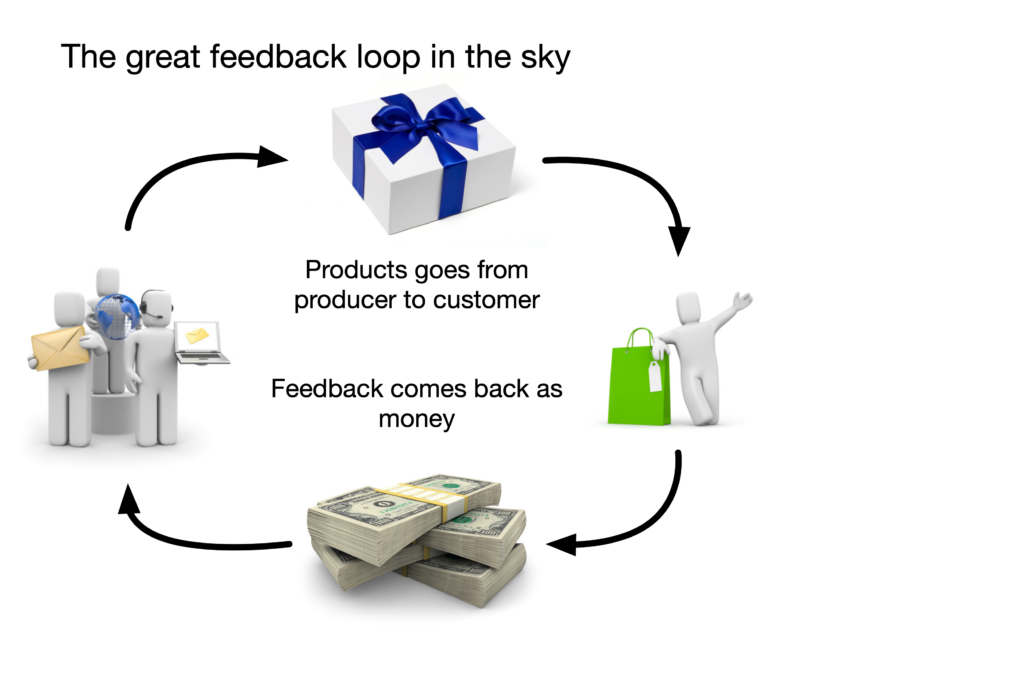
I interpret what the author was trying to say was: “corporate product managers don’t have to sell their products so they don’t have to work at making their product meet market needs and produce something customers to pay.” While there is a point there I think the author vastly under appreciates the difficulties faced by corporate product managers specifically because they don’t have the giant feedback loop in the sky provided by sales.
Other way round
The logic is the other way around: “corporate product managers have to work harder because they can’t judge success by market fit.”
When your goal is to create a product that earns revenue you have a massive advantage: you know what success looks likes, people buy. There is an default answer to the question “What is this product for?” – “To make money.” That might not always be the true but it is a good starting point.
As a Silicon Valley Product Manager you have one overriding goal loop: to make customer give you their money.
Money is the best form of feedback
When someone pays they giving you feedback. They are saying “The most valuable use of this money for is your product.”
They are choosing not to spend money on something else – perhaps a competitor or maybe something you don’t see as a competitor. They are giving up the interest benefits of money in the bank. Rather than buy your software a customer might decide to go to the cinema and see a film with the same money. Money is meaningful feedback, money costs.
Silicon Valley Product Manager can test almost any product hypothesis with the question: does it generate more revenue? Money is the great feedback loop in the sky.
Vanity products
In the corporate environment things are a lot harder. Unfortunately, corporates have a habit of starting vanity products, or continuing endeavours past the point where they should be killed.
I once managed a corporate extranet. The company had persuaded itself that customers really wanted to self-serve in all sorts of ways and had build a website to do just that. Umm.
When I took over the product I started meeting customers – actual customers who paid for the firms telecoms products. They were being given the extranet free to make the products more sticky.
It only took a few interviews to discover that customers did not want the knowledge sharing platform the website was intended to be. Quite the opposite. The last thing customers wanted was their engineers sharing information with engineers from competitors.
Bang went the big motivator for the website.
The remaining capabilities could be provided by the SalesForce system the company was in the process adopting. And it would be a lot cheaper to just give customers a styled SalesForce portal.
Kill your darlings
Inside the company the extranet was always fighting for resources because it didn’t deliver revenue. It repeatedly lost out to other projects that could claim increased product sales.
As Product Manager the way to deliver the most value was to kill the product. I did.
Corporations have a habit of treating every ideas a potential feature, without the discipline of market feedback choosing decisions come down to opinions.
Recently I inherited a backlog along with the product. It contained a multitude of stories that some stakeholder or other thought the system should do. Many more stories originated with team members who thought “It would be good if they system does this.”
If this were commercial product I could reason, and even test, whether those stories held value: would anyone be willing to buy them? What new market could they open up? Can they give us an advantage over a competitor?
But no. There is no feedback loop. No market discipline. Everyone of those stories is there because some stakeholder thought it was a good idea. Stakeholders don’t agree – one say it is pointless, another that it is essential. Some stakeholder have command more authority than others – little Hippos.
Data over opinions
As Jim Barksdale at Netscape said: “Data beats opinions – If you don’t have any facts, we’ll just use my opinion.” Everyone of those stakeholders has an opinion and without the money feedback loop getting data can be impossible.
Part of my role as Product Manager is to determine the value and make judgements on those opinions. As a result I spend a lot of time talking, or rather listening, to stakeholders. I have to be fair (or at least seen to be.)
I work hard at trying to determine the value of my product and understand how enhancements can add value. But that also means I need to decide what constitutes value because it is not money. No wonder many product people get exhausted and give up trying.
Less is more but doing less means saying no. That can be career threatening. It also means deciding what to do soon and what to delay, again without the giant feedback loop in the sky that can be hard.
Corporate life isn’t easy
So when I read a comment like “Corporate Product Manager have it easy because they don’t need to achieve Product Market fit” I get annoyed. This is another example of the Silicon Valley view of Product Management dominating the discussion.
Corporate product management might look easy from the outside but from the inside I long for a giant feedback loop in the sky to give me the data.
The Product Manager’s great feedback loop in the sky Read More »
